NC Early Voting Push. Cancer Alley Win. NFL Shuts Out Black Coaches.Trump Nominee’s “White Identity”
YouTube · g36nd9ScjVI
Quick Read
Summary
Takeaways
- ❖North Carolina Democrats aim to regain state Supreme Court control by 2028 to reverse partisan and racial gerrymandering.
- ❖Micro-targeting registered Black voters in rural 'black belt' areas is key to increasing Democratic turnout in North Carolina.
- ❖Louisiana's Cancer Alley residents secured a landmark legal victory, allowing their lawsuit against toxic industrial plants to proceed.
- ❖A Trump nominee, Jeremy Carl, struggled to define 'white identity' during his confirmation hearing, revealing underlying white nationalist sentiments.
- ❖The NFL's hiring practices for head coaches are characterized by nepotism and a lack of fair hiring enforcement, as evidenced by zero Black head coaches hired in 10 openings.
- ❖Black-owned media is essential for covering critical community events and providing unique perspectives often overlooked by mainstream outlets.
- ❖The 'do for self' philosophy is incomplete without acknowledging and strategically engaging with government resources and political processes.
Insights
1North Carolina Democrats' Strategy to Combat Gerrymandering
The North Carolina Democratic Party is focused on regaining control of the State Supreme Court by 2028 to reverse partisan and racial gerrymandering. This strategy involves re-electing Justice Anita Earles in 2026 and targeting three Republican seats in 2028. The goal is to restore fair legislative and congressional maps, which previously allowed for a more balanced representation.
In 2022, Democrats sent seven members to Congress after a Democratic state supreme court forced map redraws. Losing the court in November 2022 led to new gerrymandered maps. Re-electing Justice Allison Riggs by 734 votes in 2024 was step one.
2Importance of Micro-Targeting Rural Black Voters in North Carolina
The host and guest emphasize that increasing Black voter turnout in rural, majority-minority 'black belt' counties of Eastern North Carolina is critical for Democrats to win statewide. This requires direct, localized engagement, connecting national and state politics to daily community concerns, rather than focusing solely on large urban centers.
Out of 18 majority-minority counties in NC, all are rural and located in the northeastern corridor. The state party has invested in regional organizing directors for these areas because voters feel disaffected due to gerrymandering and policies that neglect their economic future.
3Louisiana's Cancer Alley Residents Secure Landmark Legal Victory
Residents of Louisiana's Cancer Alley, predominantly Black communities, achieved a significant legal win, allowing their lawsuit to proceed against toxic industrial plants. This case seeks a pause on new petrochemical facilities in St. James Parish, highlighting community-led resistance against environmental racism despite political opposition.
A judge ruled that groups representing residents can move forward with their lawsuit to impose a pause on toxic industrial plants in two majority-Black districts in St. James Parish. The host notes that the Trump administration had previously pulled federal support from such lawsuits.
4Systemic Nepotism and Lack of Accountability in NFL Coaching Hires
Despite 10 NFL head coach openings, no Black head coaches were hired, exposing a system rife with nepotism and a lack of enforcement for fair hiring laws. The 'Rooney Rule' is described as a 'suggestion' without consequences, perpetuating a 'plantation mentality' where opportunities are passed down through white family lineages.
Demar Smith, former head of the NFL Players Association, states 90% of Black coaches believe the NFL does not adhere to fair hiring statutes. He highlights that coaches like John Harbaugh (special teams) and Dan Campbell (tight end) became head coaches, while successful Black coordinators like Byron Leftwich (Super Bowl winner) remain unhired.
5Trump Nominee's 'White Identity' Comments Reveal White Nationalist Ideology
Trump nominee Jeremy Carl's confirmation hearing exposed his struggles to define 'white identity' and his concerns about its 'erasure' through mass immigration. His comments, including references to 'Anglo-derived culture' and 'white churches,' were framed as thinly veiled white nationalist sentiments, despite his attempts to articulate them as cultural differences.
Senator Chris Murphy pressed Jeremy Carl on his definition of 'white identity' and what he believed was being erased. Carl cited 'Anglo derived culture,' 'Scotch-Irish military culture,' and differences in 'white church' tone and 'food ways,' expressing concern about a 'majority common American culture' being 'balkanized' by mass immigration.
Bottom Line
State Attorneys General across the U.S. have failed to enforce existing state fair hiring laws against the NFL, effectively granting the league immunity from accountability despite clear statistical evidence of discrimination.
This inaction by state legal authorities allows the NFL's systemic bias in coaching hires to persist without legal challenge, perpetuating a closed system that disadvantages Black coaches and reinforces racial disparities in leadership positions.
Advocacy groups could pressure state attorneys general to investigate and prosecute NFL teams for violations of state fair hiring laws, leveraging legal mechanisms beyond federal oversight to force systemic change.
The 13th Amendment, which abolished slavery, can be a potent, yet underutilized, legal tool in environmental justice cases, framing disproportionate pollution in Black communities as a 'badge and incidence of slavery.'
This legal argument connects contemporary environmental injustices to historical systems of oppression, potentially strengthening cases by appealing to fundamental constitutional protections against involuntary servitude and its lingering effects.
Environmental justice lawyers should explore and strategically employ 13th Amendment arguments in lawsuits, particularly in cases where industrial pollution mirrors historical plantation footprints, to broaden legal precedent and achieve more impactful victories.
The 'do for self' rhetoric within the Black community often overlooks the necessity of engaging with and leveraging government resources, leading to a missed opportunity for wealth creation and community development.
This perspective suggests that solely relying on internal efforts without understanding how other groups utilize government subsidies, tax breaks, and policy influence leaves Black communities at a disadvantage in a system where politics dictates resource distribution.
Black organizations and leaders should actively educate communities on how to navigate and demand resources from local, state, and federal governments, shifting from a purely self-reliant mindset to one of strategic political and economic engagement.
Opportunities
Affirmation-Based Apparel and Home Goods
Develop and market apparel, accessories, and home scent products (candles, wax melts, diffusers) featuring positive affirmations. The business model can include a philanthropic component, donating a portion of sales to organizations supporting single mothers and families, leveraging a personal connection to the cause.
Key Concepts
Independent Organizational Infrastructure
The concept that Black communities should build and fund their own political and social organizations, rather than relying solely on established political parties, to drive voter turnout, advocate for specific issues, and collect data for future action. This ensures priorities align with community needs and resources remain within the community.
Micro-Targeted Political Engagement
A strategy emphasizing granular data analysis of voting patterns at the precinct level, focusing on registered voters who did not turn out in previous elections. This approach involves door-to-door, block-by-block outreach by community organizations to connect political issues directly to individual lives, aiming for incremental but significant turnout increases.
Environmental Racism
The disproportionate placement of environmentally hazardous industries and waste facilities in communities of color, leading to adverse health outcomes. This model highlights how historical patterns of segregation and power imbalances perpetuate environmental injustice, often mirroring the footprint of former plantations.
Plantation Mentality (in Sports Management)
A critique of professional sports leagues, particularly the NFL, where owners and management maintain absolute control over players and coaches, often disregarding fair labor practices and diversity. This model suggests a system where Black talent is exploited for profit, while opportunities for leadership and wealth generation are restricted through nepotism and systemic bias.
Lessons
- Engage in local political processes by attending city council, school board, and county commissioner meetings to monitor agendas and advocate for community interests before decisions are finalized.
- Support and build independent Black organizational infrastructure for voter registration, turnout, and advocacy, rather than solely relying on mainstream political parties, to ensure community priorities are addressed.
- Redirect financial contributions from political parties and candidates to Black-led grassroots organizations that are actively engaged in on-the-ground work, data collection, and direct community empowerment.
Building Independent Black Political Power
**Identify & Map Black Organizational Infrastructure:** Catalog churches, Divine Nine chapters, Masonic lodges, community groups, and student organizations within specific precincts and campuses.
**Micro-Target Registered Voters:** Utilize board of elections data to identify registered voters, particularly those who did not vote in previous elections. Focus on door-to-door, block-by-block outreach.
**Assign Organizational Responsibilities:** Task each Black organization with engaging a specific number of voters or covering a defined geographic radius within a precinct, moving beyond comfort zones.
**Collect & Leverage Data:** Implement systematic data collection on voter registration status and engagement. This data can then be used for future advocacy on local issues beyond elections.
**Fund Independent Campaigns:** Mobilize fundraising efforts within the Black community to directly fund Black-led get-out-the-vote (GOTV) efforts, local campaigns, and media, ensuring financial independence and control over messaging.
Notable Moments
Senator Chris Murphy's grilling of Trump nominee Jeremy Carl on 'white identity' during his confirmation hearing.
This exchange exposed the nominee's struggle to articulate his views without revealing underlying white nationalist sentiments, highlighting the presence of such ideologies within potential government appointees.
Sharon Lavine's emotional testimony about the Cancer Alley victory and the ongoing fight against petrochemical plants.
Her account powerfully illustrates the direct human cost of environmental racism and the spiritual conviction driving community-led resistance, demonstrating that ordinary citizens can achieve significant legal wins against powerful industries.
Demar Smith's statistical breakdown of NFL hiring discrimination and the 'Rooney Suggestion'.
His insights, backed by survey data from Black coaches, reveal the systemic nature of nepotism and lack of accountability in the NFL, framing the 'Rooney Rule' as an ineffective gesture rather than a genuine mechanism for diversity.
Quotes
"So many people think when I talk about rural North Carolina, I'm talking about white rural North Carolina. And what they forget about this state is that out of the 18 majority minority counties that we have in North Carolina, 18 of them are rural."
"We cannot wait for the benevolence of the party. We cannot wait for the party to bestow permission or even infrastructure on us. We have to build ourselves."
"Black folk ain't never waited on the Democrats. This is a recent phenomena. Let's return to how we used to do it. That's when we made the most progress."
"Every time one of these silly ass negroes hops they punk ass on YouTube or on radio or on television or anywhere or at the barber shop on the corner saying dumb like, 'Uh, that's right. That's right. You know, we we do for self. Do for self. We don't need no help. We can do it all by ourselves.' Well, guess what? These white folks are lining up at the at at Washington DC in state capitals in county commissioner meeting in city hall meetings and schoolboard meeting realizing that uh we can get resources from government."
"The Rooney rule is literally the only rule in the history of the National Football League that the league doesn't enforce and has never worked. So, it's just a suggestion."
"After 12 years in the major leagues, I do not feel that I am a piece of property to be bought and sold irrespective of my wishes."
Q&A
Recent Questions
Related Episodes
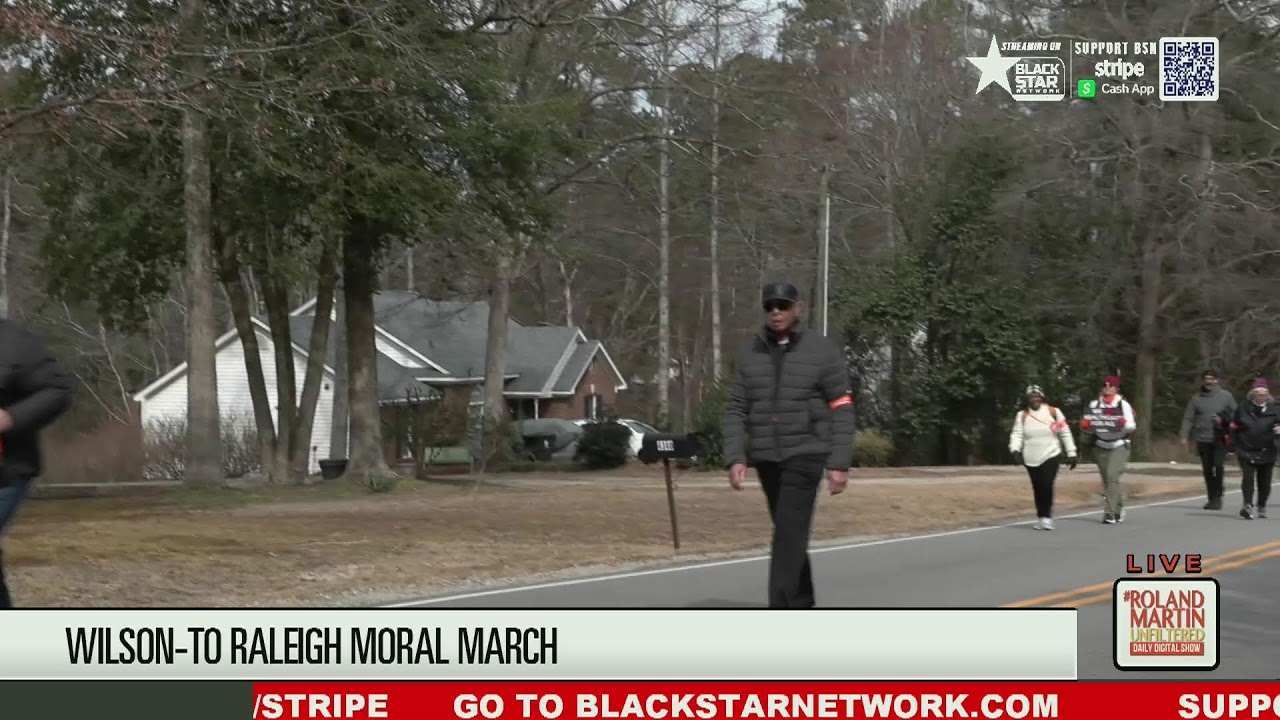
NC Early Voting Push. Cancer Alley Win. NFL Shuts Out Black Coaches.Trump Nominee’s “White Identity”
"Roland Martin Unfiltered dissects systemic racism in politics, sports, and environmental justice, revealing how Black communities are fighting back against gerrymandering, corporate exploitation, and hiring discrimination."

LIVE! Love Forward Together Mass People’s Assembly & Moral March Mobilization In Raleigh, NC
"Thousands marched across North Carolina in the 'This Is Our Selma' movement, led by Reverend William Barber, to combat gerrymandering, voter suppression, and advocate for a proactive, love-driven vision of social and economic justice."
BREAKING: MAGA RIGS VIRGINIA As Trump THREATENS NUCLEAR HOLOCAUST & Kyle EXPLODES!!!
"Host Kyle Kulinski vehemently condemns Republican actions, from alleged gerrymandering and voter suppression to environmental negligence, while sharply criticizing Trump's rhetoric on Iran and other controversial political figures and policies."

“Explosive!” New Republican ballot scandal SURGES INTO NEWS
"A California sheriff and gubernatorial candidate seized over half a million ballots, an act the hosts frame as a dangerous escalation in Republican efforts to undermine election integrity and normalize ballot seizures."