
WORLD WAR 3 HAS JUST BEGUN | Timcast IRL
YouTube · gDkAPwo89fQ
Quick Read
Summary
Takeaways
- ❖The US is actively engaging in economic warfare by blockading the Strait of Hormuz, aiming to force global energy markets to rely on American oil.
- ❖Russia and China are reportedly supplying Iran with dual-use materials and military technology, intensifying geopolitical tensions and suggesting a broader alliance.
- ❖Prominent Democratic strategist James Carville advocates for aggressive political maneuvers like D.C./Puerto Rico statehood and Supreme Court expansion to secure long-term one-party rule.
Insights
1US Naval Blockade and Economic Warfare in the Strait of Hormuz
The US Navy fired on an Iranian-flagged vessel, the 'Tuska,' suspected of carrying dual-use Chinese cargo, after it attempted to run a blockade in the Strait of Hormuz. This action is part of a broader US effort to enforce a naval blockade on Iran, aimed at pressuring Tehran and, according to host interpretation, forcing global energy markets to rely on US oil, positioning the US as a net oil exporter for the first time since WWII.
US fired on engine room of Iranian-flagged vessel (), US believes it was a Chinese-laden vessel with dual-use materials (), US Sentcom statement on refusal to comply (), Shipping data shows Toska stops in China (), US effort to enforce naval blockade on Iran (), Trump's motive framed as shutting down the Strait to force world to buy US oil ().
2Emerging Geopolitical Alliances and 'World War III' Speculation
European intelligence reports suggest Russia is supplying drones to Iran, and Russia is suspected of providing technology to detect US airships after an F-15E was shot down. These actions, coupled with China's alleged supply of dual-use cargo to Iran, are seen as forming a 'three-man coalition' (China, Russia, Iran, plus potentially North Korea), leading to pundit speculation that these interconnected conflicts, involving over 20 nations, already constitute World War III, drawing parallels to how past world wars were recognized retrospectively.
European intelligence reports Russia supplying drones to Iran (), Russia suspected of providing technology to detect US airship after F-15E shooting (), Pundits saying it is World War III with Russia and China supplying Iran (), Historical context of World War II recognition (), Power block of Chinese, Russians, Iranians ().
3Trump's Alleged Nuclear Threat and PR Strategy
A viral story, widely fact-checked as unconfirmed, claimed that former President Trump attempted to activate nuclear codes against Iran but was stopped by General Dan Kaine. The hosts speculate this story, regardless of its veracity, could be an intentional leak or 'Madman theory' tactic by Trump's administration to project an image of unpredictability and extreme resolve, serving as a form of psychological warfare or leverage in negotiations.
Video of guy claiming Trump tried to activate nuclear codes (), Host's skepticism (), Fact check on Kaine incident (), Mirror UK report on Larry Johnson's claim (), Host's theory that Trump wanted story to get out (), Madman theory discussed ().
4Democrats' Strategy for Permanent One-Party Rule
James Carville, a Democratic strategist, publicly advised Democrats to 'don't say it, just do it' regarding expanding the Supreme Court and granting statehood to D.C. and Puerto Rico if they gain power. The hosts interpret this as a clear 'gameplay for a permanent one-party state,' believing Democrats are more likely than Republicans to act decisively on their stated political goals.
James Carville quote on one-party rule (), Carville encouraged Democrats to make Puerto Rico a state, expand Supreme Court (), Host's belief Democrats will pack the court (), Comparison of Republican inaction vs. Democratic intent ().
5Ethical Concerns and Societal Implications of Surrogacy
A viral video of a baby crying 'mama' while being held by gay fathers ignited a debate on the ethics of surrogacy. The hosts argue that surrogacy, particularly when involving egg donors and gestational carriers for gay couples, is akin to human trafficking and intentionally deprives a child of a biological mother, potentially leading to trauma and long-term dysfunction. They express concerns about the future of 'designer babies' and 'womb factories' if no ethical limiting principles are established.
Gay dad backlash over mocking surrogate baby crying for mama (), Video of baby crying 'mama' (), Matt Walsh's response linking to gay marriage (), Host's argument comparing surrogacy to selling a child (), Discussion on biological vs. gestational surrogacy and egg donors (), Concerns about 'womb factories' and 'designer babies' ().
Bottom Line
The US is strategically leveraging global conflicts and blockades to rewire the global energy trade, forcing East Asian and other nations to become dependent on American energy supplies, thereby consolidating US economic power.
This shift could lead to a new era of US energy dominance, but also increases global instability as nations like China face critical energy shortages and seek alternative, sanctioned sources from Russia, further solidifying opposing geopolitical blocs.
Nations aligned with the US could benefit from stable energy supplies, while those in opposing blocs face increased economic pressure and incentives to develop alternative, independent energy solutions.
China's window to assert itself as a global superpower is perceived as closing due to an aging population, diverging GDP from the US, and an untested military, potentially creating a 'now or never' scenario for actions like an invasion of Taiwan.
This assessment suggests a heightened risk of aggressive Chinese military action in the near future, particularly given the current vulnerability of East Asian allies and the US's diverted military resources to the Middle East.
For nations anticipating this, it presents an urgent need to bolster regional defense, diversify supply chains away from China, and strengthen alliances to deter potential aggression or mitigate its impact.
The increasing prevalence of low-skill, unqualified labor in critical sectors like trucking (e.g., through 'donkey routes' and bunk CDLs) is predicted to lead to a rise in accidents, which will then be used to justify and accelerate the automation of these industries.
This creates a self-fulfilling prophecy: poor labor practices lead to safety issues, which then provide the rationale for replacing human workers with autonomous systems, potentially leading to mass job displacement in the long term.
Companies that can develop and deploy highly reliable, cost-effective autonomous solutions will gain a significant competitive advantage, while policymakers face the challenge of managing the social and economic fallout of rapid automation.
Key Concepts
Fog of War
The concept that in wartime, information is intentionally confusing, incomplete, and often propagandistic, making it impossible for the public to know the full truth or strategic intentions of leaders.
Madman Theory
A political strategy where a leader attempts to make their adversaries believe they are irrational and volatile, potentially willing to take extreme actions (like using nuclear weapons), to deter them from challenging the leader's demands.
Deer Population Equilibrium
An analogy used to describe how a population, if left unchecked and subsidized without natural limits, will eventually overconsume resources, leading to widespread suffering and collapse, implying a need for 'culling' or managed limits.
Lessons
- Critically evaluate news and official statements during geopolitical conflicts, recognizing the 'fog of war' and potential for intentional misinformation or strategic leaks.
- Consider diversifying investments beyond traditional financial instruments, as geopolitical instability and economic warfare can rapidly rewire global markets and devalue fiat currencies.
- Engage in local and national political discussions regarding electoral reform and judicial appointments, as strategies for 'permanent one-party rule' could fundamentally alter democratic governance.
Notable Moments
A viral video of a baby crying 'mama' while being held by gay fathers, who then mock the baby's cries, sparks a heated debate on the ethics of surrogacy and child welfare.
This moment highlights the emotional and ethical complexities surrounding modern family structures and reproductive technologies, exposing deep societal divisions and concerns about the psychological impact on children.
A chaotic and passionate debate erupts among the hosts regarding corporate personhood, property rights, and the perceived threat of 'corporatocracy' versus communism.
This segment showcases the ideological fault lines within conservative discourse, revealing fundamental disagreements on economic philosophy, the role of government, and the definition of oppression in a capitalist society.
Quotes
"When the Democrats take power, it is one party rule. DC Puerto Rico statethood pack the Supreme Court. Don't say it, just do it. And there will never be a republican government again if that does happen."
"There has never been a war in which the public has known what was going on. Even in World War II, you might get some reports later on, but a lot of it's propaganda."
"The chaos isn't coming, my friends. It is already here."
"The existence of luxury is not oppression of of the impoverished. This is communism."
Q&A
Recent Questions
Related Episodes
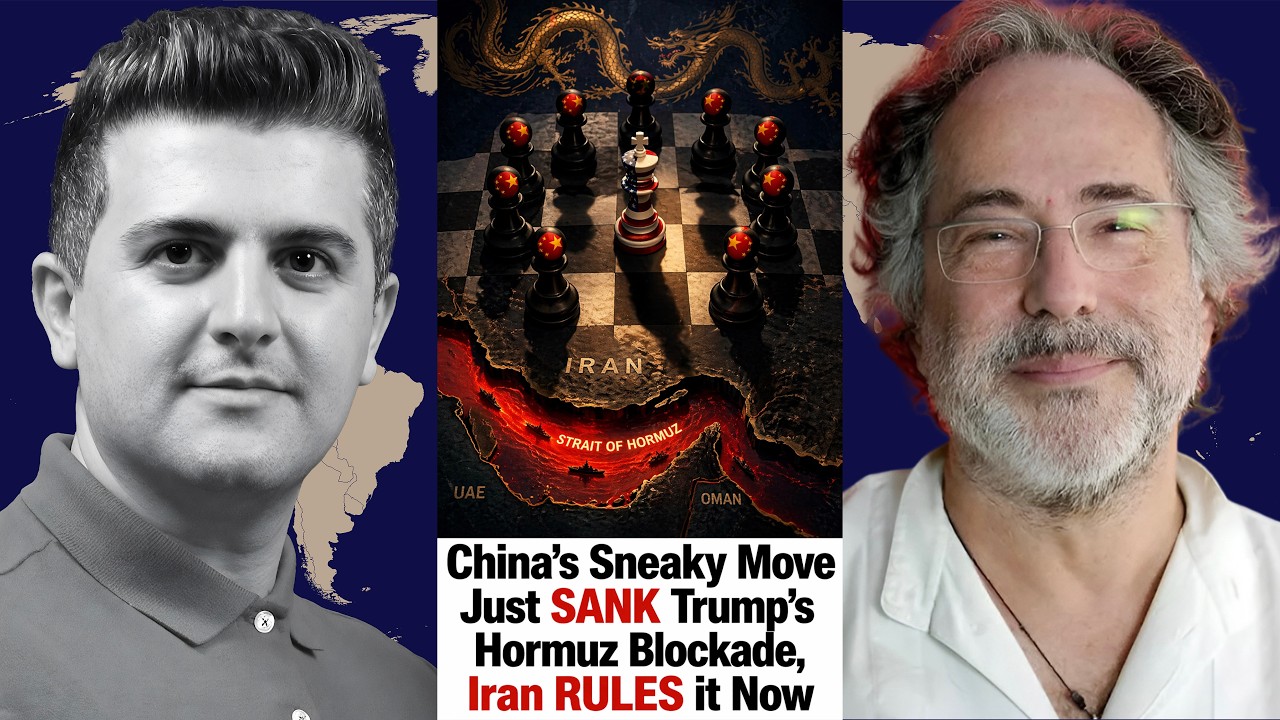
Pepe Escobar: “Total Failure”: Trump’s Blockade Just Backfired Disastrously
"Pepe Escobar argues that the US blockade against Iran, spearheaded by Donald Trump, has utterly failed and backfired, accelerating global economic chaos and challenging US geopolitical dominance."

🚨 TOTAL F*CKING CHECKMATE 😂😂😂
"The host argues that Trump's 'ceasefire' with Iran was a calculated '5D chess' move to orchestrate a global energy market reshuffle, while simultaneously lambasting 'woke' domestic policies and the 'freefall' of anti-Trump conservative figures."

Patrick Henningsen: Hezbollah JUST Fired Back at Israel - Iran Vows to “Crush” All Attacks
"Patrick Henningsen argues that the US and Israel initiated an illegal war against Iran, driven by Trump's incompetence and Israeli influence, leading to an inevitable escalation with severe global economic repercussions."

Iran Update: Israel’s Newest Bombing Campaign, the Oncoming War With China and How to Avoid It
"Colonel Wilerson reveals how the US and Israel are actively bombing China's strategic infrastructure in Iran, escalating a covert economic war that Beijing intends to win without direct military conflict by dismantling the dollar's global dominance."