
Death Of The Voting Rights Act; The Coming Oil Shock w/ Rory Johnston, Ari Berman | MR Live
YouTube · gSk2sPg2dIc
Quick Read
Summary
Takeaways
- ❖The closure of the Strait of Hormuz has caused the largest oil supply shock in history, leading to a billion-barrel deficit for the year.
- ❖Prior to the war, the world faced an oil supply glut due to OPEC+ unwinding production cuts and rapid growth from non-OPEC+ producers.
- ❖Oil traders are hesitant to bid prices higher due to extreme volatility and the risk of sudden price drops from unpredictable political announcements.
- ❖The current oil crisis is expected to accelerate the energy transition by highlighting issues of affordability and energy security.
- ❖The Supreme Court, led by Chief Justice John Roberts, has systematically dismantled the Voting Rights Act over decades, rendering it a 'name only' law.
- ❖The gutting of VRA Section 5 (pre-clearance) in 2013 and Section 2 (preventing racial discrimination in voting/maps) in 2026 has eliminated key protections.
- ❖Justice Alito's argument that partisan gerrymandering is acceptable even if it disproportionately affects Black voters mirrors Jim Crow-era tactics that masked racial discrimination.
- ❖The Supreme Court's disregard for the 'Purcell principle' (not changing election laws mid-election) by allowing redistricting after votes have been cast is a dangerous precedent.
- ❖The current judicial actions are creating a 'post-Reconstruction era' where multi-racial democracy, particularly in the South, is under severe threat.
Insights
1Historic Oil Supply Shock and Market Paralysis
The closure of the Strait of Hormuz has created the largest oil supply shock in history, leading to an estimated billion-barrel deficit for the year, even if the strait reopens immediately. Despite this severe deficit, oil traders are reluctant to bid prices higher due to extreme volatility caused by unpredictable political announcements. This uncertainty prevents long-term investment in increased production, as companies fear sudden price drops if the crisis resolves quickly, creating a paradox where bullish fundamentals are met with cautious market behavior.
Rory Johnston states, 'this is by far the largest supply shock in history. But at this stage given the market's apprehension... it feels like we're going to need to wait until inventories draw down to truly worrying levels until the market starts flying or responding higher.' He notes that US shale producers, despite increased profitability, are not increasing production due to investment uncertainty. ( - , - )
2Supreme Court Dismantles Voting Rights Act, Ushering in a 'Post-Reconstruction Era'
Chief Justice John Roberts has systematically worked to dismantle the Voting Rights Act (VRA) since the Reagan administration. The 2013 Shelby ruling gutted Section 5 (pre-clearance), and recent decisions have effectively neutered Section 2, which prohibited racial discrimination in voting laws and maps. The Court now demands proof of 'intentional discrimination,' making it nearly impossible to challenge gerrymandering that disproportionately disenfranchises Black voters, even if the outcome is clearly racist. This judicial activism, coupled with the Court's disregard for its own 'Purcell principle' (not changing election rules mid-voting), is creating a situation akin to the post-Reconstruction era, threatening multi-racial democracy, particularly in the South.
Ari Berman details Roberts' 'over 40-year war to kill the Voting Rights Act' (). He explains the gutting of Section 5 in 2013 and Section 2 in 2026, stating the law 'remains a name only.' ( - , - ). Berman notes Justice Alito's decision 'completely rewrite[s] the 15th amendment' by requiring intentional discrimination, mirroring Jim Crow tactics. ( - , - ). The Court's actions are 'rolling back an entire civil rights movement.' ( - )
3Energy Transition Accelerated by Geopolitical Instability
The current oil shock, driven by geopolitical conflict, is inadvertently accelerating the global energy transition. The crisis reframes the argument for renewable energy and reduced fossil fuel dependence from purely altruistic climate concerns to practical issues of affordability and energy security. This shift in narrative is expected to drive policy and investment towards alternatives, reducing reliance on volatile regions like the Middle East over the next decade.
Rory Johnston states, 'this is going to accelerate the energy transition cuz I think at one point... the kind of classic more altruistic climate um climate concern kind of energy transition process and mandate and the argument for it was kind of coming under fire and wasn't quite as effective. I think reframing this as one about this is about affordability, this is about energy security, this is about the future and kind of reducing dependence on the Middle East... is what we're going to see from the kind of energy transition community for the next decade.' ( - )
Bottom Line
The Supreme Court's recent voting rights decisions, particularly its disregard for the Purcell principle, suggest a willingness to intervene in elections in unprecedented ways, potentially enabling future attempts to suspend or alter voting processes.
This creates a dangerous precedent where judicial decisions could directly influence election outcomes, eroding public trust and the integrity of democratic processes. It implies that 'guard rails are off' for protecting elections.
Advocates for democratic reform must prioritize Supreme Court reform and develop robust legal and political strategies to counter judicial overreach, anticipating and preparing for potential challenges to future elections based on these new precedents.
The current oil market volatility, while boosting short-term profits for some producers, disincentivizes long-term investment in increased fossil fuel production due to uncertainty about future prices and demand.
This creates a bottleneck in supply response, exacerbating price shocks and potentially leading to a more rapid decline in fossil fuel investment than previously anticipated. It reinforces the idea that fossil fuels are an unstable long-term investment.
Governments and private investors should capitalize on this disincentive by accelerating investments in renewable energy infrastructure and energy efficiency, leveraging the current crisis to solidify the transition away from fossil fuels as a matter of economic and national security.
Key Concepts
Market Volatility and Trader Behavior
In highly uncertain geopolitical situations, even if fundamental analysis points to higher prices, extreme volatility and the risk of sudden policy reversals (e.g., a Trump tweet) can deter traders from making long-term bullish bets, leading to underpricing of risk in futures markets despite immediate supply deficits.
Intentional vs. De Facto Discrimination
This model distinguishes between explicit, overt discrimination (de jure) and discrimination that occurs in practice or effect (de facto), regardless of stated intent. The Supreme Court's shift towards requiring proof of 'intentional discrimination' in voting rights cases makes it nearly impossible to challenge gerrymandering or voting laws that disproportionately harm minority groups, effectively legalizing outcomes that are racist in their impact if not in their explicit design.
Lessons
- Consider getting a COVID-19 booster and the shingles vaccine, as research suggests boosters reduce the risk of long COVID, and the shingles vaccine may inhibit types of dementia, despite temporary discomfort.
- Contact your state representatives and governor to advocate for raising taxes on the ultra-wealthy to fund essential services, especially in states facing budget deficits, as a counter to national cuts.
- Stay informed about Supreme Court decisions and their implications for voting rights, as these rulings can profoundly impact democratic processes and representation in your community.
Notable Moments
Discussion of the FDA blocking studies on vaccine safety.
This moment highlights concerns about transparency in public health information and provides a segue for the host to deliver a PSA on vaccine benefits and risks, emphasizing the importance of boosters for long COVID prevention and shingles vaccine for dementia inhibition.
Critique of Fox News' Jesse Watters' explanation of 'Project Freedom' pause.
This segment satirizes media narratives that uncritically support political actions, even when contradictory or illogical, illustrating how propaganda frames events to save face for political figures like Trump.
Sam Seder calls Governor Kathy Hochul's office live on air.
This demonstrates a direct, actionable form of political engagement, urging listeners to call their representatives to advocate for taxing the wealthy to fund public services, connecting the abstract issue of wealth inequality to concrete policy action.
Quotes
"The world that was before the Iran war, that world is largely gone. We're never going back to that exact world, but we will have to get back to a world in which the Strait of Hormuz is open."
"OPEC plus had rapidly unwound its production cuts because it had spent the last 3 years artificially restraining supply to keep prices artificially higher. And eventually that proved unsustainable and they needed to walk it back."
"John Roberts has had a four decade over 40-year war to kill the Voting Rights Act and it looks like he's finally succeeded."
"The 15th amendment was explicitly about race. It says that the right to vote shall not be abridged or denied on the basis of race, color, or previous condition of servitude. So, I mean, it explicitly mentions race because it was about getting rid of slavery and giving black men the right to vote. And the Voting Rights Act was the tool to effectuate the 15th Amendment. So, they completely turned it on its head."
"Suspending elections is now the default position of the Republican party under Trump."
Q&A
Recent Questions
Related Episodes

All Roads Lead To the South: Nat’l Day Of Action For Voting Rights | Mass Rally | Montgomery, AL
"A mass rally in Montgomery, Alabama, ignites 'Freedom Summer 2026' to combat the Supreme Court's decimation of Black political power and demand unprecedented voter mobilization across the South."

🚨 LEFTISTS ARE F*CKING SEETHING 😂😂😂
"The host aggressively celebrates perceived 'wins' for the right-wing, from global conflicts and domestic politics to cultural shifts, framing them as a 'humiliation' for the 'leftist world order' and a testament to Donald Trump's influence."
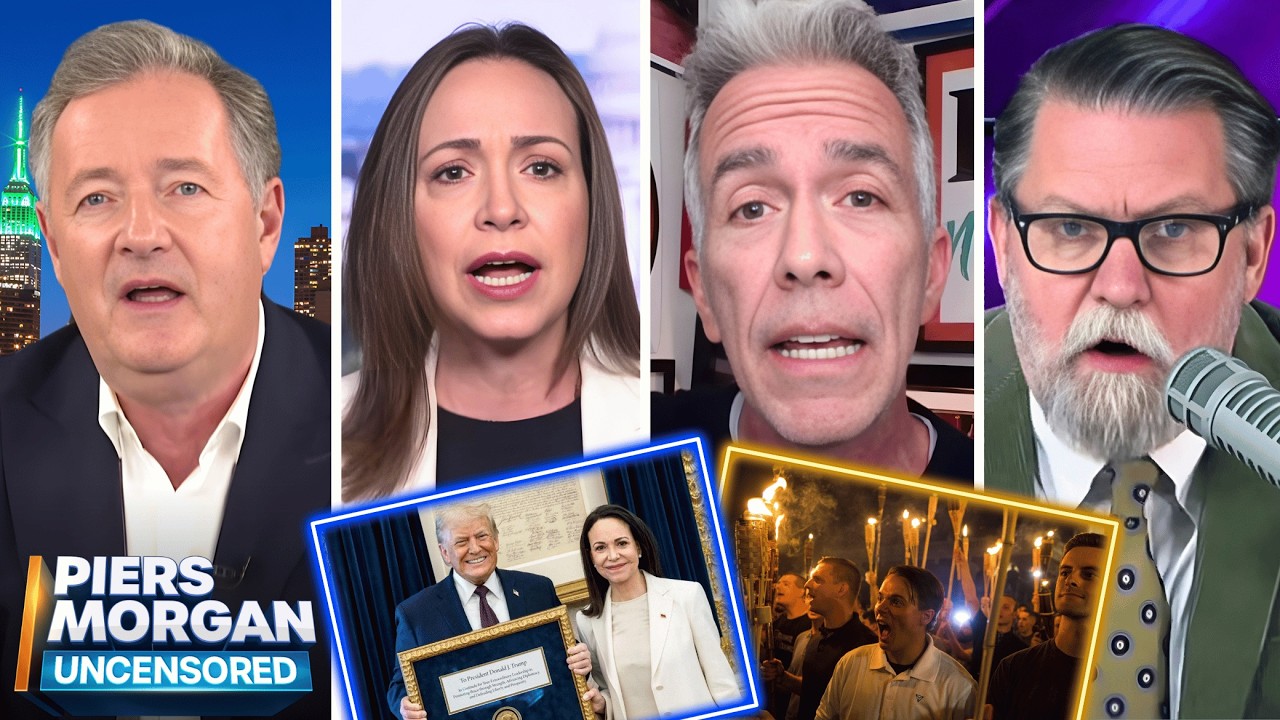
"Fighting Solves EVERYTHING!" Who's To Blame For Political Violence? + Maria Machado On Trump
"This episode dissects the escalating political violence in the US, with panelists fiercely debating the role of partisan rhetoric and media in radicalization, alongside an interview with Venezuelan opposition leader Maria Machado on US intervention and her country's future."

🚨 TOTAL F*CKING CHECKMATE 😂😂😂
"The host argues that Trump's 'ceasefire' with Iran was a calculated '5D chess' move to orchestrate a global energy market reshuffle, while simultaneously lambasting 'woke' domestic policies and the 'freefall' of anti-Trump conservative figures."