Carrie Prejean Boller SLAMS Zionists & Trump
YouTube · i99umx91xnM
Quick Read
Summary
Takeaways
- ❖Carrie Prejean Boller, a Catholic, stated that Catholics do not embrace Zionism and questioned if this makes them antisemitic.
- ❖The hosts argue that anti-Zionism is disagreement with a political ideology, distinct from antisemitism, which is hatred of Jewish people.
- ❖Boller read a quote from an anti-Zionist rabbi who believes Zionist ideology falsely claims Israel as the nation-state of all Jews, leading to accusations of divided loyalties for American Jews.
- ❖Panelists on the Religious Liberty Commission equated anti-Zionism with antisemitism, defining it as delegitimizing, demonizing, or applying a double standard to Israel.
- ❖Boller questioned why the commission, meant for religious liberty, focused heavily on Israel and anti-semitism, while denying Jewish and Palestinian voices critical of Zionism.
- ❖Boller faced pressure from the White House and commission leadership to stop posting about Gaza and Zionism prior to the public hearing.
- ❖Catholic theology, as explained by Boller, rejects the Christian Zionist (dispensationalist) belief that modern Israel fulfills biblical prophecy and is necessary for the Second Coming of Christ.
- ❖The hosts and Boller suggest that the US government and religious leaders are compromised by pro-Israel lobbying, leading to suppression of dissent and an erosion of American religious freedom.
Insights
1Religious Liberty Commission's Alleged 'Zionist Agenda'
Carrie Prejean Boller, a Trump appointee to the Religious Liberty Commission, asserted that the commission's focus on defining anti-Zionism as antisemitism, while suppressing dissenting voices, indicates a 'Zionist agenda' rather than a genuine commitment to broad religious freedom. She noted the commission's refusal to hear from anti-Zionist Jewish or Palestinian Christian speakers.
Boller stated, 'This is so fake. This is so pretend that you care about religious liberty when it comes to Jewish Americans. Why didn't we hear from a child who was told that they can't wear the little, you know, yarmaka or whatever it's called? Why why weren't we told that some student on a college campus, you know, was told that they can't pray or or a Muslim or whatever? Like, why are we hearing about Israel over and over and over again?' () She also mentioned specific denials: 'Who better than Norm Finkelstein? I suggested him. He was denied. Nico Palad, he's a pro Palestinian. He was denied. Rabbi Shapiro, he was denied.' ()
2White House Pressure to Silence Anti-Zionist Views
Boller revealed that White House officials and commission leaders (Dan Patrick, Paula White) attempted to pressure her into silence regarding her posts about Gaza and anti-Zionism, stating she 'needed to stop posting about Zionism and that I'm not allowed to be an anti-Zionist to be on this commission.' This occurred before the public hearing where she made her controversial statements.
Boller recounted, 'I got a call from the White House one day and it was from the designated federal officer who serves at the White House and she told me that um some people in the White House were concerned about my posts about Gaza and Israel and that I needed to stop posting about Zionism and that I'm not allowed to be an anti-Zionist to be on this commission.' () She later added, 'Dan Patrick and Paula White called me shortly thereafter… and they said, 'You know, Carrie, you really got to stop posting on social media. Your job here on this commission is protect the president.'' ()
3Catholic Theology Rejects Modern Zionist Biblical Prophecy
Boller explained that Catholic doctrine fundamentally rejects the Christian Zionist belief that the modern state of Israel (established in 1948) fulfills biblical prophecy. She stated that Catholics believe the Church is the 'new Israel' and the 'new people of God,' fulfilling the old covenant through Christ, thus rendering the political entity of modern Israel devoid of specific biblical prophetic meaning.
Boller clarified, 'We as Catholics, we don't believe that Israel today has anything to do with Israel of the Bible. Okay? Christianity has been hijacked by evangelical Christian Zionists and it's time we take Christianity back.' () She further elaborated, 'We actually believe that we are the new Israel that we are the new people of God. The old covenant is now fulfilled in the new through Christ.' ()
4Conflation of Anti-Zionism and Antisemitism as a Political Weapon
The hosts and Boller argue that equating anti-Zionism with antisemitism is a deliberate tactic to silence criticism of Israel and its policies. They contend that this conflation increases actual antisemitism by implying all Jewish people support Zionism, and that it is used to label critics of Israeli actions as hateful bigots.
The host stated, 'With Zionists essentially conflating Zionism with the whole of the, you know, Jewish people, all they're doing is increasing anti-semitism because there are idiots out there who might be fooled into thinking that's true.' () Boller added, 'They want you to equate Zionism a political ideology, racist political ideology. Okay? I've done a lot of research since then, and I have learned so much about how the the founding of Israel was created, the 700,000 innocent Palestinians that had to be displaced, many of them slaughtered, their houses were overtaken.' ()
Bottom Line
The internal conflict within the Trump administration's Religious Liberty Commission, where a presidential appointee (Boller) is threatened with removal by the commission's chairman (Dan Patrick) for expressing views on Israel, suggests a significant power struggle and ideological litmus test beyond the commission's stated purpose.
This indicates that 'religious liberty' in this context is narrowly defined to protect specific political allegiances (pro-Zionist) rather than diverse religious expressions. It reveals the vulnerability of appointed officials who deviate from an unstated, but enforced, political line.
This situation could be leveraged by political opponents or advocacy groups to expose hypocrisy within the administration's stated commitment to religious freedom, potentially mobilizing a broader coalition of religious and civil liberties advocates against perceived political coercion.
The host's observation that 'regular people' like Boller gain more credibility by speaking out against perceived government corruption regarding Israel, compared to 'well-established guys' (politicians/pastors) who are 'bought by this foreign government,' highlights a growing public distrust in traditional authority figures.
This suggests a shift in public perception where authenticity and independence are valued over institutional credentials, particularly on controversial foreign policy issues. It implies that grassroots voices, even those with past controversies, can gain significant traction if seen as principled.
This creates an opportunity for independent media and non-establishment figures to lead public discourse on foreign policy, bypassing traditional gatekeepers and potentially influencing public opinion more effectively than established political or religious leaders.
Key Concepts
Distinction between Political Ideology and Religion/Ethnicity
The core argument that Zionism is a political ideology, separate from Judaism as a religion or Jewish ethnicity. Criticizing a political ideology (Zionism) is fundamentally different from hating a religious or ethnic group (antisemitism).
Dispensationalism (Christian Zionism)
A theological framework, primarily held by some evangelical Christians, that interprets biblical prophecy to mean the modern state of Israel's existence is a fulfillment of God's plan and a prerequisite for the Second Coming of Christ. This belief often mandates unwavering political support for Israel, contrasting with Catholic views presented.
Government Capture/Foreign Influence
The idea that a government or its agencies (like the Religious Liberty Commission) are unduly influenced or 'captured' by external interests, in this case, pro-Israel lobbying, to the extent that it compromises its stated mission and the rights of its own citizens.
Lessons
- Critically examine definitions of 'antisemitism' to distinguish between hatred of Jewish people and criticism of the political ideology of Zionism or the actions of the Israeli government.
- Be aware of potential political pressure campaigns aimed at silencing dissenting voices, especially when government bodies are involved in defining or regulating speech related to foreign policy.
- Educate yourself on the theological differences between various Christian denominations (e.g., Catholicism vs. certain Evangelical Christian Zionist views) regarding the modern state of Israel and its perceived biblical significance.
- Support or engage with independent media and non-establishment figures who challenge dominant narratives, particularly on sensitive geopolitical issues where mainstream discourse may be influenced by lobbying or political agendas.
Notable Moments
Carrie Prejean Boller questions panelists on the Religious Liberty Commission about whether anti-Zionism makes Catholics antisemitic, and reads a quote from an anti-Zionist rabbi.
This moment directly challenged the commission's perceived agenda and definition of antisemitism, sparking the core controversy of the episode and exposing the ideological divide.
Shabos Kenbomb, a panelist, states that the only genocide was October 7th and refuses to condemn Israel's actions in Gaza, while the chairman attempts to shut down Boller's line of questioning.
This exchange vividly illustrates the panel's bias, the attempt to control the narrative, and the stark difference in how 'genocide' and civilian casualties are framed by different sides.
Boller reveals that the White House and commission leaders tried to pressure her to stop posting about Gaza and Zionism before the hearing, telling her her 'job here on this commission is protect the president.'
This exposes alleged direct political interference and an attempt to suppress religious liberty within a commission supposedly dedicated to protecting it, highlighting a potential conflict of interest and lack of integrity.
Quotes
"Disagreeing with the political ideology of Zionism is something entirely different. Now, with that said, uh that was Catholic conservative activist and former Miss California Carrie Prejan Bowler."
"American Jews are increasingly treated as less fully American. our loyalty question, our belonging made conditional because Zionist ideology falsely claims Israel is the nation state of Jews everywhere and that every Jew is nationally tied to it. He says this framing is anti-semitic at its core."
"Undoubtedly anti-ionism is anti-semitism and undoubtedly... one does not have to support the specific policies of the government of Israel, but to not support the right of Israel to exist, which is what anti-ionists do, while not taking that same stand to the 28 Muslim countries and 13 Christian countries in this world, is a double standard, is hypocrisy, and is absolutely anti-semitism."
"As long as Israel does not believe Palestinians have the right to exist in their own land, their own country, as long as they deny the Palestinian people their own country and their own agency, I don't care about the existence of Israel. I don't believe Israel has the right to exist."
"It's not the Jews, it's not the Muslims who are attacking me. It's Christian Zionists. Those are the ones who are attacking me. They're mad that I converted to Catholicism, and they're mad that I dared to speak out against Israel because that's their religion."
"They don't want you to equate Zionism a political ideology, racist political ideology. Okay? I've done a lot of research since then, and I have learned so much about how the the founding of Israel was created, the 700,000 innocent Palestinians that had to be displaced, many of them slaughtered, their houses were overtaken."
"I would rather die than worship Israel. A a genocidal state that is committing genocide against innocent Palestinians."
Q&A
Recent Questions
Related Episodes

Iran Deal Skepticism. Whoopi Vs Vance. Potomac Park Invasion. Racist Hurls Slurs At Black Boy.
"This episode dissects multiple instances of alleged anti-Black policies and racial injustice, from the Trump administration's legal challenges to reparations and the Iran deal, to police brutality and the erasure of Black history."
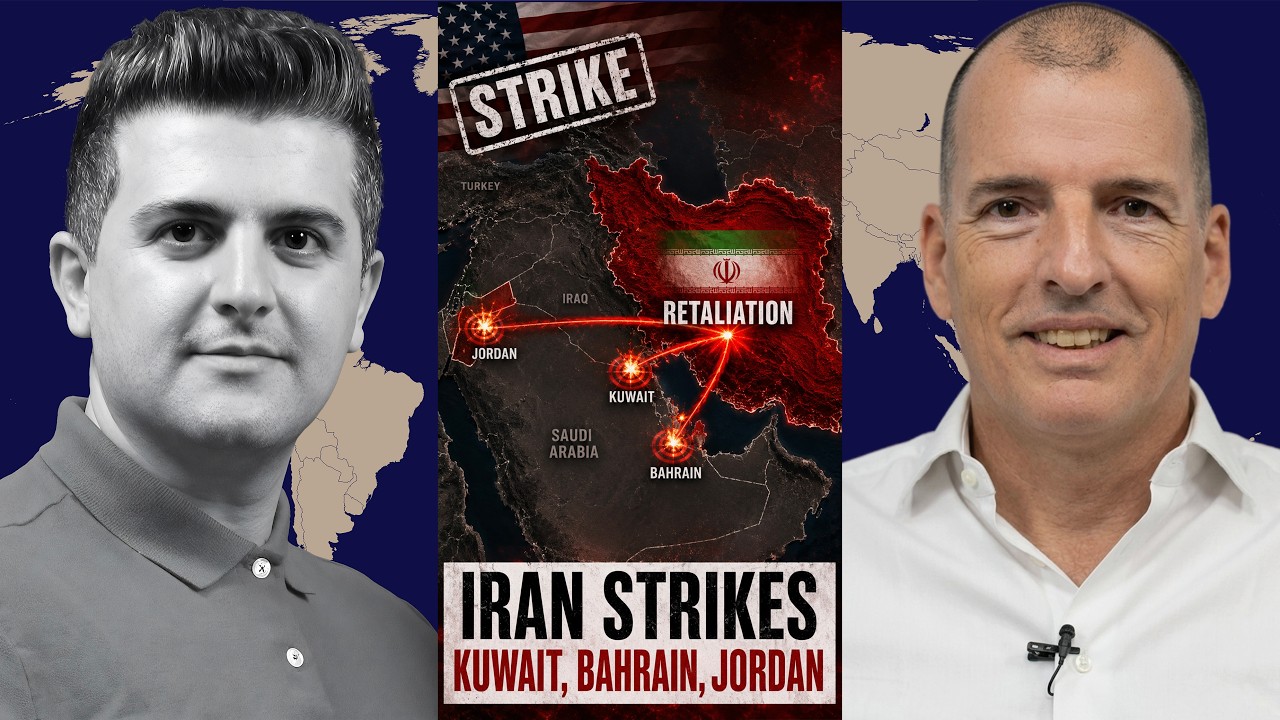
Alex Krainer: US STRIKES Iran – Iran RETALIATES Against Kuwait, Bahrain & Jordan!
"Amidst escalating US-Iran conflict and Iranian retaliation against regional US allies, this episode argues that US foreign policy is deeply controlled by an 'Anglo-Zionist conspiracy' led by the Rothschild banking dynasty, prioritizing Israeli interests over American ones."

LIVE: Trump HIDES FROM PUBLIC as US SOLDIER KILLED!!! 6/2/2026
"The host exposes alleged government cover-ups regarding military casualties, Trump's unexplained public absence, and questionable political appointments, arguing these reflect a 'regime of loser babies' and a failing foreign policy."

Trump Just ENDED JD Vance’s White House Dreams
"A New York Times article and internal White House dynamics reveal Donald Trump's deep dissatisfaction with J.D. Vance, potentially ending Vance's 2028 presidential ambitions and highlighting a broader struggle for control within the Republican Party."