
Rashad COOKS Skip Bayless For DOUBTING Wemby
YouTube · iD7o8WhgrM8
Quick Read
Summary
Takeaways
- ❖Wembanyama's defensive impact, including 12 blocks in a 'bad' Game 1, was overlooked by critics like Skip Bayless.
- ❖His physical response to Naz Reid was a statement of self-protection after uncalled fouls, signaling a new, tougher side.
- ❖Training with Hakeem Olajuwon has significantly enhanced Wembanyama's post-game, making him a more versatile offensive threat.
- ❖The Timberwolves' Rudy Gobert is being 'played off the floor' by Wembanyama, highlighting a generational shift in big-man dominance.
- ❖Minnesota's coach, Chris Finch, needs to implement drastic defensive adjustments, such as varied double-teams and zone defenses, to confuse Wembanyama.
- ❖The lack of complex defensive execution in the modern NBA, due to 'dumbed down' coaching and one-and-done college players, is a critical issue.
Insights
1Wembanyama's Defensive Resilience and Offensive Evolution
Despite a poor shooting night in Game 1, Wembanyama recorded 12 blocks, demonstrating his consistent defensive impact. His subsequent offensive outbursts, including a 39-point, 15-rebound game, showcased his rapid development. His physical response to Naz Reed, resulting in an ejection, was framed as a necessary statement of self-protection due to uncalled fouls, revealing a competitive edge previously unseen.
Wemby had 12 blocks in Game 1 after a 'shitty night' offensively. He then scored 39 points and 15 rebounds in a later game. His elbow to Naz Reed was a 'boiling point' reaction to uncalled fouls.
2Wembanyama Dominates Rudy Gobert with Advanced Post-Moves
Wembanyama is effectively 'playing Rudy Gobert off the floor,' leveraging his training with Hakeem Olajuwon to employ sophisticated post-moves, patience, and off-the-dribble skills. This matchup highlights a generational shift where Wembanyama's versatility and offensive repertoire are overwhelming a four-time Defensive Player of the Year.
Wemby, the unanimous Defensive Player of the Year, dominated Gobert, a four-time DPOY. His training with Hakeem Olajuwon is evident in his tactics, positional setups, spacing, spin-backs, and ability to finish through contact.
3Timberwolves' Coaching and Player Underperformance
The Minnesota Timberwolves are criticized for their lack of defensive adjustments against Wembanyama and the underperformance of key players like Julius Randle and Rudy Gobert. Randle's low shooting percentages and high turnovers are particularly problematic, while Gobert's defensive struggles against Wembanyama are leading to calls for lineup changes.
Julius Randle is averaging 36% from the field, 21% from three, and 14 points, with four turnovers. Coach Chris Finch stated, 'We got punked' after a 38-point loss, despite Gobert being on the floor. Suggestions include starting Naz Reed over Gobert or Randle to shake up the lineup.
4Need for Complex Defensive Schemes in the Modern NBA
The discussion highlights a perceived 'dumbing down' of defensive strategies in the NBA, with teams relying too heavily on simple switching. To counter a player like Wembanyama, coaches need to implement more complex, varied defensive schemes, such as mixed double-teams (on the catch, on the first dribble) and zone defenses, which require higher player discipline and basketball IQ.
Hosts suggest mixing up double-teams on Wembanyama (on the catch, on the first dribble) to confuse him and force turnovers. They advocate for starting games with zone defense and playing big to control the paint and rebounding. The 'dumbed down' NBA defense is contrasted with college-level defensive teaching.
Lessons
- For coaches facing dominant offensive players like Wembanyama, implement varied defensive schemes (e.g., alternating double-teams on the catch vs. first dribble, zone defense) to keep the player guessing and disrupt their rhythm.
- Teams struggling with a key player's underperformance (e.g., Julius Randle's offensive slump) should consider strategic lineup changes or benching them to spark a different dynamic, even if it risks alienating the player.
- Prioritize player development in complex defensive rotations and communication from an early stage, as modern NBA players often lack the discipline for sophisticated schemes due to simplified coaching at lower levels.
Countering a Dominant Big Man (Wembanyama) in the Playoffs
Start big: Deploy a lineup with multiple strong rebounders and interior defenders to control the paint and defensive glass.
Implement varied defensive pressure: Mix full-court pressure, zone defense, and alternating double-teams (on the catch, on the first dribble) to confuse the opponent's primary scorer.
Force turnovers: Target players with high turnover rates by creating indecision through unpredictable defensive schemes, especially when they are forced to pass out of double-teams.
Exploit transition opportunities: If the opponent takes contested shots or turns the ball over, immediately push the pace for fast break points, leveraging players who thrive in full-court scenarios.
Demand offensive production from all starters: Ensure that physical defenders are also contributing offensively to prevent them from becoming liabilities and allowing the opponent to focus solely on their defensive assignment.
Notable Moments
Rashad Cook's passionate defense of Wembanyama against Skip Bayless's criticism, labeling Bayless's comments as 'picking up horseshit'.
This sets the tone for the episode, highlighting the strong belief in Wembanyama's talent and the frustration with perceived unfair criticism, framing the subsequent analysis as a vindication of Wembanyama's potential.
Discussion of Wembanyama's physical altercation with Naz Reid and subsequent ejection, framed as a necessary 'boiling point' reaction to uncalled fouls.
This moment reveals a new, tougher dimension to Wembanyama's persona, suggesting he won't be intimidated by physicality and is willing to protect himself, which is crucial for his long-term success in the NBA.
The comparison of Wembanyama's elbow to Naz Reid with Shai Gilgeous-Alexander's more subtle but potentially more dangerous move on Austin Reaves.
This offers a nuanced perspective on 'dirty' plays, arguing that intent and potential for injury should be considered, and highlights how subtle moves can be more impactful than overt physical altercations.
Quotes
"Everyone said that was a bad game for Wimby. They had 12 blocks. Did what he needed to do on the defensive end after having a really really shitty night."
"Half of a player means he still has half of the game to dominate, right? And um did he break a record that game? I think he broke a record or something."
"If they not going to protect me, I'm going to protect myself. So that's just what it is, man."
"He's like, I want this. I want this challenge. Especially if that's what Rudy lives and dies on is that defensive four uh player of the years that he he can hold over Wimby and say, 'Look, you're not just going to come in here and do this to me.'"
"The NBA would be a lot much a better product with older players in my opinion."
"The lack of adjustments defensively in a lot of these games. Watching the same game plan come out and play it the same way where you just got beat the game before doing it this way is asinine to me."
Q&A
Recent Questions
Related Episodes

The NBA Playoff's WILD Weekend LIGHTS UP Gil's Arena
"NBA analysts debate referee bias, player injuries, and coaching adjustments impacting the Western Conference Finals, while celebrating the Knicks' historic sweep to the Eastern Conference Finals and Jalen Brunson's leadership."

The New York Knicks May NEVER Lose Again!!
"The New York Knicks' dominant sweep of the Cleveland Cavaliers has ignited fervent belief among analysts that their unique team chemistry, star player role acceptance, and strategic coaching adjustments make them an unstoppable force heading into the NBA Finals."
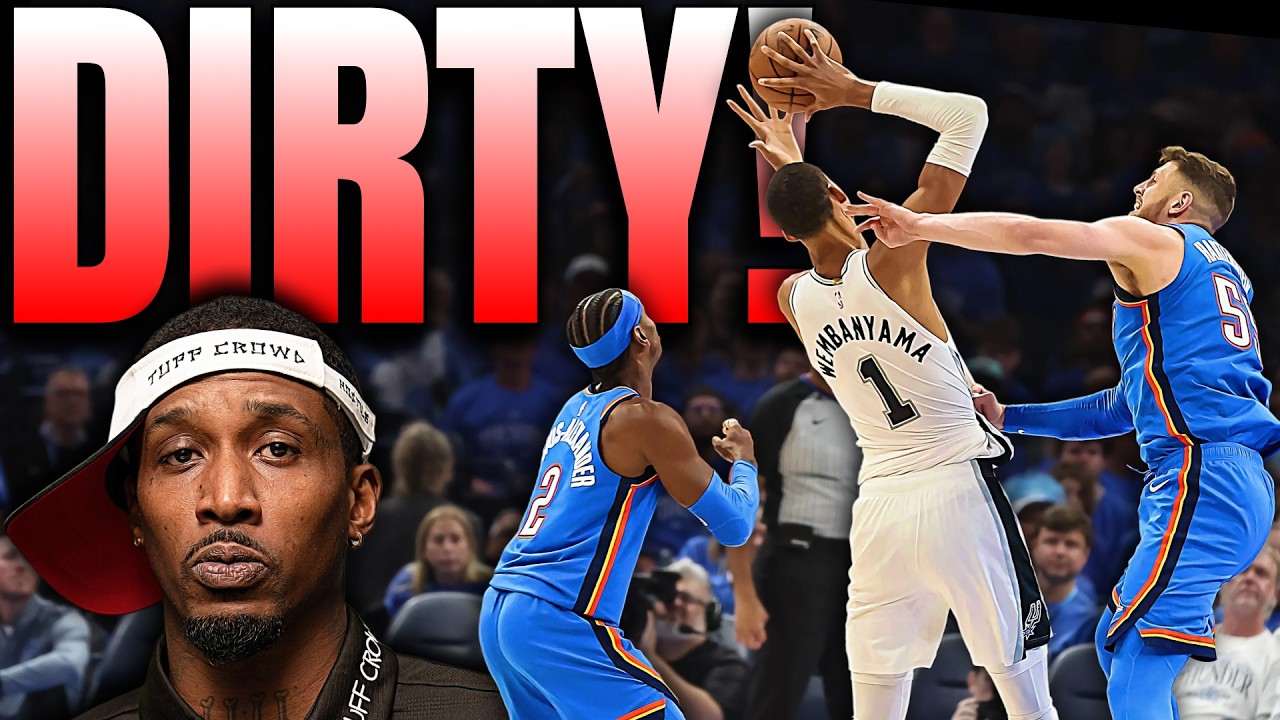
The REAL Reason The OKC Thunder Won Game 2
"OKC's Game 2 victory over the Spurs was driven by Isaiah Hartenstein's aggressive defense on Victor Wembanyama and the Spurs' critical turnover issues, despite controversial officiating and a perceived lack of offensive strategy from San Antonio."
KNICKS BEAT THE BREAKS OFF THE HAWKS, CELTICS IN TROUBLE & FUTURE OF THE NUGGETS? | S8 EP79
"The hosts and guest dissect major NBA playoff upsets, including the Knicks' dominant win, the Celtics' precarious position, and the Nuggets' unexpected elimination, alongside a preview of a high-stakes boxing match."