🚨 Trump HIT with LAWSUIT he FEARED the MOST on ELECTIONS
YouTube · inKR5tdstw8
Quick Read
Summary
Takeaways
- ❖A coalition of 20-24 Democratic Attorneys General, including Virginia AG Jay Jones, filed a lawsuit against Trump's executive order on mail-in ballots.
- ❖The executive order directs the Department of Homeland Security, Social Security Administration, and the Postal Service to create a 'citizen check database' to vet mail-in ballot eligibility.
- ❖Critics argue the order is unconstitutional, violating the 10th Amendment and Article I, which designate states as responsible for running federal elections.
- ❖The lawsuit characterizes the executive order as a broad attempt at voter suppression, designed to sow confusion and deter voters.
- ❖Virginia AG Jay Jones emphasizes that states like Virginia have robust, secure mail-in voting systems with no evidence of widespread voter fraud.
- ❖The legal challenge seeks a temporary restraining order, with expectations for a rapid court decision given the urgent nature of election-related issues.
Insights
1Trump's Executive Order Centralizes Election Verification
Donald Trump issued an executive order mandating the Department of Homeland Security (DHS) to collaborate with the Social Security Administration (SSA) and the Postal Service to verify the citizenship status of individuals applying for mail-in ballots. This process would involve creating a new 'citizen check database' and empowering the Postal Service to withhold ballots from those not on an approved master list.
The host describes the order as setting up an 'Orwellian regime that sits between the voter and the ballot box,' involving DHS, Social Security (private data), and the Postal Service to decide 'who gets a mail-in ballot.' AG Jones confirms the order's existence and the lawsuit against it.
2Lawsuit Alleges Unconstitutional Federal Overreach and Voter Suppression
Democratic Attorneys General contend that Trump's executive order is unlawful and unconstitutional. They argue it violates the 10th Amendment and Article I, which grant states the authority to administer federal elections. The order is seen as a direct federal infringement on states' constitutional duty and a tactic to suppress votes by creating chaos and making voting harder, rather than addressing legitimate issues.
The host questions, 'How is this not a violation of the constitution of the 10th amendment of article one... separation of powers?' AG Jones states, 'anyone who has read the Constitution knows [the executive order] is unlawful.' He adds, 'this is nothing more than an attempt by the president... to sow confusion to stir up nonsense... to make it much harder when really he knows that he's going to lose the ballot box.'
3States Assert Secure Election Management and Lack of Fraud
Virginia Attorney General Jay Jones highlights his state's robust and secure mail-in voting system, including 45 days of early voting and acceptance of ballots up to three days post-election. He asserts that Virginia has no issues of voter fraud, citing a previous 'wild goose chase' by his predecessor that found no evidence. This challenges the premise of Trump's executive order.
AG Jones states, 'in Virginia we have the Virginia Voting Rights Act... which has expanded early voting here in Virginia. We have 45 days. We have mail voting. You can accept a mail ballot up to 3 days after the election day. So, it's taken up until that Friday afterwards. Mail voting is safe and secure. We have safe and secure elections here in Virginia. We have no issues of voter fraud.'
4Legal Challenges Expected to Move Swiftly
The Democratic Attorneys General, in coordination with groups like the ACLU, have filed their lawsuits in the District of Massachusetts, seeking temporary restraining orders. They anticipate a fast resolution from the courts due to the urgent nature of election-related legal challenges.
The host asks, 'When do you think? Is it going to be sometime early next week? We're going to be in court on this and perhaps get the TTRO that you're seeking.' AG Jones responds, 'I certainly hope so... I expect it'll be it'll be fast. I think it's obviously of an emergent nature and so I think courts understand that.'
Lessons
- Understand that claims of 'voter fraud' are often framed by critics as a pretext for 'voter suppression' tactics, aiming to restrict ballot access rather than ensure integrity.
- Familiarize yourself with your state's specific election laws and processes, particularly regarding mail-in voting and early voting, to counter potential confusion from federal directives.
- Support organizations and elected officials who advocate for states' rights in election administration and actively challenge perceived federal overreach in voting processes.
- Engage in civic actions such as rallying, protesting, or signing petitions to voice concerns about election integrity and voter access, as these are highlighted as crucial in broader fights for democracy.
Quotes
"This is nothing more than an attempt by the president and this administration to sow confusion, to stir up nonsense, to make things chaotic for us here in our respective states."
"When you hear voter fraud, that's just a fancy, a fancy fake term, predatory term for voter suppression. That means they, when you hear somebody talking about fraud in a country that has no outcome determinative fraud, they just want to steal your vote."
"The biggest responsibility of anybody in public office is to keep people safe. This is a measure of keeping a matter keeping people safe and a measure that will make us less safe and less secure."
Q&A
Recent Questions
Related Episodes
Major SCOTUS "Birthright Citizenship" Case, and Charlie Kirk Murder Trial Bullet Questions
"Megyn Kelly and legal experts dissect the Supreme Court's oral arguments on birthright citizenship and break down new, potentially exculpatory evidence in the Charlie Kirk murder trial, including an 'inconclusive' bullet match and complex DNA findings."

PBS News Hour full episode, March 23, 2026
"President Trump's surprise diplomatic signals on the Iran war, a fatal plane collision at LaGuardia amidst a federal shutdown, and a Supreme Court case on mail-in ballots dominate a day of complex national and international developments."

SHOCK Ruling on Trump Deportation PLOT + DEBUNKED Election WARRANT?!? | It's Complicated
"The Fifth Circuit Court's controversial ruling redefines 'seeking admission' for non-citizens, potentially allowing indefinite detention for millions, while a federal search warrant for 2020 election ballots is criticized as a 'test run' for future election interference."
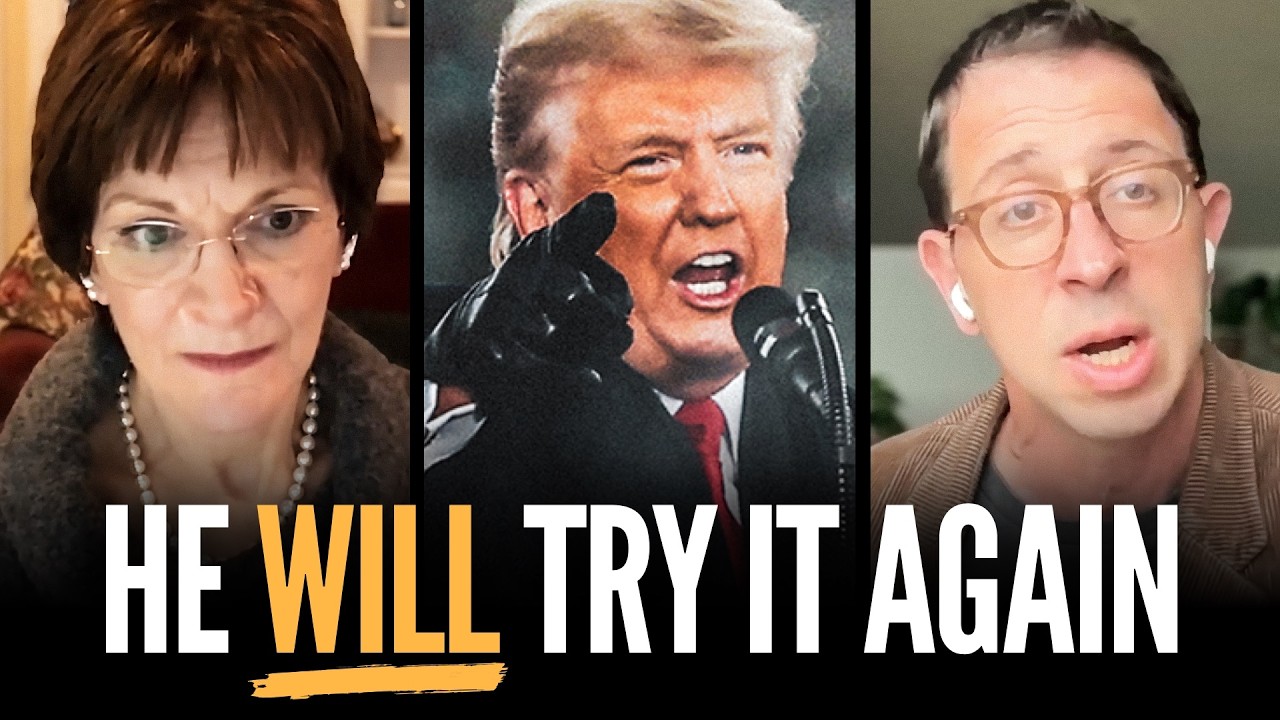
Trump’s Blueprint for Breaking Elections (w/ Ian Bassin) | Mona Charen Show
"Ian Bassin, founder of Protect Democracy, details how Trump's predictable playbook to subvert elections and undermine democratic institutions can be countered through strategic litigation, state-level reforms, and robust citizen engagement."