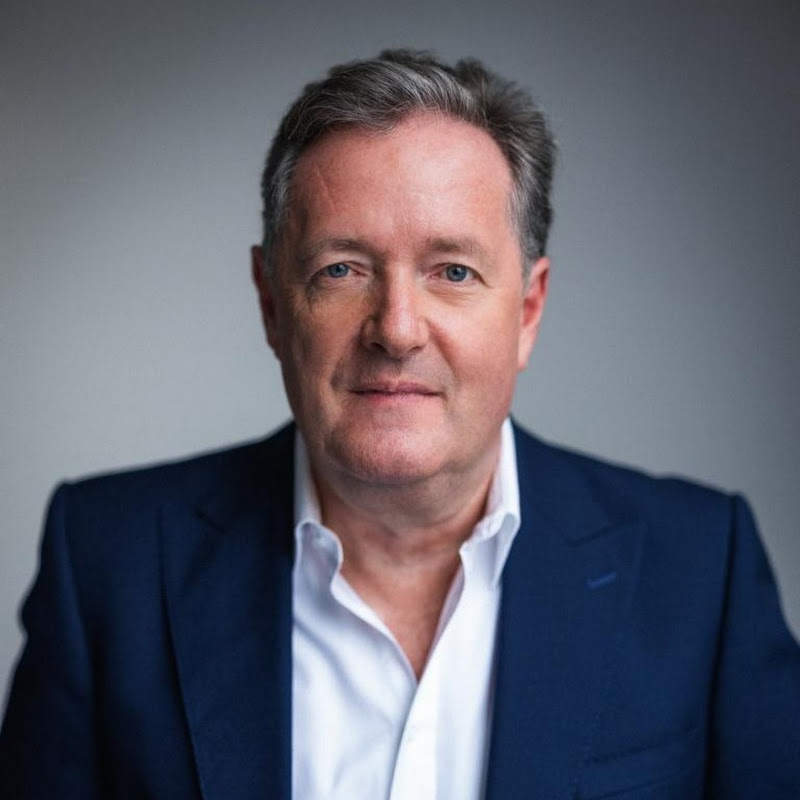
'What They Didn't Want Me To Release' Trump Set To Publish Aliens and UFOs Files
YouTube · k1aUBkSesmY
Quick Read
Summary
Takeaways
- ❖Former President Trump indicated he would declassify government files on UFOs/UAPs, implying former President Obama had previously revealed classified information on the topic.
- ❖UFO researcher Jeremy Corbell asserts that UFOs are real, sometimes occupied, and that governments have had contact, deliberately concealing this for national security and technological exploitation.
- ❖Corbell claims to have released military footage demonstrating 'instantaneous acceleration' by UAPs, a phenomenon beyond known human physics.
- ❖Skeptic Dr. Michael Shermer argues that 95% of UFO sightings have terrestrial explanations, and the belief in alien visitation is a 'religious impulse' given the vast interstellar distances.
- ❖Journalist Jesse Michaels posits that 'non-human intelligence' exists and is observed around sensitive defense sites, suggesting government secrecy stems from an inability to explain or control these incursions.
- ❖Michaels mentions alleged non-Earth materials from a 1957 crash being analyzed by a Stanford professor, showing unique silicon purity and magnesium isotope ratios.
Insights
1Government Secrecy and the Pursuit of 'Derivative Technologies'
Jeremy Corbell and Jesse Michaels argue that governments, particularly the US, have maintained secrecy around UFOs (UAPs) since the atomic era. This compartmentalization, initially for national security to distinguish between adversarial nations and unknown phenomena, evolved into a strategy for strategic advantage and the exploitation of 'derivative technologies' from recovered craft. Michaels adds that the secrecy persists because governments cannot explain or control UAP incursions over sensitive defense sites, implying a lack of aerial dominance.
Corbell states, 'They utilized the atomic programs apparatus for compartmentalization... national security... strategic surprise and national sovereignty and advantage... we're going to look for... derivative technologies from exploitation programs.' (, , ). Michaels notes, 'These crafts seem to fly over our most sensitive defense sites... with impunity. So you are essentially admitting that... aerial dominance exists... on behalf of something that you don't even fully know.' (, )
2The 'Instantaneous Acceleration' Anomaly and Physical Evidence Claims
Corbell highlights 'instantaneous acceleration' as a key observable characteristic of UAPs, which he claims is demonstrated in military footage he released. This phenomenon, if true, defies known human physics and G-force limitations. Jesse Michaels further supports the idea of physical evidence, mentioning a Stanford professor analyzing materials from a 1957 crash with non-Earth elemental compositions.
Corbell states, 'The last one I released... showed one of what we call the five observables of UFOs... instantaneous acceleration... It's not traditional propulsion.' (, , ). He adds, 'You have at your ability now to go online and watch the government's analysis of a UFO, a UAP that they said is UAP that instantaneously accelerates to the right.' (). Michaels details, 'He has... materials in his lab that come from a 1957 crash in Ubatuba, Brazil... contain silicon... with a purity level that he's never seen before... and magnesium with isotope ratios implying some sort of neutron bombardment.' (, , )
3Skepticism as a Demand for Concrete, Verifiable Evidence
Dr. Michael Shermer, a prominent skeptic, challenges the claims of alien visitation by emphasizing the lack of concrete, publicly verifiable evidence. He dismisses most sightings as terrestrial explanations or optical illusions and views the belief in visiting aliens as a 'religious impulse' rather than a scientific conclusion. Shermer argues that extraordinary claims require extraordinary evidence, which he believes is consistently missing.
Shermer states, '95% of supposed UFO sightings can be put down to ordinary terrestrial explanations... or extraordinary terrestrial explanations, Russian or Chinese spy planes or drones.' (). He asserts, 'The fact that I would like it to be true... doesn't make it true.' (). He demands, 'Just show it to us. I mean, if we have the aliens, I'll change my mind tomorrow. Just show it to us.' (, ). He also points out the discredited credentials of a key UFO figure, Bob Lazar ().
Bottom Line
The debate over UFOs is shifting from mere sightings to the potential for 'new physics' and 'space-time metric engineering' as a prerequisite for interstellar travel, challenging conventional scientific understanding.
If UAP phenomena genuinely involve physics beyond current human comprehension (e.g., instantaneous acceleration, time travel), it implies a fundamental gap in our scientific models, potentially leading to a 'quantum revolution' level of discovery.
Investing in research that explores anomalies in physics, particularly those related to propulsion and energy, could unlock breakthroughs if the UAP claims hold any truth.
Government secrecy around UAPs is framed not just as hiding alien presence, but as concealing a lack of aerial dominance and the potential existence of disruptive technologies that could destabilize established institutions.
This suggests that disclosure is not just about revealing 'aliens' but about admitting a significant national security vulnerability and potentially releasing technologies that could upend current energy, transportation, and defense industries.
Entrepreneurs and defense contractors could prepare for a future where existing aerial defense systems are obsolete, and new paradigms for energy and propulsion emerge, potentially from reverse-engineered technologies.
Notable Moments
Jeremy Corbell abruptly leaves the panel discussion, stating he is 'not sticking around for your panel' because 'this is not about debate,' and instead delivers a four-point plan for government disclosure.
This moment underscores the deep ideological divide and frustration among some UFO proponents who view the existence of UAPs as an undeniable fact, beyond the need for debate or skeptical scrutiny. It also highlights the perceived urgency and seriousness of the disclosure movement.
Piers Morgan challenges Dr. Shermer on the 'before nothing' philosophical question, suggesting the human brain's inability to comprehend it implies a 'superior entity,' drawing a parallel to his debate with Richard Dawkins.
This reveals the host's personal philosophical leanings and how fundamental existential questions can intersect with the UFO debate, framing the search for extraterrestrial intelligence as a form of modern spirituality or a quest for ultimate answers.
Quotes
"UFOs are real. Sometimes they are occupied. This is, and this is an informed opinion. Oddly, it's not a political issue. People can handle the truth of that. And this has been a decades-long immaculate deception."
"There was supposed to be a transfer from Lockheed Martin to a program called AATIP... he admitted to one UFO non-human intelligence-built craft that our government has in possession."
"It's really a religious kind of impulse that there's somebody out there vastly superior to us that knows we're here, and that's religion."
"I believe non-human intelligence exists... there's an abundance of evidence that should shift the consensus now in the open source world that there is some intelligence between man and let's say you know some ineffable god."
"You have these hypotheses as to what they are but they have complete you know aerial dominance over you and god forbid you get one of these things wrong and you know one of these incursions are actually China or Russia you know that's even more scary."
Q&A
Recent Questions
Related Episodes

Crooners Welcome | This Past Weekend w/ Theo Von #664
"Theo Von shares raw, unfiltered opinions on life's 'greasy' moments, from his unexpected Stagecoach performance as a 'crooner' to his strong stance against AI data centers and candid advice on relationships and fatherhood."

OCCUPY BAAL STREET: Iran, Albania, And The TPUSA Takeover. | Ep 347
"Candace Owens exposes alleged globalist plots, linking Ivanka Trump's Albanian island 'discovery' to Rothschild family control of strategic waterways and accusing US foreign policy of serving these interests, while also scrutinizing Turning Point USA's handling of Charlie Kirk's succession."
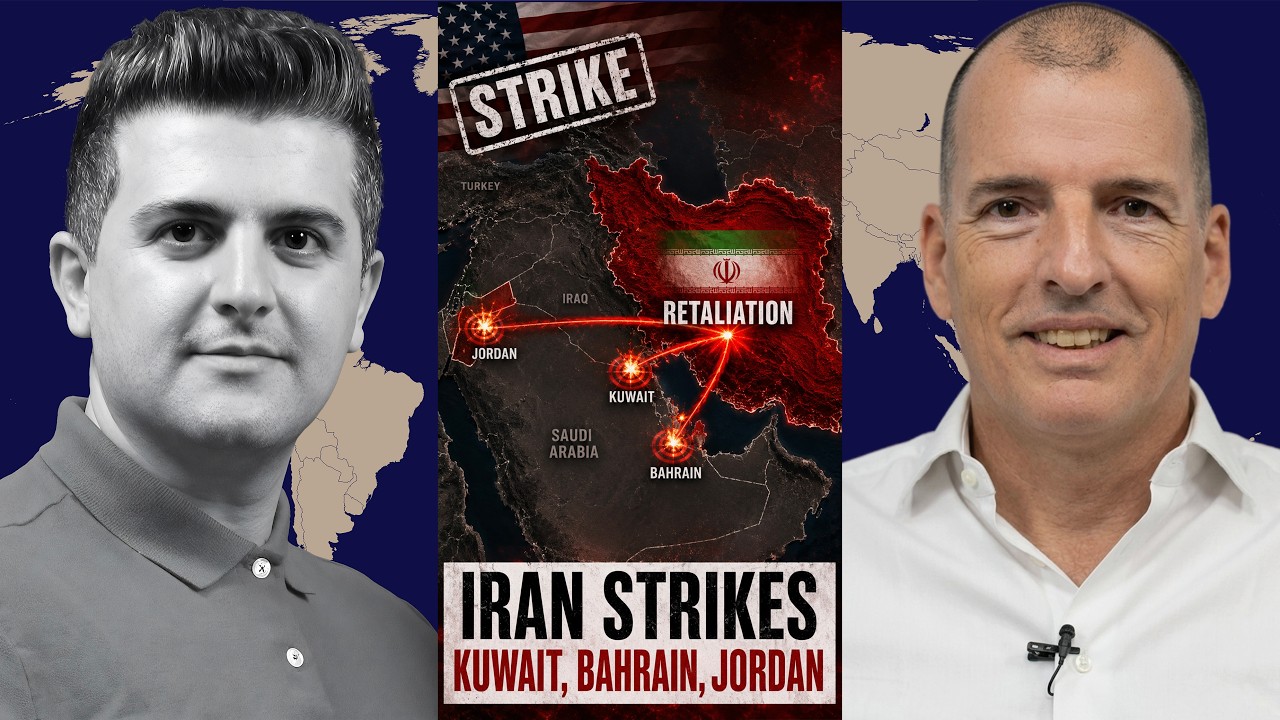
Alex Krainer: US STRIKES Iran – Iran RETALIATES Against Kuwait, Bahrain & Jordan!
"Amidst escalating US-Iran conflict and Iranian retaliation against regional US allies, this episode argues that US foreign policy is deeply controlled by an 'Anglo-Zionist conspiracy' led by the Rothschild banking dynasty, prioritizing Israeli interests over American ones."

Dan Bongino’s EPIC CRASHOUT Over Jimmy Dore!
"Jimmy Dore dissects Dan Bongino's alleged hypocrisy regarding the Epstein files and his public meltdown during a past interview, framing it as a case of psychological projection and political opportunism."