
MUSIC STAR D4VD THROWN IN SEGREGATION, NEW JAIL, AFTER GRISLY MURDER OF CELESTE, 13
YouTube · m1sZL5DJ5fo
Quick Read
Summary
Takeaways
- ❖Music star D4VD (David Anthony Burke) was charged with the murder and dismemberment of 13-year-old Celeste Rivas.
- ❖Prosecutors allege the motive was to prevent Rivas from exposing their sexual relationship, which would jeopardize his lucrative music career and world tour.
- ❖Rivas's body was found in two bags in the 'frunk' (front trunk) of Burke's Tesla, in an advanced state of decomposition.
- ❖Burke was moved to segregation in jail due to his 'noteworthy' status and for his protection.
- ❖Evidence includes digital communications, surveillance footage of his Tesla being moved, and the discovery of a burn cage and chainsaw at his home.
- ❖His defense team is led by celebrity attorney Blair Burke, known for representing high-profile clients.
Insights
1Alleged Motive and Charges
Prosecutors allege D4VD murdered Celeste Rivas with a sharp object because she threatened to expose their sexual relationship, which he feared would destroy his music career. The charges include murder with special circumstances (lying in wait, financial gain, murdering a witness to an investigation into lewd acts with a minor under 14).
Nancy Grace states, "He murdered her with a sharp object because she threatened to come forward about their sex relationship knowing it would destroy his music career." Caitlyn Becker adds that his rising career, money, and world tour 'factored into why he ultimately allegedly slaughtered this girl.' The prosecution's charges include 'financial gain' and 'murdering a witness to an investigation' into 'lewd and lascivious sexual acts committed by Mr. Burke... while she was under 14 years old.'
2Gruesome Discovery and Decomposition
Celeste Rivas's body was found in two trash bags—her head in one, the dismembered body in another—in the frunk of D4VD's Tesla. The body was in deep decomposition, making a precise cause of death difficult to determine, but forensic experts expect detailed evidence on tool marks and entomology.
Nancy Grace describes the discovery: 'Her head in one trash bag... and the rest of her body dismembered and the second bag in his frunk, the front trunk of his Tesla.' Joseph Scott Morgan details the scene: 'When they opened that frunk, there would have been a smell that rolled out and it assaulted everybody around there... it was also insects.' He notes the body was 'in a rather advanced state of decomposition' and expects a 'highly detailed forensic case' involving 'tool marks' and 'entomology.'
3Timeline of Events and Digital Evidence
Investigators, including private investigator Steve Fischer, established a timeline: Rivas allegedly arrived at Burke's home on April 23rd and was never seen alive again. Burke traveled to New York for a music popup event on April 24th-25th, during which he visibly broke down crying while performing 'Afterlife.' Prosecutors believe dismemberment occurred around May 5th. Digital evidence, including ring cam footage showing the Tesla being moved around the neighborhood, is critical to the case.
Steve Fischer explains his timeline: 'April 23rd... is the date that she was likely lured and and killed by him' and 'May 5th is the date of dismemberment.' He notes Burke 'leaves... the night of the 24th, he's on a plane to New York for a 3-day music popup.' Nancy Grace highlights a moment on April 25th where 'D4VD visibly breaks down crying mid song while performing Afterlife.' Steve Fischer also collected 'ring cam, door cam, surveillance cam within the Hollywood Hills neighborhood, indicating that D4VD's Tesla was moved multiple times around the neighborhood so as to avoid detection.'
4Suspicious Items at Residence
A burn cage (marketed as an incinerator for animal carcasses, burning up to 1600 degrees) and a chainsaw were found in D4VD's rented Hollywood Hills mansion. These items, along with the fact that the house came with yard service, raise questions about their intended use in the context of the crime.
Steve Fischer details finding 'a burn cage, which is it's marketed as an incinerator... it burns up to 1600 degrees' and 'a chainsaw. It had not been used.' He questions their presence, noting the rental house 'comes with yard people.' Joanna Nevas adds that the purchase of a burn cage 'may speak to the mutilation of the corpse but does not necessarily speak to the actual homicide.'
5Challenges for Prosecution and Defense
The defense will likely challenge the specific dates of death and dismemberment, especially given Burke's travel. The prosecution will rely heavily on digital evidence and potential witness testimony from Burke's associates, as the 'kids' around him are expected to cooperate to avoid being defendants.
Caitlyn Becker states, 'He has a crack defense team. Major major defense team. He's being rep by Blair Burke.' She believes Burke's team 'is going to take any opportunity to be able to poke holes in just the most minor places in the prosecution's case.' Dr. Bethany Marshall suggests, 'because these are all kids and not slick criminals, kids are easily scared. All these other kids in the house, they're not going to be that loyal to him. They would rather be witnesses than be defendants.' Caitlyn Becker concurs, 'it's going to come down to people turning on him on the stand.'
Bottom Line
D4VD was placed in segregation in jail not just for his protection due to the nature of his alleged crime, but also because his celebrity status and 'crack defense team' would 'hammer' the authorities if anything happened to him, highlighting how notoriety influences correctional facility protocols.
The handling of high-profile defendants in correctional facilities involves additional considerations beyond standard inmate safety, often influenced by legal team pressure and public optics.
This reveals a nuanced aspect of the justice system where the defendant's public profile can dictate specific protective measures, potentially influencing the course of legal proceedings or public perception.
The advanced decomposition and dismemberment of Celeste Rivas's body present significant challenges in determining the exact cause and time of death, forcing forensic experts to rely on subtle evidence like tool marks, hemorrhage patterns, and entomology (insect activity) to reconstruct the events.
In cases where direct evidence of cause of death is obscured, investigators must employ highly specialized forensic techniques to piece together the narrative, which can be more complex and time-consuming than standard autopsies.
This underscores the critical role of specialized forensic disciplines in solving complex crimes and highlights the need for continuous advancement in these fields to overcome investigative hurdles.
Psychoanalyst Dr. Bethany Marshall suggests that the alleged crime and subsequent actions (like leaving the body in the car and moving it around) indicate 'not slick criminals' but 'kids' who made 'idiotic 20-year-old decisions,' implying that digital evidence (texts, videos) from his young associates will be crucial and easily obtainable, leading to 'swift justice.'
The lack of sophistication in alleged criminal acts by young individuals often leaves a more extensive digital footprint, making them more vulnerable to rapid detection and prosecution through digital forensics and witness cooperation.
This highlights the growing importance of digital evidence in modern criminal investigations, suggesting that youth and reliance on digital communication can inadvertently aid law enforcement in solving cases quickly.
Lessons
- Understand how digital footprints (cell phone data, surveillance footage, social media posts) are increasingly critical in solving complex criminal cases, especially those involving a timeline.
- Recognize that celebrity status, while offering some protection (like segregation in jail), does not guarantee immunity from prosecution, as demonstrated by other high-profile cases like R. Kelly and Harvey Weinstein.
- Consider how forensic science, particularly entomology and analysis of decomposition, plays a vital role in reconstructing events when a body is severely compromised.
Notable Moments
D4VD visibly broke down crying mid-song while performing 'Afterlife' at a New York City popup event on April 25th, just days after Celeste Rivas was allegedly killed.
This moment is presented as potentially indicative of guilt or distress, occurring during a period when prosecutors allege Celeste Rivas was already dead and her body was being concealed.
Nancy Grace aggressively challenges Caitlyn Becker's initial point about musicians sometimes getting away with accusations, listing high-profile figures like Diddy, R. Kelly, Weinstein, and Epstein who are now incarcerated or dead.
This exchange highlights the show's strong stance on accountability and refutes the idea that celebrity status provides a 'hall pass' for serious crimes, emphasizing that justice can eventually catch up to even the most famous individuals.
Quotes
"He murdered her with a sharp object because she threatened to come forward about their sex relationship knowing it would destroy his music career."
"It was him being on the upswing in his career. It was the money that he was making at the time. And it was this world tour that he was about to embark on that prosecutors believe factored into why he ultimately allegedly slaughtered this girl..."
"When they opened that frunk, there would have been a smell that rolled out and it assaulted everybody around there... Not only did that assault the investigators when they opened it up, it was also insects."
"This is a new trend Nancy. This is swift justice not not uh victims who are being predated on for years before the perpetrator comes to the to the um notice of law enforcement."
"I think it's impossible that this man would have gone through with all of these actions single-handedly. So, people were there, people know something, and as you said, they want to be witnesses, not defendants."
Q&A
Recent Questions
Related Episodes
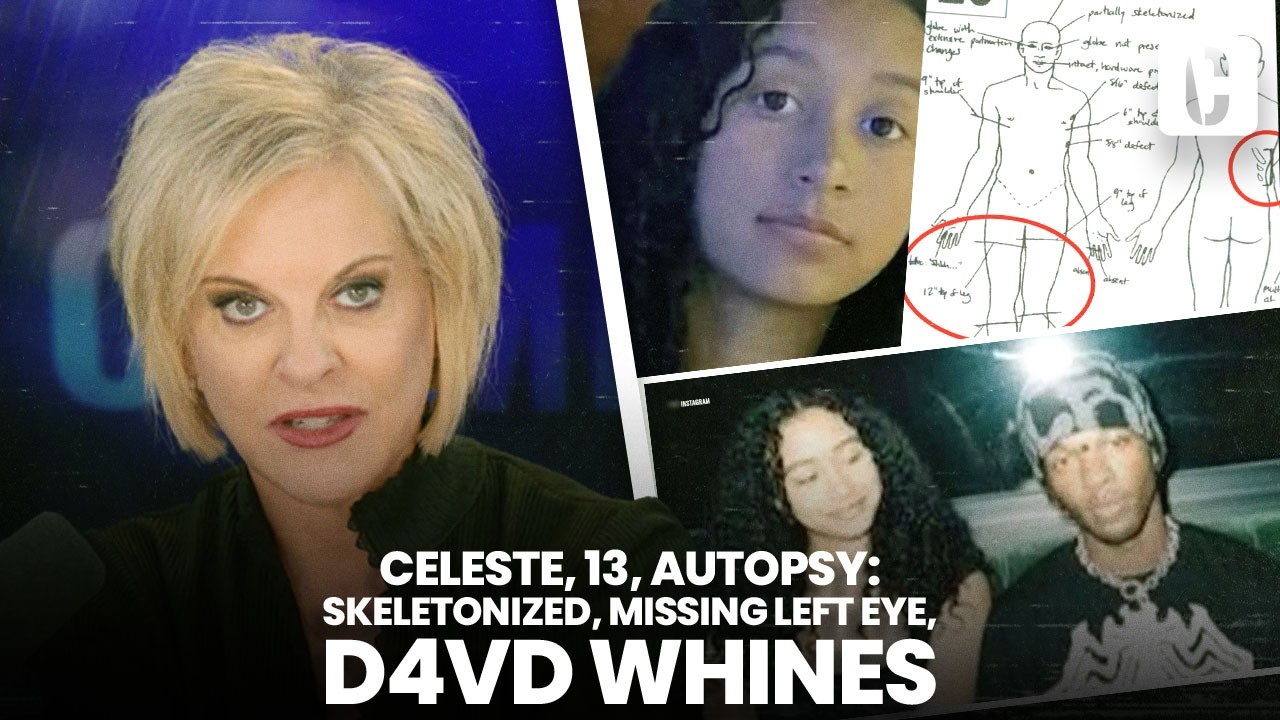
CELESTE, 13, AUTOPSY: SKELETONIZED, MISSING LEFT EYE, D4VD WHINES
"A 13-year-old girl, Celeste Rivas, was found partially skeletonized with a missing left eye, traces of meth and MDMA, and fatal stab wounds, while the accused musician David Anthony Burke (D4VD) complains about jail conditions."

True-crime cases with recent developments | 48 Hours Full Episodes
"This episode reconstructs four complex true-crime cases, detailing the harrowing searches for missing persons, the challenges of prosecuting murders without bodies, and the enduring quest for justice in cold cases spanning decades."

Amanda Knox and John Ramsey - Megyn Kelly's "Double Feature" of Fascinating Interviews
"This episode features two individuals, Amanda Knox and John Ramsey, whose lives were irrevocably altered by tragic crimes and subsequent wrongful accusations, revealing systemic failures in justice and media manipulation."
TEEN'S DNA REVEALED IN ANNA KEPNER'S R*** KIT
"The investigation into Anna Keaptainner's death on a cruise ship reveals shocking DNA evidence, a previously unknown male minor, and critical questions about evidence handling and family dynamics."