Pepe Escobar: Iran & Russia JUST HUMILIATED Trump’s Bullying Plan – FULL Control of Hormuz Now
YouTube · mCeseehHEUU
Quick Read
Summary
Takeaways
- ❖Iran has set three non-negotiable conditions for any future US negotiations: a guaranteed end to the war, a new toll system for the Strait of Hormuz, and then a discussion on a diluted nuclear deal.
- ❖Russia, through President Putin, publicly endorsed Iran's sovereignty and strategic partnership, signaling direct involvement in a diplomatic solution to the conflict.
- ❖The Strait of Hormuz, not international waters, is being reconfigured by Iran and Oman to include toll booths, with Iran demanding payment in its national currency.
- ❖Iran is effectively circumventing US naval blockades by utilizing six new overland trade corridors through Pakistan and expanding rail links to China.
- ❖The US blockade on Iran is seen as a 'test drive' for a broader global blockade strategy targeting nations that challenge the petrodollar and US hegemony.
- ❖The SCO (Shanghai Cooperation Organization) defense ministers met in Kyrgyzstan, discussing the Iran situation, viewing the US war as an attack on Eurasian integration and the 'Primakov Triangle' (Iran, Russia, China).
- ❖The UAE's decision to potentially leave OPEC+ is driven by desperation and a desire to sell more oil, aligning with US interests to lower oil prices, but risks Iranian retaliation.
- ❖China has strategically diversified its energy routes and invested in green energy to mitigate its 'Malacca Syndrome' vulnerability, anticipating future US attempts to blockade the strait.
Insights
1Iran's Non-Negotiable Conditions for Peace
Iran has presented three firm conditions for any meaningful negotiations: 1. A permanent end to the war with written guarantees from major powers and UN Security Council approval. 2. A new setup for the Strait of Hormuz, including Iranian toll booths paid in Iranian Rial. 3. Only then, a discussion on a diluted JCPOA (nuclear deal), which would be less favorable to the US than the original.
Iranian Foreign Minister Arai refined these conditions after visits to Islamabad and Oman, communicating them to Pakistani mediators before his meeting with Putin.
2Russia's Strategic Endorsement of Iran
During a 90-minute meeting, President Putin personally received Iranian Foreign Minister Arai, a rare gesture for a non-head of state. Putin conveyed gratitude from the Supreme Leader, affirmed Russia's strategic partnership, praised Iran's fight for independence and sovereignty, and stated Russia's direct involvement in finding a diplomatic solution for regional peace.
Putin's specific quotes: 'Please convey my most sincere words of gratitude confirmed that Russia just like Iran intends to continue our strategic partnership.' and 'We see how courageously and heroically the people of Iran are fighting for their independence and sovereignty.'
3Iran's Blockade Evasion Strategies
Iran is effectively bypassing US naval blockades through multiple avenues: 1. Utilizing six new overland corridors opened by Pakistan for goods, including some oil. 2. Transporting oil and goods via the China-Iran railway. 3. Exporting gas through the Turkmenistan-Xinjiang pipeline via swaps. 4. Iranian tankers navigating close to territorial waters of Iran and Pakistan to Mumbai.
Mention of 3,000 containers stranded in Karachi now moving overland to Iran; oil and gas transport via rail and pipelines; tankers using territorial waters.
4UAE's OPEC+ Stance Driven by Greed and Desperation
The UAE's consideration of leaving OPEC+ is attributed to a desire to increase oil exports (e.g., from 2.5 million to 5 million barrels/day) to generate more revenue, aligning with US goals of lowering oil prices. This move is seen as a bet on continued US and Israeli protection, but risks Iranian retaliation.
The speaker frames it as 'a move conditioned as much by greed as desperation,' noting the friction between Abu Dhabi and Riyadh, and Dubai's 'dead' business model.
5SCO's Unified Stance Against US Blockade Strategy
Defense ministers from all SCO member states (including Russia, China, India, Pakistan, Central Asian nations) met in Kyrgyzstan, where Iran's defense minister offered to share experience in defeating the US. This meeting signifies a collective recognition that the US blockade against Iran is a 'test drive' for a global blockade against Eurasian integration, BRICS, and the 'Primakov Triangle'.
The meeting of SCO defense ministers in Kyrgyzstan, and the Iranian minister's offer to share 'experience in defeating the Americas'.
Bottom Line
The US naval blockade on Iran is a 'test drive' for a future global blockade strategy aimed at all nations that refuse to sell energy in petrodollars and assert their independence.
This implies that the current conflict with Iran is a precursor to broader economic warfare, forcing nations to choose sides and accelerate de-dollarization efforts and alternative trade mechanisms.
Nations and businesses can proactively invest in non-dollar trade, alternative payment systems, and diversified supply chains to build resilience against potential future blockades.
The Strait of Malacca is anticipated to be the next major geopolitical chokepoint targeted by US blockade efforts, following the challenges in Hormuz.
This poses a significant threat to global trade, particularly for East Asian economies heavily reliant on energy and goods passing through Malacca, potentially leading to increased regional tensions and military posturing.
Countries like China have already invested in alternative routes (e.g., pipelines, railways) and green energy. Other nations dependent on Malacca should accelerate similar diversification and resilience strategies.
India's perceived alignment with the US and Israel has severely damaged its standing within BRICS and the SCO, potentially leading to its exclusion from key Eurasian infrastructure projects like the Chabahar port.
This highlights the high stakes of geopolitical alignment, where perceived betrayal can lead to exclusion from critical economic and strategic partnerships, impacting long-term development and influence.
For other nations, this serves as a cautionary tale, emphasizing the importance of consistent geopolitical alignment and strategic autonomy to maintain trust and participation in emerging multilateral frameworks.
Key Concepts
Primakov Triangle
A geopolitical concept referring to a strategic alliance between Russia, China, and Iran (originally Russia, China, India) aimed at countering US unipolarity and fostering Eurasian integration. The podcast suggests India's current alignment with the US and Israel has weakened its role, solidifying the new triangle of Iran, Russia, and China as the primary target of US pressure.
Malacca Syndrome
China's strategic vulnerability due to its heavy reliance on the Strait of Malacca for energy imports and trade, which could be easily blockaded by a hostile naval power. China's response involves diversifying energy sources, building alternative land routes (pipelines, railways), and fostering strong regional relationships to mitigate this chokepoint risk.
Lessons
- Monitor the development of alternative trade corridors (e.g., Pakistan-Iran overland routes, China-Iran railway) and non-dollar payment systems, as these could become critical for global commerce.
- Assess supply chain vulnerabilities related to traditional maritime chokepoints like the Straits of Hormuz and Malacca, and explore diversification strategies to mitigate future blockade risks.
- Understand the evolving geopolitical alliances, particularly the strengthening ties between Iran, Russia, and China, and how these blocs are challenging existing global economic and security architectures.
Quotes
"We see how courageously and heroically the people of Iran are fighting for their independence and sovereignty."
"We will do everything that serves our interest of all peoples in the region... to ensure that this piece is achieved as soon as possible."
"This blockade is, I would say, the starter of a future global blockade by the Americas, assuming they can implement it. This is a test drive, Nema."
Q&A
Recent Questions
Related Episodes
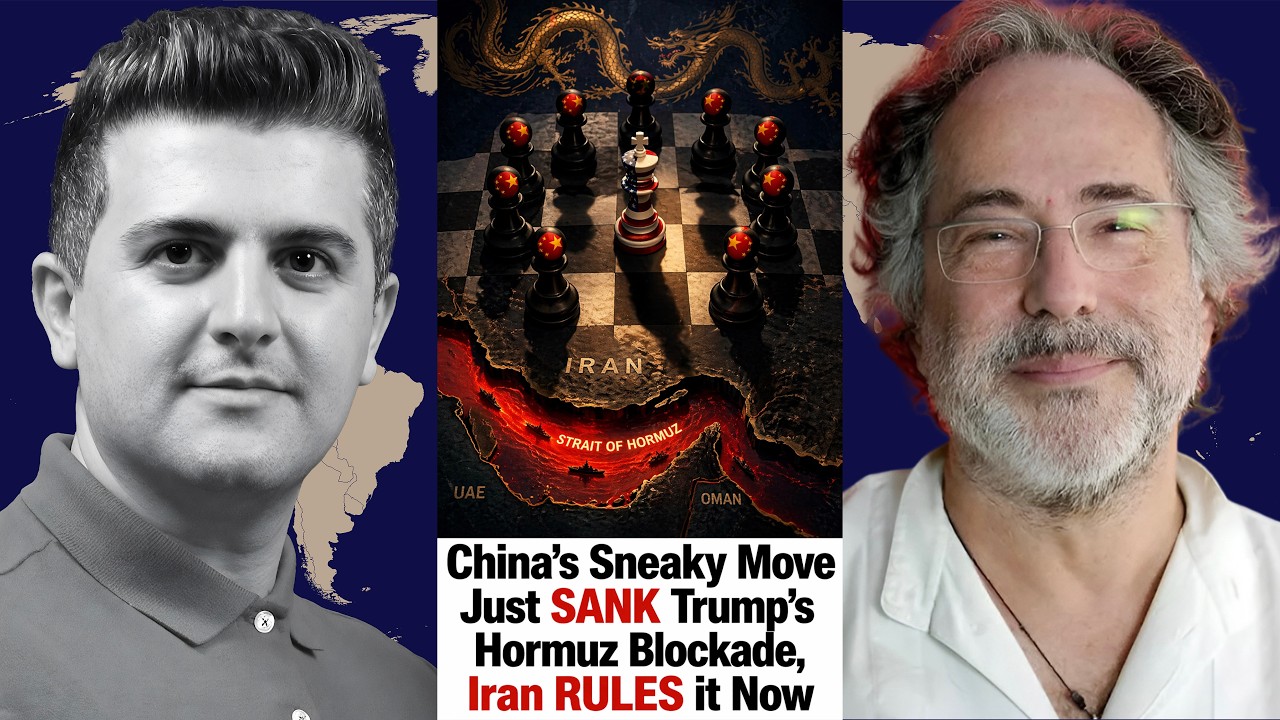
Pepe Escobar: “Total Failure”: Trump’s Blockade Just Backfired Disastrously
"Pepe Escobar argues that the US blockade against Iran, spearheaded by Donald Trump, has utterly failed and backfired, accelerating global economic chaos and challenging US geopolitical dominance."

🚨 TOTAL F*CKING CHECKMATE 😂😂😂
"The host argues that Trump's 'ceasefire' with Iran was a calculated '5D chess' move to orchestrate a global energy market reshuffle, while simultaneously lambasting 'woke' domestic policies and the 'freefall' of anti-Trump conservative figures."
Robby Soave GOES OFF On ANNOYING Liberal Black Woman Making Emotional Trump Deranged Arguments!
"The host dissects a heated foreign policy debate, arguing that 'left-wing' emotionalism and 'Trump derangement' prevent a rational understanding of US sanction strategies against Cuba and Iran."

Pentagon Prepares For EXTENDED War With Iran
"This episode dissects the geopolitical maneuvers surrounding potential US-Iran conflict, revealing strategic leaks, Netanyahu's diplomatic sabotage playbook, and the true intent behind economic sanctions."