
World-Renowned Physicist: You've Been Lied To About Reality! - Michio Kaku
YouTube · opB7_JXL0LA
Quick Read
Summary
Takeaways
- ❖Immortality is scientifically plausible through telomerase manipulation, but its link to cancer remains a major hurdle.
- ❖Quantum computers, operating on atoms, can break any known digital code, posing a severe threat to banks and cryptocurrencies like Bitcoin by 2029.
- ❖String theory suggests our universe is one of many 'bubbles' in an 11-dimensional 'hyperspace,' with dark matter being higher vibrations of these strings.
- ❖Gravity is a byproduct of space warping, causing planets to orbit stars and us to remain grounded.
- ❖UFO sightings, while intriguing, lack tangible evidence of extraterrestrial contact, with Kaku speculating any visitors would likely be robotic due to extreme maneuvers.
- ❖Human perception of reality is limited, a 'partial fiction' filtered for survival, missing most of the electromagnetic spectrum and other dimensions.
- ❖Religion serves an evolutionary purpose as a 'glue' to hold intelligent, bickering human societies together.
- ❖AI's current creativity is imitative, not truly original, but its future potential for harm (e.g., autonomous weapons) necessitates careful consideration and potential human-robot merging.
- ❖Humanity is at a 'knife's edge,' capable of self-destruction through advanced technology or achieving universal prosperity.
Insights
1Immortality is 'Tantalizingly Close' but Linked to Cancer
The human body contains telomeres, a 'clock' that shortens with cell reproduction, leading to aging and death. Telomerase, a chemical that stops this clock, has been discovered. However, cancer cells also utilize telomerase to achieve immortality, posing a critical challenge for extending human lifespans without activating cancers.
We know there's a clock in our body called the tie that tracks how long we're going to live and there's something called talomeorase which stops the clock which means that we can live forever. That's the good news. But the bad news was we found out that cancer also uses tie and talomeorase to live forever.
2Quantum Computers Threaten Global Cybersecurity and Finance
Quantum computers, which compute on atoms rather than transistors, are exponentially more powerful than traditional digital computers. They are capable of breaking any known digital code, including those securing banks and cryptocurrencies like Bitcoin. The CIA is actively monitoring this threat, with Google setting a 2029 deadline for the cybersecurity world to adapt.
Quantum computers are so powerful that even the CIA is worried that one day, perhaps in the future, they'll be so powerful they'll be able to break into any known digital code. So even the CIA is worried about the fact that these could become so powerful that they allow you to break into any known computer. So these are called quantum computers. Why are they powerful? Because they compute not on transistors. They compete on atoms.
3String Theory Explains Everything as Vibrating Strings in 11 Dimensions
String theory proposes that fundamental particles like protons and electrons are not points but rather different vibrations of a single type of string. This theory aims to unify all four fundamental forces of the universe (gravity, electromagnetism, strong and weak nuclear forces) and suggests the existence of 11 dimensions, with our universe being a 4-dimensional 'bubble' within a larger 'hyperspace.'
String theory says that what is a proton? What is an electron? They're nothing but vibrations of a string. So from a distance, this looks like a point particle... it's really a vibrating string. And each vibration corresponds to a node. So this would be a proton. This would be an electron.
4Our Perceived Reality is a 'Partial Fiction' for Survival
Human senses are limited and only perceive a tiny fraction of the full spectrum of reality. What we experience as 'real' is a filtered version, shaped by evolution for survival. This means vast amounts of information, like ultraviolet radiation, cosmic rays, or other dimensions, exist around us but are imperceptible.
What you consider to be reality is really a partial fiction that your senses are limited by what your senses can retrieve from the outside world. But it's only a teeny weeny little fraction of what actually exists.
5AI's Current Creativity is Imitative, Not Original
While AI can rearrange existing information to create seemingly new things (like images or text), it lacks true originality. Unlike human creativity, which can emerge from 'almost nothing' like a supernova (e.g., Newton's calculus), AI's output is fundamentally imitative, based on programmed data and existing patterns.
Robots right now take what is available to them and rearrange things like writing a book. ...true creativity comes from almost nothing and it's like a supernova. Well, creativity of a robot is imitative.
Bottom Line
The discovery of a star whose light output frequently reduces by 20% is highly unusual and suggests a non-natural phenomenon. One theory is that an advanced civilization has constructed a 'Dyson sphere' or large orbiting structure around it to harness its energy, causing the significant eclipse.
This observation, if confirmed as artificial, would be the strongest indirect evidence of highly advanced extraterrestrial intelligence and technology, fundamentally altering humanity's understanding of its place in the cosmos.
Further astronomical observation and analysis of such anomalous stellar behavior could lead to breakthroughs in astrobiology and the search for alien civilizations, potentially inspiring new energy capture technologies on Earth.
Black holes, often considered cosmic dead ends, could theoretically serve as 'gateways' or 'wormholes' to other universes, offering shortcuts across vast cosmic distances. While speculative, the laws of physics allow for such possibilities, requiring immense energy.
This concept transforms black holes from destructive forces into potential inter-universal travel hubs, opening up profound implications for space exploration and understanding the multiverse.
Theoretical physics research into wormholes and black hole mechanics could inform future propulsion systems or even inspire new models of cosmic structure, though practical application remains far off.
Key Concepts
String Theory
The concept that fundamental particles (protons, electrons) are not points but vibrating strings, with different vibrations corresponding to different particles. This theory aims to unify all four fundamental forces of the universe and explain the Big Bang.
Multiverse Theory (Bubble Bath of Universes)
The idea that our universe is just one of many 'bubbles' expanding in a larger 'hyperspace,' with other universes potentially existing in parallel dimensions. The Big Bang is seen as one such bubble expanding from a frothing vacuum.
Reality as Partial Fiction
Our sensory perception of reality is inherently limited and filtered for survival, meaning we only experience a tiny fraction of the true, full spectrum of existence (e.g., electromagnetic spectrum, other dimensions). Evolution has shaped our senses to prioritize survival over comprehensive understanding.
Evolutionary Purpose of Religion
Religion acts as a 'glue' for intelligent, social species like humans, providing a common framework of morality and meaning that prevents tribes from fragmenting due to bickering and individual intelligence. It offers guidance and a reason for existence, even if its narratives are metaphorical.
The Double-Edged Sword of Technology
Every significant technological advancement, from the bow and arrow to AI and nuclear weapons, possesses the inherent capacity for both immense good and catastrophic harm. Humanity's challenge is to steer these innovations towards prosperity rather than self-destruction.
Lessons
- Stay informed about the rapid advancements in quantum computing and their implications for cybersecurity and financial systems, as current encryption methods may become obsolete.
- Cultivate a critical and open-minded perspective on reality, recognizing that our senses provide only a limited view of existence, and be prepared for scientific discoveries that challenge conventional understanding.
- Engage in ethical discussions and policy-making regarding the development and deployment of artificial intelligence, particularly concerning autonomous weapons and the potential for human-robot integration.
Notable Moments
Kaku's childhood inspiration to pursue physics stemmed from Albert Einstein's failed attempt to create a 'theory of everything,' sparking a lifelong quest.
This personal anecdote highlights the profound impact of scientific ambition and the pursuit of fundamental knowledge on individual career paths and the advancement of science itself.
Kaku's experience in the US Army during the Vietnam War profoundly shifted his perspective from single-minded focus on physics to a deeper understanding of human morality, conflict, and the importance of fighting for what is right.
This demonstrates how real-world experiences, particularly those involving profound human suffering and ethical dilemmas, can broaden an individual's worldview and influence their philosophical outlook beyond their professional domain.
Quotes
"We're at the edge of a knife. You tilt it the wrong way and there's worlds war. You tilt it the other way and there's food and luxury for everyone. And it's up to us to decide which way the knife will go."
"The universe looks flat, but it's not. It's curved. And that's why planets go around the mother star because gravity is the byproduct of the warping of space."
"I would say that what you consider to be reality is really a partial fiction that your senses are limited by what your senses can retrieve from the outside world. But it's only a teeny weeny little fraction of what actually exists."
"God is a glue that holds sensient beings together when there's no reason to hold them together anymore and they bicker and they the tribe falls apart."
"Animals do not care about the future. They just care about survival. We, on the other hand, are obsessed with the future because that's where our survival lies."
Q&A
Recent Questions
Related Episodes
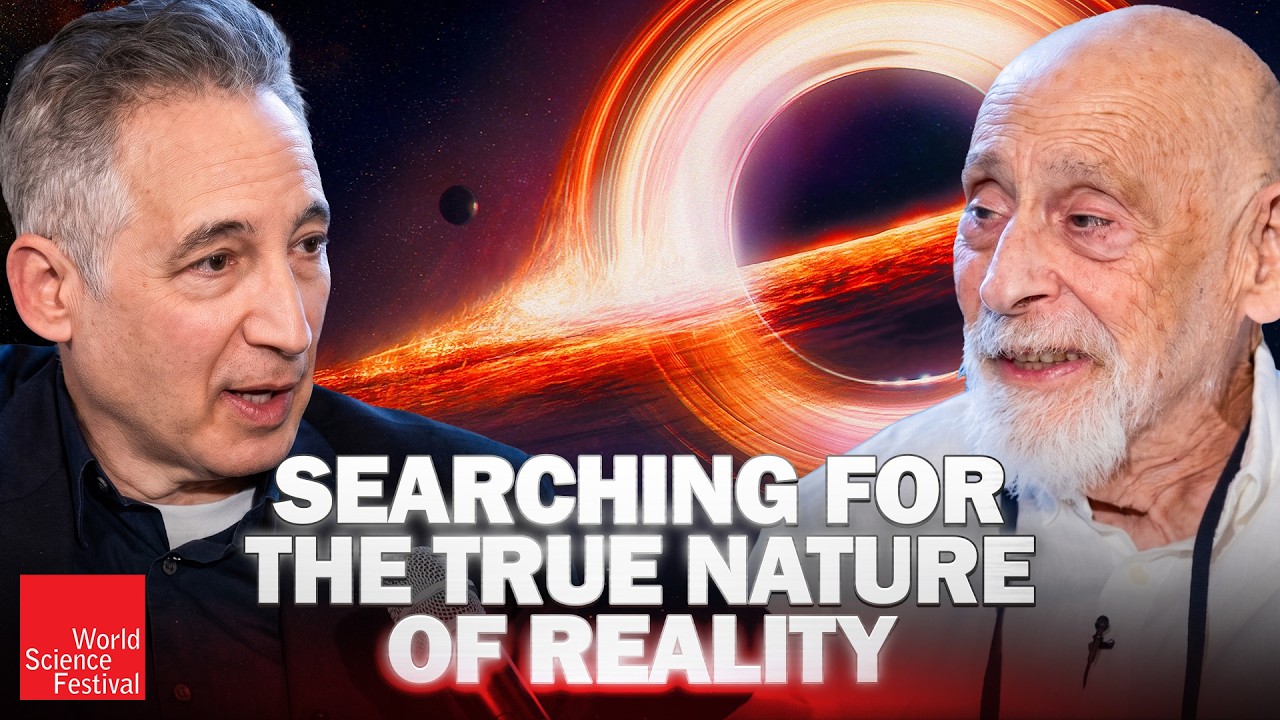
The Hardest Questions in Physics | World Science Festival
"Leonard Susskind, a co-founder of string theory and a former plumber, shares his unique approach to physics, focusing on resolving fundamental conflicts between established principles like general relativity and quantum mechanics."

MIT Physicist: DARPA, Warp Drives, Supergravity & Aliens on Jupiter | Jim Gates
"MIT Physicist Jim Gates details his journey from a four-year-old inspired by sci-fi to a leading researcher in supersymmetry, revealing how fundamental physics equations contain computer error correction codes and discussing the nature of scientific genius, AI, and the future of space travel."

The Complex Universe, with Sean Carroll
"Cosmologist Sean Carroll joins Neil deGrasse Tyson to unravel the universe's biggest mysteries, from the arrow of time and black holes to the reality of dark matter and the multiverse."

Joe Rogan Experience #2491 - Brian Simpson
"Joe Rogan and Brian Simpson delve into everything from personal health hacks and pet care to cosmic mysteries, political controversies, and the economics of digital scams and addiction."