
🚨 BREAKING: Iran War Enters Regime Change Phase - Trump Causes IRGC Infighting
YouTube · pBYYYGYvkvE
Quick Read
Summary
Takeaways
- ❖President Trump's public statements about 'talking to someone' in Iran were a deliberate tactic to create internal chaos and infighting within the IRGC leadership.
- ❖The Israeli Defense Forces have destroyed approximately 330 out of 470 IRGC missile launchers and eliminated numerous senior commanders and key technical personnel.
- ❖The 'Immortal Guard' (Iranian opposition) is reportedly awaiting a signal from the US and Israel to initiate a widespread uprising and take control of the country.
- ❖The UK has deployed short-range air defense systems to Bahrain, Kuwait, and Saudi Arabia, signaling increased Western military presence and support for allies in the Persian Gulf.
Insights
1Trump's 'Trolling' Strategy Causes IRGC Infighting
President Trump's public announcement about 'productive conversations' with an unnamed Iranian figure, followed by a clarification that this person was 'not from the current regime,' was a deliberate psychological operation. This created immense panic and suspicion within the IRGC, leading to internal accusations and public denials from figures like Parliament Speaker Kalibaf, who feared assassination by hardliners.
Trump's statement (), Kalibaf's panicked public denial (), and the host's interpretation of the resulting IRGC infighting (-).
2Crippling of IRGC Missile Capabilities and Leadership
The Israeli Defense Forces, with US assistance, have systematically targeted and destroyed a significant portion of the IRGC's military infrastructure. This includes approximately 330 out of 470 missile launchers, command and control centers around Tehran, ammunition depots, and the headquarters of the Basij unit. Multiple senior IRGC leaders and commanders, including a key missile and drone engineer (Sayed Sham Kadi), have been eliminated.
IDF reports of destroying 330 missile launchers (), strikes on command centers (), ammunition depots (, ), Basij headquarters (), and the elimination of 8 IRGC leaders () and Sayed Sham Kadi ().
3Imminent 'Regime Change Phase' Driven by Iranian Opposition
The host asserts that the conflict has entered a 'regime change phase,' with the US, Israel, and the Iranian opposition (referred to as the 'Immortal Guard,' led by Crown Prince Reza Pahlavi) coordinating. The 'Immortal Guard' has been instructed to stay home for now but is preparing for a mass uprising once the IRGC is sufficiently crippled. Covert operations are already underway, targeting regime officials.
Host's declaration of 'regime change phase' (, ), Admiral Cooper's message to Iranians to 'stay indoors' (), and reports of 'Immortal Guard' covert operations (, ).
4UK Deploys Air Defense Systems to Persian Gulf
The United Kingdom has announced the deployment of short-range air defense systems to Bahrain, Kuwait, and Saudi Arabia. This move signifies a direct military involvement in bolstering regional allies' defenses against Iranian threats.
Statement from Prime Minister Starmer confirming deployment to Bahrain, Kuwait, and Saudi Arabia ().
Bottom Line
President Trump's communication style, often perceived as erratic, is framed as a highly effective, deliberate psychological warfare tactic in geopolitics, specifically designed to exploit internal divisions within adversary regimes.
This suggests that seemingly contradictory or ambiguous statements from high-level political figures, particularly Trump, should be analyzed not for their literal meaning but for their intended disruptive or strategic impact on adversaries.
Analysts and intelligence agencies could develop frameworks to interpret such 'non-literal' political communication as a form of strategic messaging, predicting its effects on internal power struggles within target regimes.
The potential for a targeted ground invasion of Iran's Kag Island is being floated by US officials, offering a 'boots on the ground' scenario that avoids mainland invasion but cripples 90% of Iran's oil exports and symbolically challenges its sovereignty.
This indicates a strategic consideration for limited, high-impact military actions that can achieve significant economic and psychological leverage without escalating to a full-scale invasion of a large country.
Military strategists could explore similar 'island-hopping' or targeted territorial seizure tactics in other geopolitical hotspots where an adversary's critical infrastructure or symbolic assets are geographically isolated.
Lessons
- When analyzing geopolitical statements, particularly from figures known for unconventional communication, prioritize understanding the potential strategic intent and psychological impact over literal interpretation.
- Monitor internal dissent and infighting within authoritarian regimes, as external pressures (military strikes, diplomatic ambiguity) can rapidly accelerate these dynamics towards regime instability.
- Observe the coordination between external military actions and internal opposition movements, as this multi-pronged approach appears to be a key strategy in current regime change efforts.
Notable Moments
The host displays a deepfake/AI-generated video of the IRGC spokesman sarcastically claiming Iran is 'winning' despite losing all its assets, using it as a recurring comedic and propaganda tool.
This illustrates the use of humor and manipulated media as a form of psychological warfare and information operations in modern conflict, aiming to demoralize the adversary and rally support.
Iranian Parliament Speaker Kalibaf publicly denies rumors of negotiating with the US, fearing assassination by IRGC hardliners, highlighting the extreme internal paranoia and fragility within the regime.
This moment provides concrete evidence of the internal chaos and fear generated by external psychological operations, demonstrating how rumors can destabilize an already fractured leadership.
Quotes
"We are now entering the regime change phase of this conflict."
"Never take him literally, but take him seriously. If he says something, it's not what it says, but some there is a reason he's saying that."
"Iran is definitely winning the war you guys. We don't have any more leaders, no more ships, no more airplanes, no more missile LAUNCHERS AND NO MORE WEAPONS. BUT OTHER THAN THAT, EVERYTHING honky dory here in Iran. TOTALLY WINNING. NOBODY PANICKING OR ANYTHING LIKE THAT."
"I am pleased to report that the United States of America and the country of Iran have had over the last two days very good and productive conversations regarding a complete and total resolution of our hostilities in the Middle East... I have instructed the Department of War to postpone any and all military strikes against Iranian power plants and energy infrastructure for a 5day period..."
"No negotiations have been held with the US and fake news is used to manipulate the financial and oil markets and escape the quagmire in which the US and Israel are trapped."
"This whole thing would have been very different if America and Israel were dealing with a country that they were like attacking a country and a regime that had the support of their people..."
Q&A
Recent Questions
Related Episodes
Patrick Henningsen: Hezbollah JUST Fired Back at Israel - Iran Vows to “Crush” All Attacks
"Patrick Henningsen argues that the US and Israel initiated an illegal war against Iran, driven by Trump's incompetence and Israeli influence, leading to an inevitable escalation with severe global economic repercussions."

🚨 THEY F*CKED AROUND FOR THE LAST TIME 😭😭😭
"This episode unleashes a torrent of highly opinionated commentary on the US-Iran deal, Israel's role, and a scathing critique of 'leftist' policies and immigration, particularly highlighting the UK grooming gang report as evidence of Western societal decay."
BREAKING: Protests ERUPT In Iran Over IRGC Surrendering To Trump - Infighting Clashes In Tehran
"Iran is experiencing severe internal infighting and protests as hardline IRGC elements clash with government figures over a perceived 'surrender' to the US, while mainstream Western media misrepresents the situation."
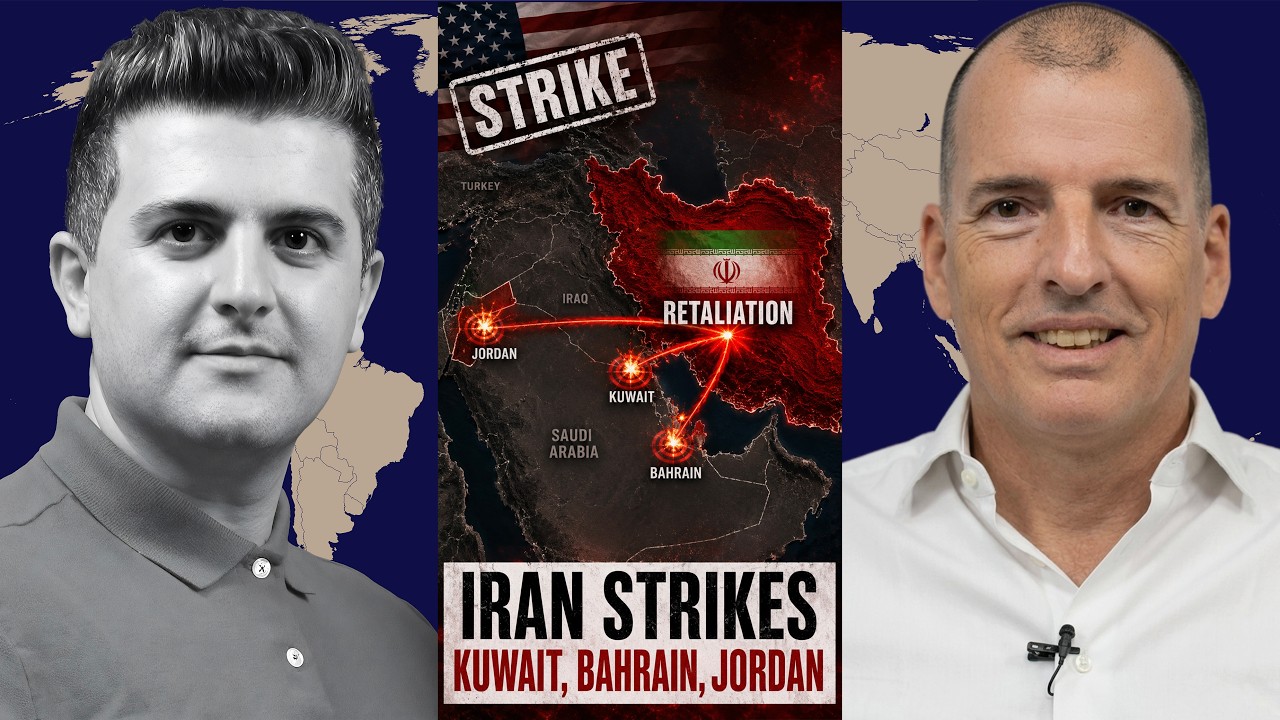
Alex Krainer: US STRIKES Iran – Iran RETALIATES Against Kuwait, Bahrain & Jordan!
"Amidst escalating US-Iran conflict and Iranian retaliation against regional US allies, this episode argues that US foreign policy is deeply controlled by an 'Anglo-Zionist conspiracy' led by the Rothschild banking dynasty, prioritizing Israeli interests over American ones."