
JD Vance’s Warning to Israel, the Last Desperate Move of Israel-Firsters & Iran’s Growing Strength
YouTube · q72s8zwwGg4
Quick Read
Summary
Takeaways
- ❖Official casualty figures from the Middle East conflict indicate more Lebanese civilians killed by Israel than Iranians by the US-Israel coalition, suggesting a secondary war against Lebanon.
- ❖The US is framed as being manipulated by Israel into a 'regime change' war against Iran, which Israel then used as a pretext to attack Lebanon.
- ❖An Israeli minister's stated 'rule' of 'kill one of us, we kill a thousand of you' is condemned as uncivilized and morally indefensible, reflecting a 'blood guilt' mentality antithetical to Western civilization.
- ❖The US military cannot achieve a military solution against Iran without economic collapse, necessitating an embarrassing but necessary withdrawal.
- ❖Despite US efforts, Iran has emerged stronger and more recognized as a global player, having withstood attacks from the US and Israel.
- ❖US military stockpiles of critical interceptor and cruise missiles are severely depleted, with replenishment taking years, leaving the US vulnerable.
- ❖Geopolitical analyst Brandon Weichert predicts a 'post-America Middle East' where Israel becomes a pariah state, and regional powers like Saudi Arabia, Iran, Pakistan, Egypt, and Turkey gain prominence.
- ❖Israeli leadership, particularly Netanyahu's government, is accused of ideological rigidity and a lack of clear strategic thinking, leading to self-inflicted strategic disasters.
- ❖US politicians who criticize Israel, like JD Vance, are immediately labeled 'antisemitic,' while some Israeli security analysts suggest the US needs another 9/11-style attack to 'understand its friends.'
- ❖The US is seen as suffering from a 'moral hazard' by providing unconditional support to Israel, enabling reckless behavior without accountability.
- ❖The US military is criticized for being unprepared for modern drone warfare despite its massive budget, as evidenced by its inability to secure the Strait of Hormuz against Iranian forces.
- ❖The current US administration's attempts at a peace deal with Iran are deemed temporary and fragile, primarily due to Israeli interference and a lack of genuine commitment from all parties.
Insights
1Disproportionate Casualties and Secondary War in Lebanon
Official figures, though acknowledged as unreliable, suggest that in the initial three months of the US-Israel conflict with Iran, over 4,000 Lebanese, mostly civilians, were killed by Israel. This contrasts with approximately 3,664 Iranian casualties (fighters and civilians) from the US-Israel coalition. This indicates that Israel used the war against Iran as a pretext to launch a separate, more devastating war against its neighbor, Lebanon, targeting a predominantly Christian and other minority population.
Host Tucker Carlson cites official figures: 'On the Iranian side, the official number is about three thousand six hundred and sixty-four... killed Iranian, fighters and civilians. And the majority are civilians, as usual in wars. Three thousand six hundred... But this is not the largest total killed in a country. In the past three months since this war in the Middle East broke out, which was waged by the United States and Israel, the largest number of killed is not in Iran, not in a Gulf state, but in Lebanon. More than four thousand Lebanese, almost all civilians, killed by Israel... since Israel and the United States launched... the war against Iran.'
2Israel's Strategic Miscalculation and Iran's Rise
Israel's objective in the conflict was to cripple Iran and remove it as a global player. However, the exact opposite occurred. Iran has emerged stronger, gaining international recognition as a significant player in energy and commodity markets, and is perceived as having successfully resisted two of the world's most formidable armies. This outcome represents a 'nightmare scenario' for Israel, as its primary adversary has been inadvertently empowered.
Carlson states: 'They went into this thing with the goal of crippling Iran, tearing the country into warring factions, sidelining it, kind of taking it off the stage as a global player. And that was their goal. They said that. And the exact opposite happened. Iran became stronger... Iran became globally recognized as a real player in international energy and commodity markets, but also as the country that stood up to two of the fiercest, and perhaps least principled armies in the world.'
3Depletion of US Military Resources and Vulnerability
The conflict has severely depleted US military stockpiles of critical defensive and offensive missiles. Approximately 50% of Patriot ballistic missile interceptors, up to 80% of THAAD interceptors, and about one-third of Tomahawk cruise missiles have been consumed. Replenishment for some systems, like Patriot interceptors and THAAD, is not expected until close to 2030, leaving significant gaps in US defense capabilities and making it vulnerable to other global threats.
Brandon Weichert details: 'About fifty percent of the Patriot ballistic missile interceptor stockpile... and fifty, and probably closer to eighty percent of the THAAD high-altitude area defense interceptors have been consumed... About a third of our entire stockpile of Tomahawk cruise missiles has been consumed. Significant amounts of JASSM missiles... and almost the entire pre-war stockpile of the new precision strike missiles, the Prisms, have also been utilized.' He adds, 'Patriot interceptors, not until close to 2030. THAAD interceptors and THAAD are the really important ones. That's not going to be provided until probably 2030.'
4Israel's 'Blood Guilt' Mentality vs. Western Justice
The host argues that Israel's stated policy of disproportionate retaliation ('kill one of us, we kill a thousand of you') embodies a 'blood guilt' principle, where entire populations are punished for the actions of a few. This is presented as a fundamental abandonment of the core Western civilization concept of individual justice, which holds that the guilty are punished and the innocent are spared, rooted in the Christian understanding of the human soul's equal value.
Carlson states: 'An Israeli minister yesterday said quite explicitly, 'These are the rules we operate by.' 'You kill one of us, we kill a thousand of you.' That is not the behavior of civilized people... It is, by definition, the punishment of the innocent. This is an act that only notorious evil regimes commit in public, and they never declare it... The core idea of Western civilization... is the idea of justice. What is justice in the West, in this thing called Western civilization? Justice is the principle that we punish the guilty and we spare the innocent.' He later adds, 'The current government has abandoned the core principle of Western civilization, which is justice on an individual basis, for an older, darker, indeed evil standard, which is blood guilt.'
5Emergence of a Post-American Middle East Order
The strategic outcome of the conflict is predicted to be a 'post-America Middle East,' where Israel, once central to US regional plans like the Abraham Accords, becomes a pariah state. The new regional powers will include Saudi Arabia, Iran, Pakistan (with its nuclear umbrella), Egypt (with Africa's second-largest economy and a strong military), and Turkey (with a robust industrial base capable of independent defense production). These nations will increasingly align against Israel, forcing a shift from containing Iran to containing Israel.
Weichert asserts: 'What I think this is going to lead to geopolitically is a post-America Middle East... where Israel is now likely the pariah state, whereas prior to the war, you'll remember, even, even after October 7th, the Abraham Accords were still really in effect and they were making Israel kind of the hub of this new US-backed order in the Middle East which is now gone.' He lists the new powers: 'Saudi Arabia, the Islamic Republic of Iran, Pakistan with its nuclear umbrella, the Egyptians, second largest economy in Africa, and among the best... perhaps the best conventional military in the Islamic world. And then Turkey, with their very impressive industrial base.'
Bottom Line
The US military's reliance on expensive, outdated platforms like aircraft carriers, while neglecting modern drone warfare and failing to secure critical chokepoints like the Strait of Hormuz, reveals a profound strategic disconnect and vulnerability.
This suggests that the US defense budget is misallocated, prioritizing legacy systems over effective modern capabilities, which could lead to further strategic defeats and an inability to project power effectively in future conflicts.
There is an opportunity for a radical restructuring of defense spending and procurement, focusing on agile, cost-effective, and technologically advanced solutions for modern warfare, potentially leading to a more efficient and effective military.
The immediate labeling of any criticism of Israel as 'antisemitism' by US politicians and media figures is a tactic to suppress legitimate debate and maintain an unsustainable foreign policy, even when it directly harms US interests.
This tactic prevents critical self-reflection and accountability, allowing a foreign government's interests to supersede those of the United States, leading to poor decision-making and public disillusionment.
A growing segment of the American population, particularly younger generations, is becoming more skeptical of this narrative. This creates an opportunity for political leaders to engage in honest, fact-based discussions about foreign policy, fostering greater transparency and alignment with national interests.
The US's strategic petroleum reserve is not as robust as official figures suggest, with a significant portion of the remaining oil being contaminated and unusable, creating a hidden vulnerability to energy shocks.
This hidden vulnerability means that in a prolonged energy crisis, such as a full closure of the Strait of Hormuz, the US could face severe economic and social disruptions much sooner than anticipated, with devastating consequences for daily life and the economy.
This necessitates an urgent re-evaluation of US energy security strategy, including investment in new, clean energy sources, domestic production, and more secure, diversified strategic reserves to mitigate future shocks and reduce geopolitical leverage by oil-producing nations.
Lessons
- Question the narratives surrounding US foreign policy and military interventions, especially when criticisms are dismissed with ad hominem attacks like 'antisemitism.'
- Demand accountability from elected officials and military leadership for strategic failures and the depletion of national resources, rather than accepting platitudes about military strength.
- Recognize the potential for 'moral hazard' in unconditional foreign aid and advocate for policies that align US support with its own national interests and values of justice and proportionality.
Notable Moments
The host recounts a hypothetical scenario of a friend asking for help against an invading gang, only to abandon the fight to attack a peaceful neighbor, illustrating Israel's actions towards Lebanon after drawing the US into conflict with Iran.
This analogy vividly frames the host's perception of Israel's 'betrayal' of US trust and resources, highlighting the perceived opportunistic nature of Israel's actions and the moral implications for the US.
An Israeli security analyst, Ben Sabti, suggests the US 'needs another Pearl Harbor or 9/11' to understand its friends, a sentiment echoed by Netanyahu after 9/11.
This quote, presented as a direct threat, reveals a disturbing level of cynicism and perceived disregard for American lives by some Israeli figures, further fueling the narrative of Israel's self-serving agenda and its willingness to exploit US suffering.
US Senator Tom Cotton is criticized for pushing legislation that would mandate intelligence sharing with a foreign state (Israel) and for attempting to abolish the Director of National Intelligence position, allegedly to prevent oversight.
This highlights a perceived 'treasonous' alignment of certain US politicians with foreign interests over national security, suggesting a deep-seated corruption or ideological capture within the US political establishment that undermines American sovereignty and intelligence integrity.
Quotes
"You kill one of us, we kill a thousand of you."
"If I were in the government of the state of Israel, I probably wouldn't attack... the only strong ally I have left in the entire world."
"The message that goes out to the rest of the world is that this small rogue state stood up to the most powerful global alliance and survived. That in itself is a massive victory, and it enhances Iran's prestige and operational power going forward."
"The justice is the principle that we punish the guilty and we spare the innocent. And that is not just some kind of accident that we kind of regret. To punish the innocent is a profound offense against the very idea of justice."
"What I think this is going to lead to geopolitically is a post-America Middle East... where Israel is now likely the pariah state."
"The Israelis now look like they're the ideological force, like they're the ones that actually might, I mean, look at this thing in Lebanon. Listen, Tucker, I know you mentioned in, in your comment that you know, they've taken over half the country. They've actually taken over, I think about twenty-five percent perhaps."
Q&A
Recent Questions
Related Episodes

🚨 TOTAL F*CKING CHECKMATE 😂😂😂
"The host argues that Trump's 'ceasefire' with Iran was a calculated '5D chess' move to orchestrate a global energy market reshuffle, while simultaneously lambasting 'woke' domestic policies and the 'freefall' of anti-Trump conservative figures."
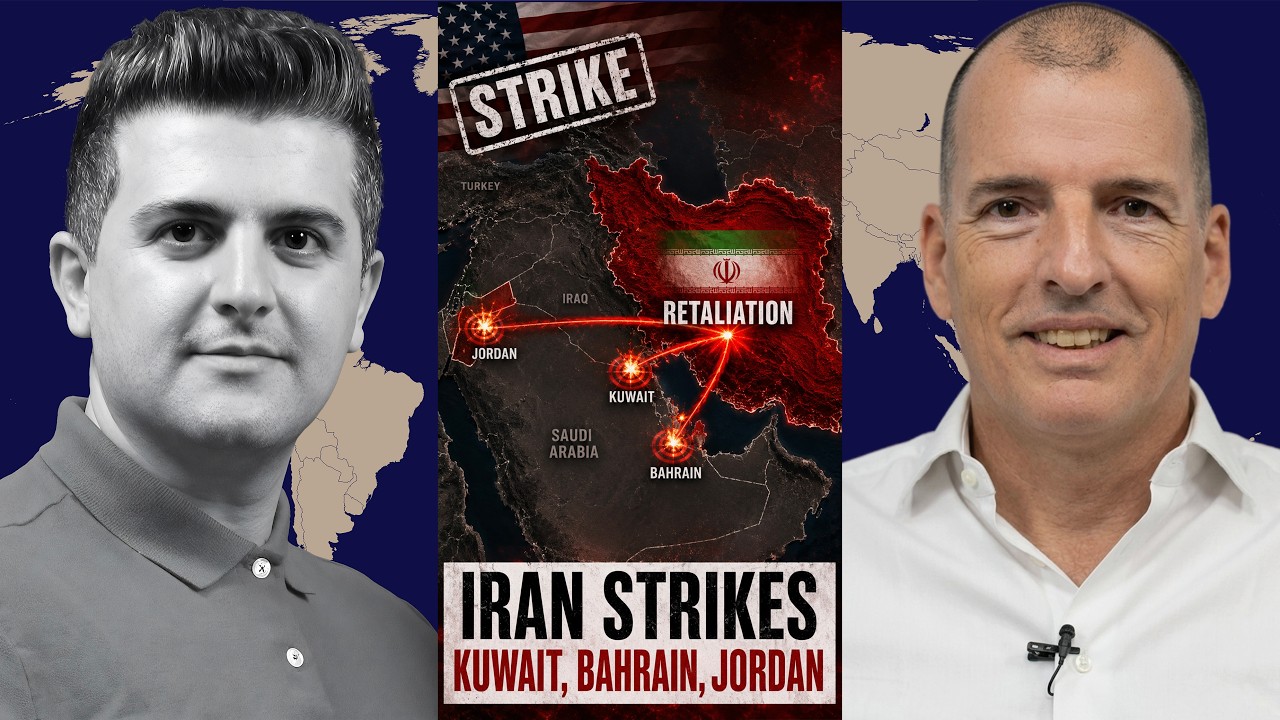
Alex Krainer: US STRIKES Iran – Iran RETALIATES Against Kuwait, Bahrain & Jordan!
"Amidst escalating US-Iran conflict and Iranian retaliation against regional US allies, this episode argues that US foreign policy is deeply controlled by an 'Anglo-Zionist conspiracy' led by the Rothschild banking dynasty, prioritizing Israeli interests over American ones."

The Fat Electrician Vs Tactically Acquired | Unsubscribe Podcast 267
"This episode features military content creators discussing current geopolitical hotspots, advanced weaponry, and the surprising psychological warfare tactics of modern conflict, alongside their personal journeys building online communities."

Patrick Henningsen: Hezbollah JUST Fired Back at Israel - Iran Vows to “Crush” All Attacks
"Patrick Henningsen argues that the US and Israel initiated an illegal war against Iran, driven by Trump's incompetence and Israeli influence, leading to an inevitable escalation with severe global economic repercussions."