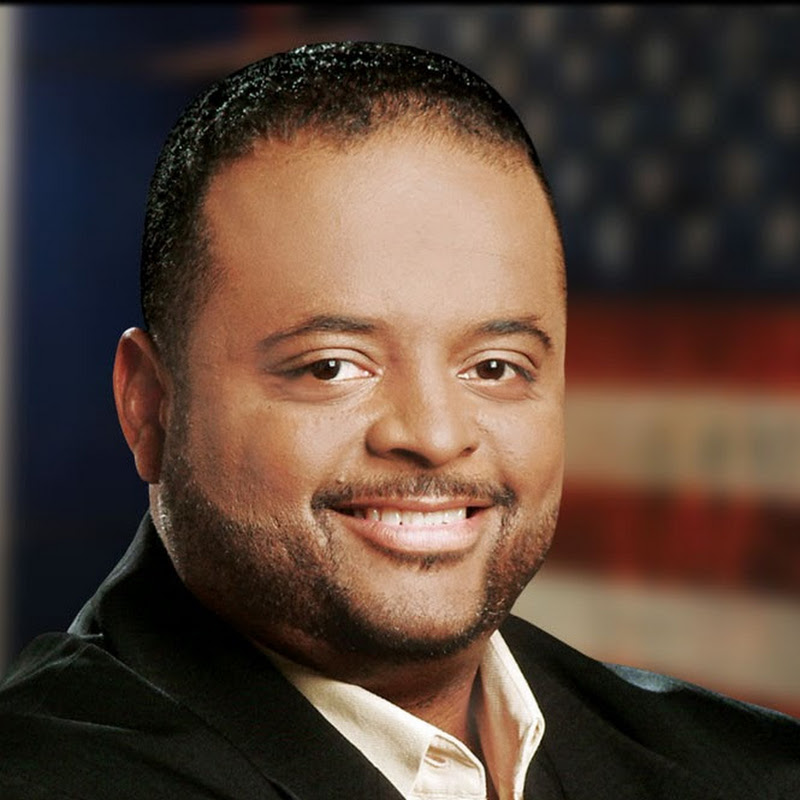
Love Forward Together March. 75-year-old Black Man faces Execution. Trump STD Funding Cut.
YouTube · qzBNf5yK3JY
Quick Read
Summary
Takeaways
- ❖The Love Forward Together March in North Carolina, led by Bishop William J. Barber II, is a multi-day movement protesting Republican redistricting and calling for a moral and political awakening.
- ❖A 75-year-old Black man, Charles Sonnie Burton, faces execution in Alabama despite prosecutors admitting he was not the shooter, with jurors and the victim's family urging clemency.
- ❖The Trump administration terminated $600 million in CDC grants for HIV and STD prevention, impacting key states and contradicting its stated goal of ending the HIV epidemic.
- ❖A strategic discussion emphasizes the need for Black communities to move beyond general conversations to concrete, micro-targeted voter mobilization efforts, focusing on specific precincts and elections.
- ❖Churches are identified as critical hubs for political organizing, capable of surveying their communities, registering voters, and providing logistical support like transportation to polls without external permission.
Insights
1The 'Build and Battle' Strategy for Black Political Power
Dr. Frederick D. Haynes III, referencing Roland Martin, advocates for a dual strategy: 'build and battle.' This means simultaneously building community infrastructure and political power while actively battling voter suppression and systemic obstacles. The focus is on proactive, long-term strategic planning rather than reactive responses to immediate crises.
Roland Martin states, 'I'm not interested in recreating a march. I'm interested in recreating the turnout.' Dr. Haynes reinforces, 'We basically need to be planning to build our communities, build political power... and at the same time, we need to battle against voter suppression.'
2Micro-Targeted Mobilization Over Macro-Level Campaigns
Effective political change for Black communities requires a shift from broad 'get out to vote' messaging to a highly specific, micro-targeted strategy. This involves identifying particular legislative seats to target, understanding the specific voting rules (which are often manipulated), and focusing resources on precise outcomes rather than general awareness.
Roland Martin criticizes, 'I'm tired of us just having this general this macro little strategy. What I am saying is it has to be a micro a targeted strategy. We need to pick off that person, that person, that person.' He gives an example of identifying the 13 votes needed for a bill.
3Churches as Autonomous Hubs for Voter Engagement
Churches possess the inherent community structure and trust to become independent, powerful centers for voter mobilization. They can operate without needing permission from campaigns, focusing on their specific precincts by analyzing voter data, educating members on local government, and providing direct logistical support for voting.
Roland Martin states, 'You don't have to ask anybody's permission.' He suggests churches 'go to the board of elections and pull the data' for their precinct, identify registered voters vs. actual voters, and organize transportation to polls. 'You can organize it yourself.'
4Long-Term Strategic Planning for Sustained Influence
To counter the strategic efforts of opposing political forces, Black communities must adopt a long-term planning horizon, thinking beyond the current election cycle. This involves anticipating future legislative sessions and redistricting efforts years in advance, learning from historical examples like the Tea Party's post-2008 planning.
Dr. Haynes emphasizes, 'We should already be thinking about in Texas 2027 and the legislative session... 2028... 2030. When the Tea Party lost in 2008, while we were partying, they were planning and that's how they took over redistricting in 2010.'
Lessons
- Identify specific political seats (federal, state, county, city) to target for change, rather than focusing on broad electoral outcomes.
- Utilize local churches and community organizations to pull voter data for their specific precincts, understanding registered voters versus actual turnout.
- Organize community-led efforts for voter registration, education on local government (City Hall 101, County Government 101), and provide direct logistical support like rides to early voting and election day polls.
Quotes
"Hip-hop does not belong in the Rock and Roll Hall of Fame, nor does opera, symphony, orchestras. How come the New York Philharmonic doesn't get the Rock and Roll? Because it's called the Rock and Roll Hall of Fame."
"We basically need to be planning to build our communities, build political power, build, and at the same time, we need to battle against voter suppression."
"I'm tired of us just having this general this macro little strategy. What I am saying is it has to be a micro a targeted strategy. We need to pick off that person, that person, that person."
Q&A
Recent Questions
Related Episodes

LIVE! Love Forward Together Mass People’s Assembly & Moral March Mobilization In Raleigh, NC
"Thousands marched across North Carolina in the 'This Is Our Selma' movement, led by Reverend William Barber, to combat gerrymandering, voter suppression, and advocate for a proactive, love-driven vision of social and economic justice."

Trump RUSHES Election Scheme as Midterms HAUNT HIM
"The hosts and guest expose the SAVE Act as a deceptive voter suppression tactic, drawing a stark contrast between the protection of gun rights and the erosion of voting rights."
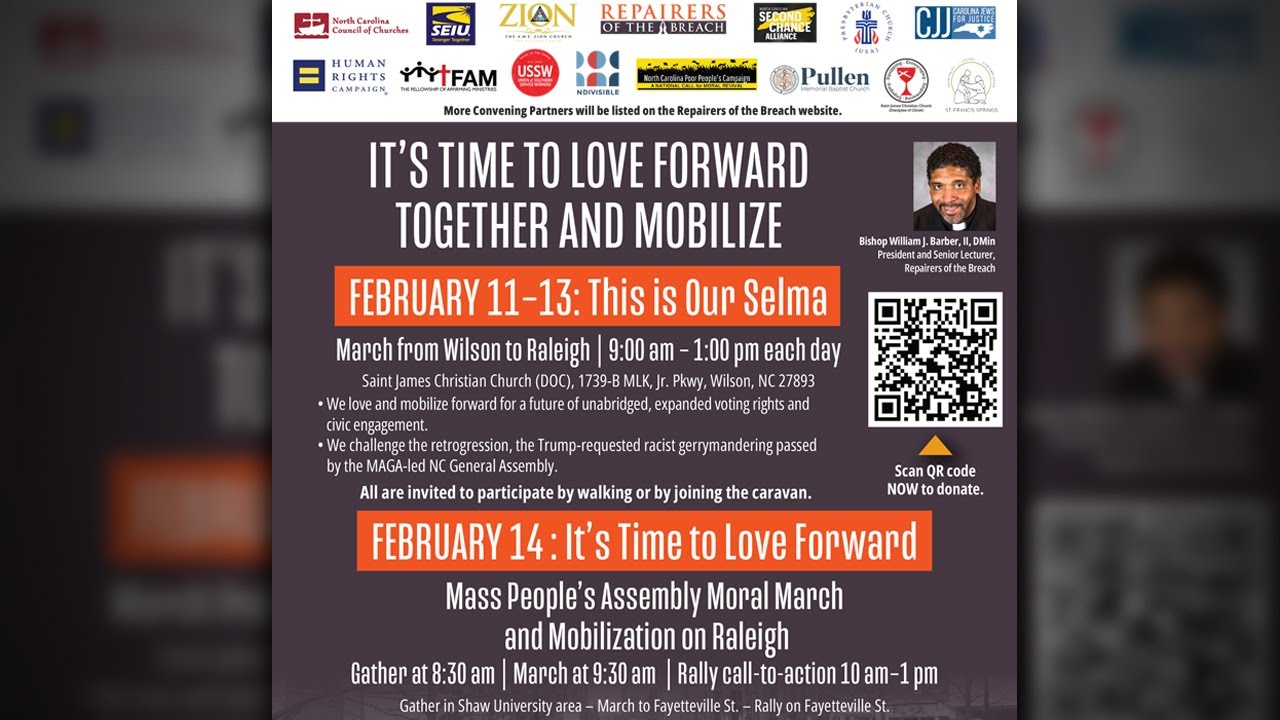
Love Forward Together Mass People’s Assembly & Moral March Mobilization | Day 2
"This episode documents Day 2 of the 'Love Forward Together' march in rural North Carolina, a mobilization against voter disenfranchisement and redistricting, emphasizing community unity and persistent activism."

NC Targets DEI. Trump Blocks Housing Bill. Minority Banks Face New Rules. Kohen Wiley Protests
"This episode exposes how current political actions, from changes in minority bank definitions to attempts to regulate college athlete earnings and block foreign aid, are systematically undermining Black economic power, voting rights, and social justice."