
ITS OVER | Tim Pool Live
YouTube · u0wbZGsD6tU
Quick Read
Summary
Takeaways
- ❖Timcast's security costs for its studio and staff range from $3-5 million annually, a direct result of perceived threats and a prior shooting incident.
- ❖The host argues that the 'assassination of Charlie Kirk' and 'violent leftists murdering people' have dramatically increased the cost of doing business for independent media.
- ❖AI-generated content, produced at massive scale (e.g., 50,000 videos/month), is diluting content algorithms, making it harder for human creators to be discovered.
- ❖Timcast's direct show revenue alone cannot sustain its operations; the Discord community and Rumble Premium are critical for survival.
- ❖A potential solution for Timcast's security and financial issues involves downsizing physical operations and moving to a remote, Zoom-based show format, despite concerns about impact.
- ❖A Medicaid fraud scheme in Minnesota led to a developmentally disabled woman's eviction after her caregiver allegedly took government funds for services but failed to pay rent.
- ❖The host expresses frustration with police enforcing evictions against fraud victims and criticizes the 'boomer generation' for allowing systemic issues like government program fraud.
Insights
1Exorbitant Security Costs Threaten Independent Media Operations
Timcast faces an annual security bill of $3-5 million for 24/7 protection of its large property, multiple buildings, and 30+ employees. This includes hiring licensed, bonded, and armed veterans or former police, costing $150k-200k per person annually. These costs, driven by a prior shooting incident and perceived political violence, have become the principal operational expense, pushing the company into the red.
The host details the need for four security personnel per day for 24-hour coverage, plus weekend relief, totaling approximately five full-time positions. He states, 'reasonable 24-hour protection is going to cost you about a million bucks a year' and for a large building, 'your range of cost for security is going to be three to five million per year for an operation like we got.'
2AI Content Overwhelms Algorithms, Undermining Human Creators
The proliferation of AI-generated videos (e.g., 50,000 per month) in news, documentaries, and other genres is 'spam blasting' and diluting content algorithms. This makes it increasingly difficult for human-produced content, even from established channels like Timcast, to appear in user feeds, leading to decreased viewership and monetization potential. The host notes that even if users don't watch AI content, its sheer volume pushes human content out of sight.
The host explains, 'me doing 20 videos a day can't compete with an AI generated 50 videos per day. And so the end result is you guys probably go, I don't want to watch the video, but at the same time, Tim Cast isn't appearing on on the feed.'
3Decentralized Monetization Fails to Cover Centralized Security Liabilities
In the modern media landscape, content creators like Tim Pool generate tens of millions of views daily across various platforms, but only a fraction of this is directly monetizable. Clips and commentary on other channels (often critical) spread his image widely, increasing his profile and security risk, without generating revenue for his operation. This disconnect means that direct ad revenue from his own content is insufficient to cover the high security costs associated with his public profile.
Pool states, 'there's tens of millions of people who know me and many of whom don't like me and want to kill me or harm me... but I can't monetize that content.' He adds, 'If we did not have Discord members, we would not exist. Period. The amount of money we make directly from the show does not sustain the operation.'
4Medicaid Fraud Leads to Eviction of Vulnerable Individuals
A case in Minnesota revealed a Somali fraudster allegedly exploited a Medicaid program designed to help disabled adults live independently. The fraudster's company, American Home Healthcare LLC, received over $2.2 million in public funds by billing for services not rendered and failing to pay rent for clients, leading to the eviction of a developmentally disabled woman who had consistently paid her share to the fraudulent company.
The host plays a news segment detailing how 'Sky' was evicted after her caregiver, Jamba Muhammad's American Home Healthcare LLC, failed to pay the master lease while still collecting Medicaid funds ($421/day) and the client's rent. Records showed billing for services when clients were out of state or received minimal care.
Bottom Line
The future of high-production independent media may hinge on adopting remote formats or integrating AI to manage content volume and mitigate physical security risks.
This suggests a significant shift away from physical studio spaces and in-person guest interactions, potentially altering the dynamic and quality of content, but ensuring survival.
Develop robust, secure, and engaging remote production platforms specifically for high-profile political commentary or debate shows, enabling broader guest access and reduced overhead.
The rise of AI-generated content creates a 'spam blasting' effect on content algorithms, making traditional organic discovery models unsustainable for human creators.
Content creators must either leverage AI themselves to compete on volume, or cultivate extremely dedicated, mission-driven communities to bypass algorithmic dilution.
Invest in AI tools for content generation and distribution that maintain a human-like quality, or build subscription/membership models that provide direct audience access, bypassing platform algorithms.
Opportunities
Centralized, Secure Media Hubs
Establish large, highly secure studio facilities (like Rumble HQ's initial concept) that can host multiple independent media operations. This centralizes security costs, making 24/7 protection affordable for several creators simultaneously, while also fostering cross-promotion and content collaboration.
AI-Assisted Content Generation for Niche Markets
Develop a service that uses AI to generate high-volume, niche-specific content (e.g., 'what if' history, survival scenarios) for creators. This allows human creators to focus on unique, high-value content while using AI to maintain algorithmic presence and capture broader audiences, competing with the 'spam blasting' effect.
Hybrid Remote/In-Person Production Model
Implement a flexible production model where high-risk or high-profile shows (like Timcast IRL) can easily switch between in-person studio broadcasts and remote (e.g., Zoom) formats. This allows for adaptability in response to security threats or to access a wider range of guests who might not travel to a physical studio.
Key Concepts
Security Through Obscurity
The concept that if an entity's location or operations are unknown or difficult to find, it inherently gains a level of security. Tim Pool suggests this as a potential strategy for Timcast by reducing physical presence and operating remotely, thereby lowering security costs.
Lessons
- Support independent media directly through memberships or subscriptions to help them offset rising operational and security costs, as ad revenue alone is often insufficient.
- Be aware of the increasing volume of AI-generated content online and its potential to dilute search results and algorithmic recommendations for human creators.
- For content creators, explore strategies to diversify revenue streams beyond platform advertising, such as community-driven memberships, to build resilience against market shifts and security liabilities.
Notable Moments
Tim Pool critiques the financial burden of 24/7 security for independent media, citing a prior shooting incident and perceived political violence as primary drivers for millions in annual costs.
This highlights a significant, often overlooked, operational challenge for high-profile independent media, directly impacting their sustainability and content production decisions.
The host details a Medicaid fraud case where a caregiver company allegedly stole over $2.2 million in public funds and client rent, leading to the eviction of a developmentally disabled woman.
This exposes a severe systemic failure in social services, demonstrating how fraud can directly harm vulnerable populations and erode public trust in government programs.
Tim Pool humorously and critically engages with a Flat Earth theory discussion from Joe Rogan's podcast, mocking the guest's claims about the moon being a 'lenticular effect' and satellite images being 'cartoons.'
This segment serves as a lighthearted interlude while also showcasing the host's perspective on extreme conspiracy theories and contrasting it with scientific consensus.
Quotes
"If we did not have Discord members, we would not exist. Period. The amount of money we make directly from the show does not sustain the operation."
"The violence is escalating. This lady got killed. We don't know if it's political or what the motivation was. She was a prosecutor. A lot of people are thinking like this may be related to Epstein stuff, but who knows? It's not like this lady was high-profile or anything."
"Me doing 20 videos a day can't compete with an AI generated 50 videos per day. And so the end result is you guys probably go, I don't want to watch the video, but at the same time, Tim Cast isn't appearing on on the feed. So then you're like out of sight, out of mind basically."
"I don't believe in coincidences and the the scale in which things are are happening right now. I'm going to go ahead and just make the assumption that it's going to largely be somehow politically motivated."
"I can't believe there are people who think the Earth is flat, to be completely honest."
Q&A
Recent Questions
Related Episodes

HOT TOPICS | Trump's America 250 Kicks Off... and It's a TOTAL FLOP!
"Don Lemon and guests dissect the perceived flop of Trump's 'America 250' event, the Supreme Court's controversial asylum ruling, and the fervent, often contradictory, views of Trump supporters."

BREAKING: Trump HUMILIATION Just ROCKED THE WORLD, This is REALLY BAD!
"The host dissects Donald Trump's perceived political blunders, including a 'disastrous' Iran deal, the alleged manipulation of Trump by foreign adversaries, and the panic over leaked Situation Room tapes related to the Epstein scandal."

All-White Jury Convicts Karmelo Anthony. Georgia Election Lawsuit. Tennessee Map Challenge Dropped.
"This episode dissects systemic racial biases in the justice system, politically motivated election law changes, and the dangers of unchecked AI in law enforcement, all while highlighting the ongoing fight for civil rights."
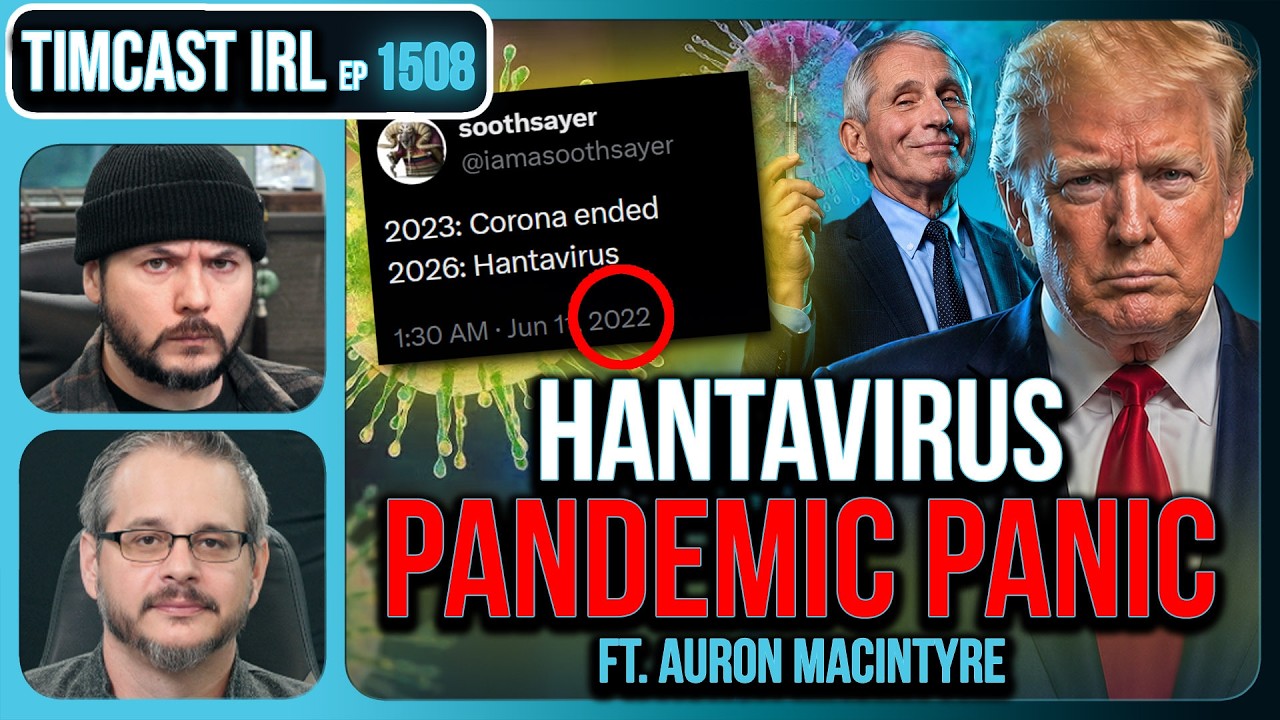
HANTAVIRUS PANDEMIC PANIC, Human To Human Spread Feared | Timcast IRL
"Tim Pool and his guests dismiss the Hantavirus panic as media desperation, pivot to discussing escalating political polarization, the rise of technocracy, and the weaponization of social issues."