
SGA's STATEMENT Game MYSTIFIES Gil's Arena
YouTube · v4FaXAbNhFk
Quick Read
Summary
Takeaways
- ❖OKC secured their ninth consecutive win after a loss, demonstrating resilience and effective adjustments.
- ❖Isaiah Hartenstein's physical defense on Victor Wembanyama significantly reduced Wembanyama's paint scoring from 26 points in Game 1 to 10 in Game 2.
- ❖The Thunder's bench outscored the Spurs' bench by 32 points, contributing 57 points and tying a franchise record.
- ❖Stephon Castle's 20 turnovers in two games set an NBA playoff record, highlighting a major weakness for the Spurs.
- ❖Victor Wembanyama's off-season training included meditation, nighttime hikes, and martial arts at a Shaolin Temple, aimed at controlling his center of gravity and preparing for NBA physicality.
- ❖The panel debated whether Jaylen Brown's direct confrontation with Stephen A. Smith was an effective way for athletes to control their narrative or an unnecessary distraction.
Insights
1OKC's Defensive Adjustment and Bench Dominance in Game 2
The Oklahoma City Thunder made a critical defensive adjustment in Game 2, tasking Isaiah Hartenstein with guarding Victor Wembanyama. Hartenstein's physical, 'borderline dirty' play frustrated Wembanyama, limiting his paint scoring and forcing him to take more three-pointers. This strategy, combined with a strong performance from OKC's bench, which contributed 57 points (a franchise record-tying 32-point advantage over the Spurs' bench), was pivotal in evening the series.
Hartenstein guarded Wembanyama for 47 possessions, reducing his paint scoring from 26 points in Game 1 to 10 in Game 2. OKC's bench outscored the Spurs' bench 57 to 25. SGA delivered 30 points and 9 assists with only 1 turnover. The Thunder won 27 points off 21 Spurs turnovers.
2Spurs' Turnover Crisis Led by Stephon Castle
The San Antonio Spurs suffered from severe ball security issues, particularly with Stephon Castle, who recorded an NBA playoff record 20 turnovers in two games. Panelists attributed this to Castle's inexperience as a primary ball-handler and OKC's aggressive, deflection-heavy defense. These turnovers frequently led to easy points for the Thunder, undermining the Spurs' offensive efforts.
Stephon Castle had 20 turnovers in two games, compared to 16 total in six games against the Timberwolves. The Spurs averaged 22 turnovers per game in the series, resulting in a -28 point differential from turnovers for San Antonio. OKC scored 27 points off 21 Spurs turnovers.
3Victor Wembanyama's Unconventional Training for NBA Readiness
Victor Wembanyama underwent an intensive, unconventional training regimen during the off-season, including a nearly two-week retreat at a Shaolin Temple in China. This training involved meditation, nighttime hikes, forest runs, and martial arts focused on controlling his center of gravity. This holistic approach, combined with mentorship from NBA legends, aimed to prepare him mentally and physically for the rigors and physicality of the NBA.
Wembanyama's training included constant meditation, nighttime hikes in total darkness, running through forests, a martial arts regimen, and a 5-hour hike while dribbling a basketball. His agent also consulted Rob Pelinka on Kobe Bryant's training and Wembanyama worked with Hakeem Olajuwon and Kevin Garnett.
4Jaylen Brown vs. Stephen A. Smith: Media Accountability and Player Voice
A long-standing feud between Jaylen Brown and Stephen A. Smith intensified, sparking a debate among the panel about media accountability and an athlete's right to control their narrative. Brown directly challenged Smith's comments on his marketability and his post-season remarks. Panelists argued over whether Smith's initial comments constituted 'throwing rocks' and if Brown's direct, public response was an effective or detrimental strategy for an athlete.
Stephen A. Smith questioned Brown's marketability and criticized his 'favorite season' comment after a playoff loss. Brown responded by calling him 'Steven A, Steven B, and Steven C' and directly addressing his comments on a Twitch stream. The panel debated if Smith was 'throwing rocks and hiding his hands' and if Brown's response was 'playing stupid games' or asserting his voice.
Bottom Line
The effectiveness of 'borderline dirty' playoff defense, as seen with Hartenstein on Wembanyama, suggests that referees often allow more physical play in high-stakes games, creating a strategic advantage for teams willing to push boundaries.
Teams can leverage this leniency to disrupt star players, even if it means risking minor fouls, as the benefit of taking an opponent out of rhythm often outweighs the penalty.
Coaches should scout referee tendencies and train players to be maximally physical without drawing consistent whistles, especially against dominant offensive forces.
The Spurs' coaching staff's failure to adjust to Stephon Castle's high turnover rate, despite having other point guard options like Mclaughlin, indicates a potential strategic inflexibility or misjudgment of player roles in critical moments.
Over-reliance on a young player in an unfamiliar primary ball-handling role, without adequate coaching adjustments or alternative personnel, can be catastrophic in playoff scenarios.
Teams should prioritize developing multiple ball-handlers or have clear contingency plans for when primary playmakers are unavailable or struggling, ensuring offensive stability.
Lessons
- Coaches should empower role players to step up defensively against star opponents, even if it requires a 'muck it up' physical approach, as long as it stays within the bounds of what referees allow.
- Teams must address ball-handling weaknesses immediately in high-stakes games, either by adjusting player roles, bringing in more experienced personnel, or implementing simpler offensive sets to reduce turnovers.
- Athletes should carefully consider the timing and platform for addressing media criticism, understanding that post-loss comments or direct confrontations can be amplified and interpreted in ways that may not serve their best interests.
Quotes
"I think they play a little better without him. I think the ball moves a little better. Um, more guys are getting opportunities and shots and I think that's what helps uh them because JDub he plays in the paint and so does SGA. So if you're the Spurs all you got to do is just pack the paint."
"I never understood how somebody can tell someone else what's disrespectful to them. How can you tell me what's disrespectful to me?"
"When the National Basketball Associate is writing your [expletive] check, freedom of speech, you cannot just say, 'I got my check.'"
Q&A
Recent Questions
Related Episodes

The NBA Playoff's WILD Weekend LIGHTS UP Gil's Arena
"NBA analysts debate referee bias, player injuries, and coaching adjustments impacting the Western Conference Finals, while celebrating the Knicks' historic sweep to the Eastern Conference Finals and Jalen Brunson's leadership."
Wemby & The Spurs PROVED They're Ready For The Moment
"The San Antonio Spurs, led by Victor Wembanyama's adjusted play and the team's resilience, secured a critical Game 3 victory against the New York Knicks, who succumbed to the immense pressure of playing at Madison Square Garden."
The REAL Reason The OKC Thunder Won Game 2
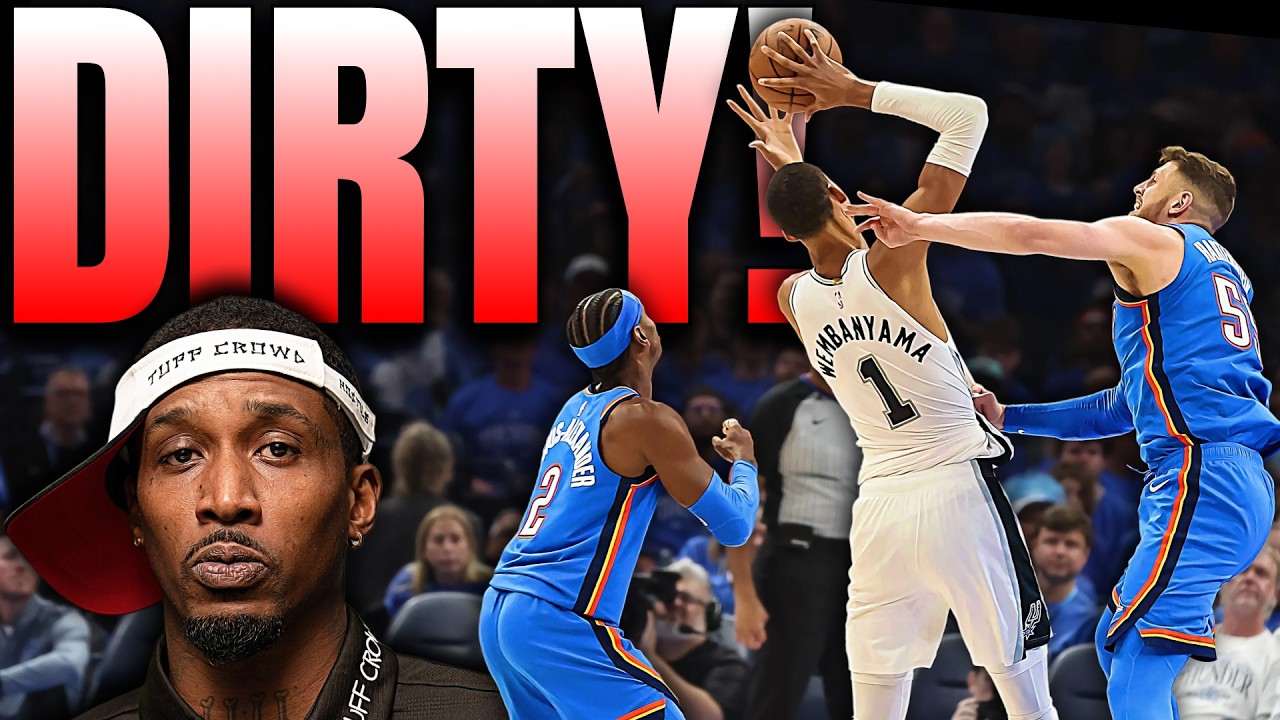
"OKC's Game 2 victory over the Spurs was driven by Isaiah Hartenstein's aggressive defense on Victor Wembanyama and the Spurs' critical turnover issues, despite controversial officiating and a perceived lack of offensive strategy from San Antonio."

TATUM'S RETURN, TRAE YOUNG'S DEBUT IN DC & BEING A BASKETBALL COACH & A PIMP IS WILD | S8 EP40
"The hosts debate Jason Tatum's return impact, Trae Young's future with the Wizards and a potential Houston trade, and the shocking case of a college basketball coach moonlighting as a pimp."