
Nuclear Physicist Goes Public with NEW Evidence on Lost Ancient Tech | Max Zamilov
YouTube · vdbDbIBI4-Y
Quick Read
Summary
Takeaways
- ❖Max Zamilov's paper, published in Nature, concludes there are no precise ancient Egyptian vases; all genuine ones are handmade.
- ❖His research found that museum-held ancient vases are indistinguishable in quality from modern handmade Egyptian tourist vessels.
- ❖"Precise" vases from private collections are statistically identical to modern machine-made vases bought on eBay.
- ❖Ancient Egyptians rarely used granite for vases; only one Aswan granite vase is documented by Barbara Aston, contrasting with the prevalence of granite in 'precise' private collections.
- ❖The theory that Flinders Petrie gave precise artifacts to private collectors is unsubstantiated; museum records show distribution to other institutions.
- ❖Ancient vase manufacturing likely involved initial chiseling, followed by rotation in an abrasive sand slurry for outer shaping, and a rotating boring bit for hollowing.
- ❖The famous Petri core #7, often cited as evidence of advanced machining, exhibits tapering and discontinuous grooves consistent with primitive copper tube drilling with abrasive grit.
- ❖Zamilov argues that ancient people were ingenious in automating difficult tasks with available low technology, like water-powered mills for stone grinding.
- ❖He expresses skepticism about cold fusion, citing flaws in radiation detection measurements and lack of replicable results over 40 years.
- ❖Zamilov advocates for the release of raw data (telemetry, video footage, sensor data) for UAPs to enable scientific study, rather than relying on unsubstantiated claims or government narratives.
- ❖He plans a new project, 'Scan Civilization,' to 3D scan Peruvian megaliths and other ancient sites to generate publicly available, analyzable data sets.
Opportunities
Custom Ancient-Style Vases for Research Funding
Offer custom-made, high-quality granite or other stone vases, replicating ancient designs using modern machining techniques, with proceeds funding scientific research into ancient technologies and artifacts. This leverages public interest in ancient mysteries to generate research capital.
Scan Civilization Project
Establish a project (e.g., 'Scan Civilization') to conduct high-quality 3D scanning and material analysis of ancient megaliths and artifacts worldwide, making all raw data publicly available for independent scientific analysis. This creates a valuable open-source database for archaeology and related fields.
Key Concepts
Scientific Method
The process of forming a hypothesis, collecting empirical data (3D scans, material analysis), testing the hypothesis against the data, and being willing to change one's opinion when facts demand it, even if it contradicts a previously held belief or popular narrative.
Occam's Razor
When faced with competing hypotheses, the one that makes the fewest assumptions is usually the correct one. Applied to UAPs, Zamilov suggests government deception is a more plausible explanation than aliens, given known patterns of government behavior.
Plank's Principle
Science makes progress one funeral at a time, referring to the resistance of established scientific communities to new ideas, especially those that challenge the status quo or threaten funding.
Lessons
- Approach claims about ancient high technology with scientific skepticism, demanding empirical data and rigorous analysis rather than relying on visual impressions or unsubstantiated narratives.
- Support initiatives focused on collecting and openly sharing high-quality 3D scans and material analyses of ancient artifacts, as this data is crucial for advancing our understanding of the past.
- Recognize and challenge confirmation bias in research, being prepared to adjust beliefs when confronted with contradictory evidence, as demonstrated by Zamilov's own shift in perspective on ancient vases.
Notable Moments
Max Zamilov's personal shift in belief regarding ancient vases, moving from a 'lost high-tech' proponent to a scientific skeptic after his data contradicted his initial hypothesis.
This highlights the core principle of the scientific method: the willingness to change one's opinion when confronted with overwhelming evidence, even if it's personally uncomfortable or contradicts popular narratives.
The discovery of a 5,300-year-old intact bow drill in a museum, which researchers initially misidentified, showcasing how overlooked artifacts can rewrite historical understanding of technology.
This illustrates that ancient ingenuity often involved clever application of simple principles rather than 'high-tech' solutions, and that existing museum collections may hold undiscovered insights.
The revelation of the Barabar Caves in India, featuring mirror-polished granite walls and precise symmetrical designs from before 200 BCE, which Zamilov identifies as a truly fascinating and unexplained ancient mystery requiring rigorous data analysis.
This moment pivots from debunking to highlighting genuine anomalies, demonstrating Zamilov's commitment to scientific inquiry wherever the evidence leads, rather than a blanket dismissal of all ancient mysteries.
Quotes
"You got to be able to change your opinion when facts demand it."
"The biggest surprise to me was that both clouds are like virtually indistinguishable, you know, they like map on top of another. So which means that the quality of the Petri vessels I, you know, cannot distinguish from the quality of the handmade vessels in uh that were made by hand in Egypt."
"The precise vases you know form a separate cluster, a separate cluster of very low values... But when you plot, you know, precise vases from Met Bell's collection or from, you know, some other people I've met and befriended, it's a different, you know, tightly packed cluster of of low concentricity error and low, you know, roundness error values that's very distinct."
"When I analyzed the in a modern you know eBay vases you know they formed the same cluster as you know the vases precise vases from Matt Bell's collection."
"Out of like 200 or 300 she got permission to take stone samples that she studied under like electron microscope to figure out the stone type and where that stone came from... How many granite vases are in that catalog of 1,000? One."
"Plank's principle: Science makes progress one funeral at a time."
"If there is some exotic process that allows you to do fusion without radiation, it will never be perfect. There will be, you know, some maybe just not the stupendous amount of radiation like from a conventional reactor that's going to kill you, you know, if you look into it, but it will be, you know, some that you should be able to detect. And if you got none, you know, to me it's telling you, it's telling clearly you have like nothing going on regardless of what you claim."
"It's far easier to believe it was a remnant of an ancient, you know, nuclear reactor."
"I think the purpose of life of every good person is to fight evil. That's the only you know true purpose that we have in our life. There is so much evil all around. We all have to fight it collectively or else it will proliferate and evil starts unfortunately with lying."
Q&A
Recent Questions
Related Episodes

MIT Physicist: DARPA, Warp Drives, Supergravity & Aliens on Jupiter | Jim Gates
"MIT Physicist Jim Gates details his journey from a four-year-old inspired by sci-fi to a leading researcher in supersymmetry, revealing how fundamental physics equations contain computer error correction codes and discussing the nature of scientific genius, AI, and the future of space travel."

Crooners Welcome | This Past Weekend w/ Theo Von #664
"Theo Von shares raw, unfiltered opinions on life's 'greasy' moments, from his unexpected Stagecoach performance as a 'crooner' to his strong stance against AI data centers and candid advice on relationships and fatherhood."

OCCUPY BAAL STREET: Iran, Albania, And The TPUSA Takeover. | Ep 347
"Candace Owens exposes alleged globalist plots, linking Ivanka Trump's Albanian island 'discovery' to Rothschild family control of strategic waterways and accusing US foreign policy of serving these interests, while also scrutinizing Turning Point USA's handling of Charlie Kirk's succession."
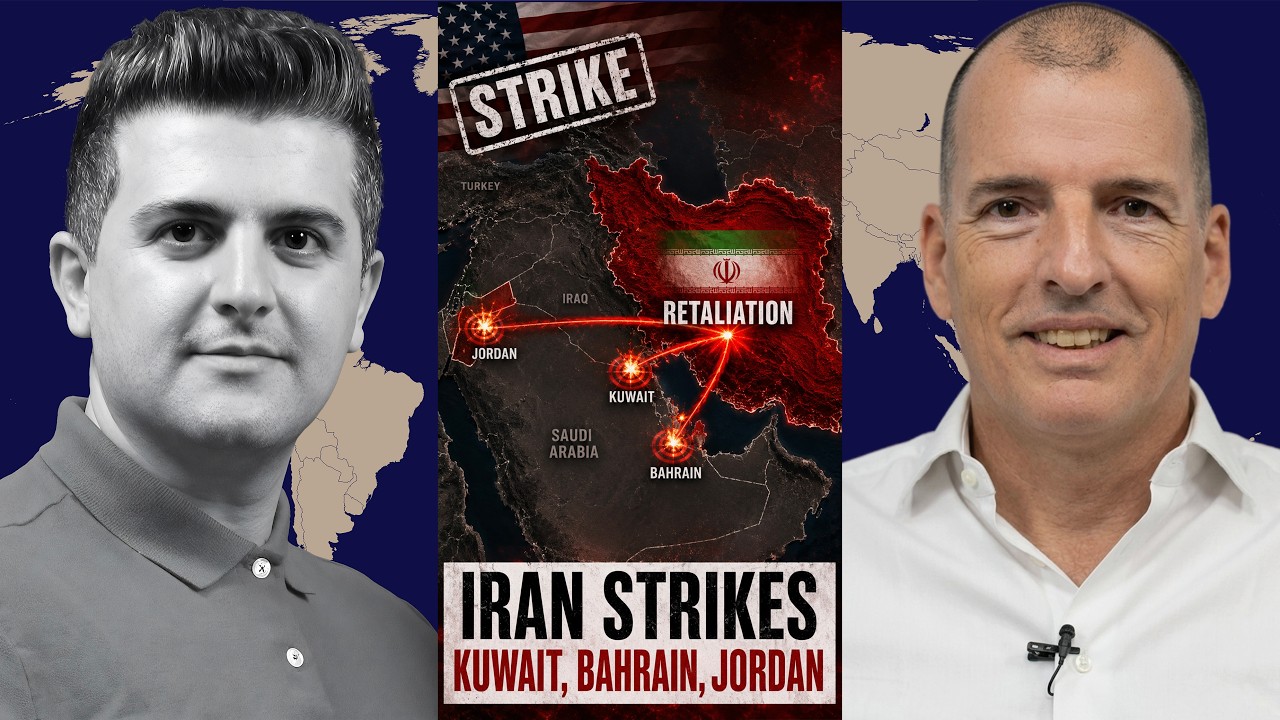
Alex Krainer: US STRIKES Iran – Iran RETALIATES Against Kuwait, Bahrain & Jordan!
"Amidst escalating US-Iran conflict and Iranian retaliation against regional US allies, this episode argues that US foreign policy is deeply controlled by an 'Anglo-Zionist conspiracy' led by the Rothschild banking dynasty, prioritizing Israeli interests over American ones."