CIA SPY ISSUES WARNING SIGNS OF AMERICA'S DOWNFALL (DO THIS NOW!)
YouTube · w68AejZ8caM
Quick Read
Summary
Takeaways
- ❖Designating drug cartels as Foreign Terrorist Organizations (FTOs) enables military-style responses, similar to counter-terrorism operations.
- ❖The US military is well-suited to interdict fast boats used by cartels, viewing them as clear targets with no civilian collateral.
- ❖Mexico's government is seen as compromised by cartels, akin to Pakistan's historical struggle with Islamic extremists, suggesting covert US action (Title 50) might be a necessary approach.
- ❖El Salvador's drastic gang crackdown, despite human rights concerns, is presented as an effective model for rapidly improving security.
- ❖Social media algorithms are blamed for amplifying political fringes and normalizing hateful discourse, contributing to societal polarization.
- ❖The 'woke mind virus' and Marxist ideology are identified as the biggest internal threats to America, requiring active resistance from those who 'know better.'
- ❖The release of the Epstein files is viewed as a deliberate distraction from more pressing national issues like government shutdowns or state mismanagement.
- ❖The US justice system is criticized for prioritizing 'finality over justice' through mandatory minimums and plea bargaining, leading to disproportionate sentences.
Insights
1Aggressive Stance on Drug Cartels as National Security Threat
The guest, a former CIA operative, supports President Trump's approach to drug cartels, viewing them as a national security threat rather than a mere law enforcement issue. This reclassification justifies military-style interdiction, such as blowing up drug boats, and covert operations (Title 50) in sovereign nations like Mexico, bypassing traditional legal and diplomatic hurdles.
The guest states, 'We had 20 years of doing this. We had to find people in places that were tough to find. Now you can do it over lunch and then be back home... President Trump said? They're faster than our ships, but not that our not faster than our missiles.' (-) and 'designating the cartels as a foreign terrorist organization is a little bit akin to the war that we were waging in Pakistan.' ()
2Trade-off Between Liberty and Security
The hosts discuss how countries like El Salvador and Dubai achieve high levels of security and low crime rates through authoritarian measures that significantly curtail individual liberties. They present El Salvador's mass imprisonment of gang members and Dubai's strict laws as effective, albeit controversial, models for maintaining order.
The host describes El Salvador's approach: 'We are going to go and round up every single gang member or associate of gang members and pretty much anybody with a face tattoo or a neck tattoo. We're going to round you up, stick you in prison... But that's one of the safest countries in the world right now.' () and the guest on Dubai: 'You could walk up, you could get up from the bar, leave your wallet sitting on the bar, walk to the bathroom, come back, your wallet's still going to be there.' ()
3Refutation of 'Can't Kill Your Way Out of It' Doctrine
The guest directly challenges the common counter-terrorism adage that 'you can't kill your way out of it,' arguing that sustained, aggressive elimination of adversaries, as seen in the reduction of car bombings post-9/11, proves otherwise. This applies to both terrorist organizations and drug cartels.
The guest states, 'Look, we used to talk about in the counterterrorism realm, you can't kill your way out of it. Well, as it turns out, but kind of can, right?' and 'As it turns out, you kill enough of them, they can't make them fast enough.' ()
4Ideological Threats and Political Polarization in the US
The hosts identify Marxism, the 'woke mind virus,' and extreme political polarization (amplified by social media) as the biggest threats to America. They argue that a significant portion of the population has been influenced by 'rubbish' ideologies that distort common sense, leading to a dangerous societal rift and the normalization of hateful rhetoric.
The guest asserts, 'The biggest threat to America? Okay. So, for me, it's a long arm of Marxism. It's ideology that has been pumped down us for the last 70, 80, 90 years. It's the the woke mind virus that has been infected our universities...' (:00) and 'social media has driven us to farther extremes... the algorithms have amplified the fringes on either side.' ()
Bottom Line
The Mexican government's public statements against US military intervention (Title 10) may be a tacit request for covert US intelligence operations (Title 50) to address cartel power without public political fallout.
This suggests a complex, unspoken understanding between nations where public denouncements mask private cooperation, allowing for 'plausible deniability' in sensitive cross-border security issues.
For intelligence agencies, this implies a continued mandate and potential for expanded covert operations in regions where overt military action is politically unfeasible but intervention is desired by local authorities.
Legalizing and regulating certain drugs, coupled with aggressive supply-side interdiction, could significantly undermine cartel business models by removing their market advantage and providing safer, taxed alternatives.
This dual approach could simultaneously reduce cartel power and generate revenue for public services like drug rehabilitation, offering a more comprehensive solution than either strategy alone.
Policymakers could explore pilot programs for regulated drug markets, carefully studying economic and social impacts, and reallocate law enforcement resources from user prosecution to cartel disruption.
Opportunities
Private Intelligence and Security Services
Offering services to individuals and organizations to understand and mitigate online risks, including removing personal information from the internet. This caters to a growing demand for digital privacy and security in a hyper-connected world.
Regulated Drug Market Infrastructure
Developing and managing systems for the legal production, distribution, and taxation of currently illicit substances (e.g., beyond marijuana). This would involve pharmaceutical-grade production, secure supply chains, and retail models, potentially managed by established commercial companies like Coca-Cola or Anheuser-Busch, rather than pharmaceutical giants, to ensure reasonable pricing.
Key Concepts
National Security vs. Law Enforcement Paradigm Shift
Reclassifying drug trafficking as a national security issue, rather than purely a law enforcement one, allows for military-grade responses and more aggressive tactics, bypassing traditional legal constraints and due process concerns.
Security-Liberty Trade-off
The principle that societies can achieve significantly higher levels of safety and order by sacrificing individual liberties and implementing strict, often brutal, enforcement mechanisms, as exemplified by El Salvador's gang crackdown or Dubai's legal system.
Pottery Barn Rule of Foreign Policy
The principle that if a nation intervenes militarily and 'breaks' another country's government or stability, it then 'owns' the responsibility for managing and rebuilding that nation, as discussed in the context of invading Mexico or Iraq.
Weaponization of Institutions
The concept that government agencies (like the DOJ) or media outlets can be manipulated or used to persecute political opponents or control public narratives, rather than serving their intended impartial functions.
Lessons
- Challenge the 'can't kill your way out of it' mindset when confronting organized crime or terrorism, considering whether decisive, even aggressive, action is necessary and effective.
- Evaluate the trade-offs between security and liberty in societal governance, drawing lessons from diverse global models like El Salvador and Dubai, and consider their applicability to domestic issues.
- Actively resist the 'woke mind virus' and ideological extremism by articulating and defending 'common sense' principles, rather than passively allowing divisive narratives to dominate public discourse.
Quotes
"They're faster than our ships, but not faster than our missiles."
"If you get too into the weeds and you you you overthink a problem, uh there's always a reason why not to do something."
"As it turns out, you kill enough of them, they can't make them fast enough."
"It's not a matter of can we, it's a matter of will we."
"The biggest threat is people like us not having the courage to stand up for what we know to be right."
Q&A
Recent Questions
Related Episodes

🚨 THEY F*CKED AROUND FOR THE LAST TIME 😭😭😭
"This episode unleashes a torrent of highly opinionated commentary on the US-Iran deal, Israel's role, and a scathing critique of 'leftist' policies and immigration, particularly highlighting the UK grooming gang report as evidence of Western societal decay."
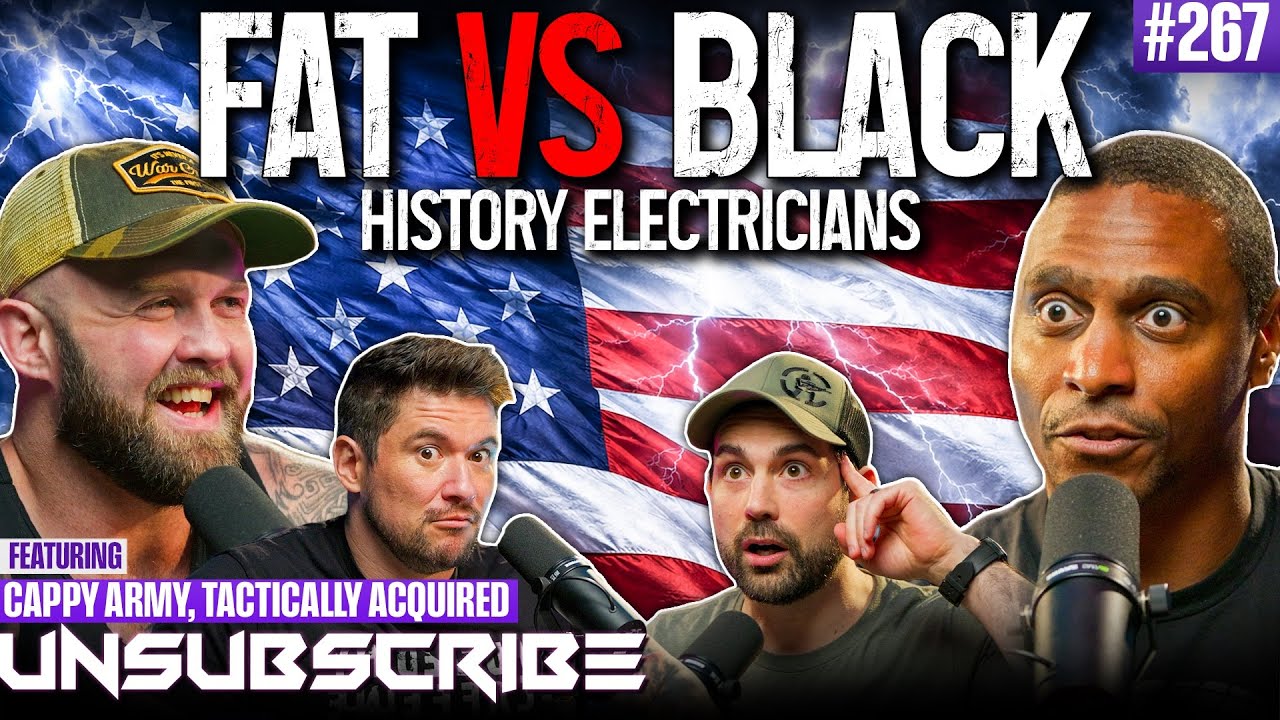
The Fat Electrician Vs Tactically Acquired | Unsubscribe Podcast 267
"This episode features military content creators discussing current geopolitical hotspots, advanced weaponry, and the surprising psychological warfare tactics of modern conflict, alongside their personal journeys building online communities."
🚨 THEY… F*CKING... FOUND… OUT… 😂😂😂
"The host delivers a fiery, unfiltered commentary on global and domestic political events, framing them as a battle between a 'collapsing globalist order' and a 'resurgent new right' that prioritizes national sovereignty and traditional Western values."

🚨 LEFTISTS ARE F*CKING SEETHING 😂😂😂
"The host aggressively celebrates perceived 'wins' for the right-wing, from global conflicts and domestic politics to cultural shifts, framing them as a 'humiliation' for the 'leftist world order' and a testament to Donald Trump's influence."