Joe Rogan Experience #2518 - Tim Dillon
YouTube · wTdqkloiSvk
Quick Read
Summary
Takeaways
- ❖Los Angeles is experiencing a decline similar to Detroit, driven by the entertainment industry's exodus due to high taxes and regulations.
- ❖European nations, particularly the UK, are seeing alarming suppression of free speech, with arrests for social media posts, alongside significant cultural tensions from rapid immigration.
- ❖American consumerism, characterized by massive stores like Bucky's and Costco, is alien to Europeans who buy food for days, not weeks, and have smaller refrigerators.
- ❖AI is poised to create immense societal disruption, leading to widespread joblessness and wealth inequality, potentially uniting people against surveillance and for autonomy.
- ❖The traditional role of family and community is being replaced by state, corporate, and ideological affiliations, leading to a more individualistic and often selfish society.
- ❖Mainstream media outlets are perceived as sacrificing credibility by pushing politically motivated narratives, contributing to a widespread distrust in institutions.
- ❖The 'ends justify the means' political approach weaponizes empathy and ignores collateral damage in pursuit of ideological goals, such as dismantling 'patriarchal white male-dominated society'.
- ❖The US government's involvement in Middle Eastern conflicts and its relationship with Israel are viewed as driven by powerful donors, often at odds with American interests and public sentiment.
Insights
1LA's Decline: From Hollywood to 'Hollywood the Sequel'
Los Angeles is experiencing a significant decline, likened to Detroit, primarily because its core industry—show business—has been overtaxed and overregulated, driving production to other states and countries. This shift has reduced LA's cultural value and economic prominence, leaving it feeling like a 'museum' of its former self. Governor Gavin Newsom's defense of California's GDP is seen as arrogance, ignoring the exodus of people and corporations.
Rogan states, 'The industry dried up. So the big industry in Hollywood... was always show business. And that's... They barely make movies anymore.' Dillon adds, 'They overtaxed and overregulated their biggest industry to other states and other countries.'
2Cultural Clash: American Consumerism vs. European Habits
American consumption habits, characterized by massive stores like Bucky's and Costco, bulk buying, and large refrigerators, are completely alien to Europeans. Europeans typically buy food for only a few days and have smaller living spaces, leading to a perception that Americans are 'preppers.' This difference extends to food quality, with American food containing more chemicals, leading Europeans to get sick when visiting the US.
Dillon notes, 'Costco's are alien to them. The idea that you could buy mayonnaise in a bucket... They don't do that there. They buy stuff for like the week.' Rogan adds, 'They don't have refrigerators like we have, but also they don't have the same amount of preservatives in their food, which is why it's not poison.'
3Erosion of Free Speech and Cultural Tensions in the UK
Freedom of speech in the UK has been severely suppressed, with people arrested for retweets and likes, particularly concerning immigration. This policing of 'certain words' and 'ways of speaking' is framed as an 'incitement to violence,' even for legal social media posts. Rapid immigration, often driven by EU policy to artificially boost economies, has created cultural tensions, especially outside London, due to stagnant economies and vastly different cultural values concerning women's rights, LGBTQ+ rights, and freedom of speech.
Rogan highlights, 'The amount of arrests that people get over there for retweets and likes.' Dillon explains, 'There is a cultural tension there between... immigrants, migrants coming in and this the very established society.'
4AI's Transformative and Potentially Destructive Power
Artificial intelligence is seen as the next major societal battleground, potentially uniting people against issues of surveillance and privacy. However, it also poses a significant threat, capable of disrupting economies, causing widespread joblessness, and exacerbating wealth inequality. The goal of creating a 'digital god' controlled by a select few is viewed with deep suspicion, suggesting a future where autonomy is traded for perceived peace and order.
Rogan states, 'The next fight seems to be about surveillance, privacy, your your own rights.' Dillon adds, 'AI is going to disrupt the economy to a point where like we're not going to have people owning homes and cars and things like that.'
5The Decline of Family and Rise of Ideology
In America, the traditional importance of family has significantly diminished, replaced by individual pursuits and ideological affiliations. This shift is reinforced by societal trends, including therapy that enables selfishness, leading to a lack of foundational core in many lives. In contrast, other cultures, like India, maintain strong family bonds that even deter drug use due to fear of disgracing relatives, highlighting America's unique cultural trajectory towards state and corporate dependence.
Dillon observes, 'Family in America almost means like nothing. Like we've we've kind of we've everything's such an individual pursuit that family means nothing.' He recounts a therapist advising against attending a cousin's wedding if it wouldn't make him happy, illustrating the prioritization of individual feelings over family obligations.
6Media Manipulation and Distrust in Institutions
Mainstream media outlets are perceived as actively manipulating narratives and sacrificing credibility for political agendas. The example of CBS News allegedly instructing a reporter to insert falsehoods into a story about a protest, contradicting video evidence, is cited as a prime example. This behavior, coupled with questionable hiring decisions (like a sobbing anchor), contributes to a widespread public distrust, particularly among an older, less 'online savvy' demographic who are less likely to verify information.
Rogan references a CBS report where 'the falsehood CBS asked for was to describe protester Renee Good as driving her car toward the officer who killed her, which Pelley said contradicts video evidence of the event.' Dillon remarks on the CBS Evening News anchor crying about his drug dealer father, questioning his suitability for the role.
7The 'Ends Justify the Means' Political Strategy
A pervasive political approach prioritizes an 'end goal,' such as dismantling a 'patriarchal white male-dominated society,' over the ethical implications of the 'means' used to achieve it. This strategy often involves ignoring the rights of certain groups, weaponizing empathy, and suppressing dissent by labeling critics as racist or anti-immigrant. This approach is seen as a deliberate design by a small group concerned primarily with economic matters and global governance, rather than national cultures or individual sovereignty.
Dillon states, 'If the goal is to just eliminate... this patriarchal white male-dominated society... a lot of people ignore what happens in the middle.' He adds, 'They shut down those conversations. And I think it's because a lot of people believe more in a global world.'
Bottom Line
The current globalist agenda, driven by economic concerns, seeks to artificially grow economies through migration while eroding national sovereignty and cultural identities, leading to significant social unrest.
This top-down approach prioritizes economic metrics over the well-being and cultural cohesion of long-standing national populations, creating a volatile environment where citizens feel disenfranchised and their concerns are dismissed as 'racist' or 'ethnocentric.'
For political movements, there's an opportunity to gain traction by explicitly championing national sovereignty, cultural preservation, and the economic well-being of existing citizens, offering a clear alternative to globalist policies.
The 'QAnon' phenomenon, despite its perceived absurdity, represents an extreme dedication to a narrative, reflecting a deep human need for purpose and belonging in a world where traditional institutions have lost credibility.
This commitment highlights the power of belief systems, even unconventional ones, to fill a void left by declining trust in government, media, and traditional community structures. It suggests that people are desperate for 'the plan' to make sense of chaos, regardless of its factual basis.
Understanding the psychological drivers behind such movements could inform strategies for building genuine, purpose-driven communities and restoring trust, rather than simply dismissing or demonizing these groups.
The US government's alleged use of advanced, possibly quantum-based, technology to track individuals (e.g., 'quantum magnetometry' for heartbeats) suggests a level of surveillance capability far beyond public knowledge.
This raises profound questions about privacy, civil liberties, and the true extent of government control. If such technology exists, the narrative around its deployment (e.g., finding a downed pilot) could be a cover for broader, undisclosed surveillance capabilities, creating a 'China-like' social credit system in the US.
Advocacy for transparency in government technological development and robust legal frameworks to protect digital and physical privacy will become increasingly critical as these capabilities advance.
Notable Moments
Discussion of 'General Butt Naked,' a Liberian warlord who fought naked and engaged in cannibalism for protection, later becoming a Christian preacher.
This bizarre story is used to illustrate the extreme forms of chaos that exist in other parts of the world, contrasting it with the 'privileged bubbles' of Western society, and questioning the ease with which individuals can seemingly 'convert' from extreme barbarism.
The White House trolling QAnon with a post about 'Q' (quantum computing) and then clarifying 'by Q we mean quantum.'
This moment highlights the government's awareness of and willingness to engage with fringe online communities, blurring the lines between official communication and internet culture, and underscoring the perceived 'fakeness' of political discourse.
The CBS Evening News anchor, Tony Dokoupil, crying on air while discussing his childhood and his father being a drug dealer.
This is presented as an example of the decline of credible journalism and the prioritization of emotional, personal narratives over objective reporting, further eroding public trust in mainstream media figures and institutions.
Quotes
"When you see somebody with a cigarette, it always looks good. You never say to yourself like that person's going to lose control of their life."
"That arrogance of like this is the best place in the world. Everyone's going to come here no matter what. That that's the Gavin Newsom attitude whenever he defends California."
"A big part of LA's problem is there's a bunch of people that are in the empathy industry."
"The problem is going to be if you can't demand, if you if you don't have a voice anymore. And this is the potential nightmare scenario that we're seeing play out slowly in England. So in England their freedom of speech has been suppressed to an alarming point."
"The ends justify the means approach of politics seems to be what we're doing right now, where is basically if the goal is to just eliminate... this patriarchal white male-dominated society, a lot of people ignore what happens in the middle."
"My worry is that in the guise of fighting China, we're going to become China."
Q&A
Recent Questions
Related Episodes

HANTAVIRUS PANDEMIC PANIC, Human To Human Spread Feared | Timcast IRL
"Tim Pool and his guests dismiss the Hantavirus panic as media desperation, pivot to discussing escalating political polarization, the rise of technocracy, and the weaponization of social issues."

Iran Update: Israel’s Newest Bombing Campaign, the Oncoming War With China and How to Avoid It
"Colonel Wilerson reveals how the US and Israel are actively bombing China's strategic infrastructure in Iran, escalating a covert economic war that Beijing intends to win without direct military conflict by dismantling the dollar's global dominance."

🚨 THEY F*CKED AROUND FOR THE LAST TIME 😭😭😭
"This episode unleashes a torrent of highly opinionated commentary on the US-Iran deal, Israel's role, and a scathing critique of 'leftist' policies and immigration, particularly highlighting the UK grooming gang report as evidence of Western societal decay."
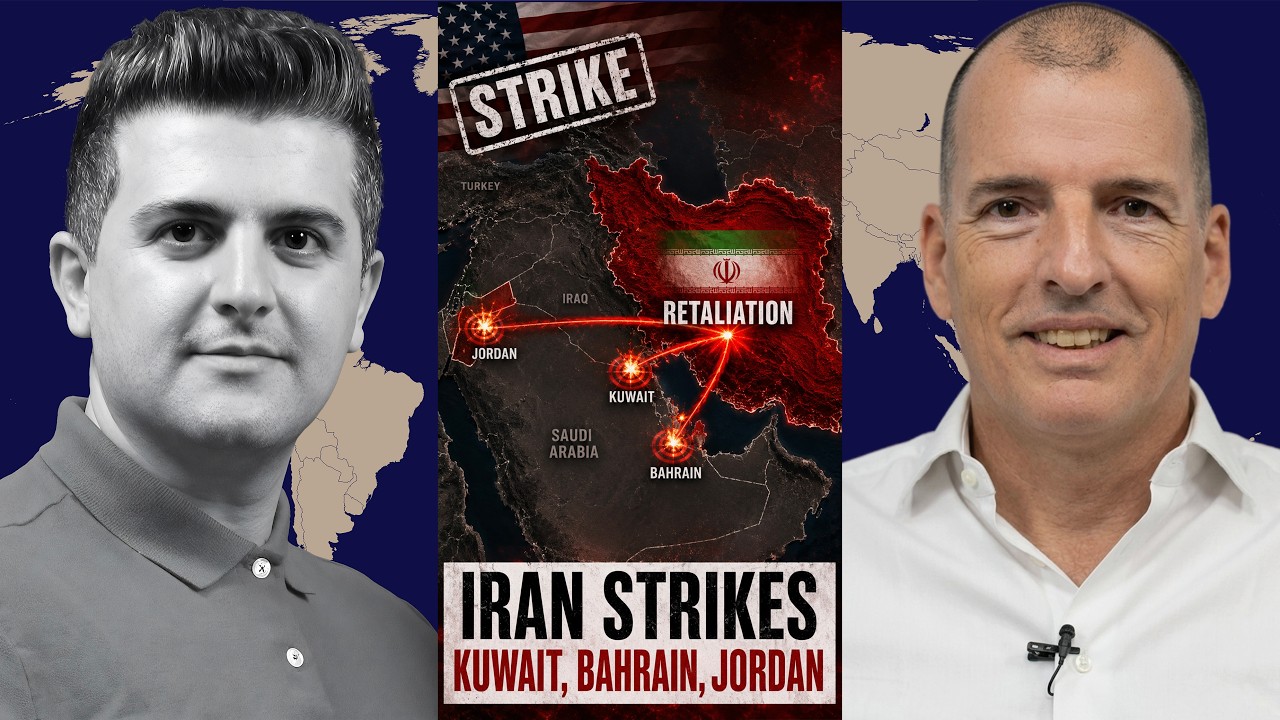
Alex Krainer: US STRIKES Iran – Iran RETALIATES Against Kuwait, Bahrain & Jordan!
"Amidst escalating US-Iran conflict and Iranian retaliation against regional US allies, this episode argues that US foreign policy is deeply controlled by an 'Anglo-Zionist conspiracy' led by the Rothschild banking dynasty, prioritizing Israeli interests over American ones."