Norm Finkelstein RESPONDS To Tucker Saying Trump Israel's "Slave"
YouTube · xAHyDy18lqU
Quick Read
Summary
Takeaways
- ❖Trump's war with Iran became 'unnecessary, unwinnable, and expensive,' making further large-scale conflict unlikely.
- ❖Israel's influence is real, but the idea of Trump being a 'slave' or blackmailed lacks evidence and ignores Trump's agency.
- ❖Even highly intelligent US administrations have been profoundly wrong about war outcomes, making Trump's miscalculation plausible without conspiracy.
- ❖Trump's oversized ego and preference for 'yesmen' created an 'informational void' that Netanyahu leveraged to push for war.
- ❖The current prevalence of conspiracy theories, including novel ones like 'Israel killed JFK,' reflects a decline in historical and materialist analysis.
Insights
1Trump's Iran War: Unnecessary, Unwinnable, and Unaffordable
Norm Finkelstein asserts that the war with Iran began with widespread public opposition, proved economically burdensome, and was ultimately unwinnable, even with extreme threats. These three factors, combined with Trump's lack of mental discipline and tendency to move from crisis to crisis, make a return to large-scale conflict an unlikely option for his presidency.
Finkelstein lists three burdens: 'unnecessary war' (), 'economically onerous war' (), and 'unwinnable war' (). He describes Trump as a 'human wrecking ball' and an 'agent of chaos' who 'thrives on the chaos' but has 'learned that you can't win this time' (, ).
2Refutation of Tucker Carlson's 'Slave to Israel' Theory
Finkelstein directly challenges Tucker Carlson's claim that Trump is a 'slave to Israel' or potentially blackmailed, calling it a 'very large claim' without evidence. He dismisses the blackmail theory due to a complete lack of proof and argues that Trump's decision-making can be explained by more plausible factors.
Finkelstein asks, 'What's the evidence?' (). He states, 'They might be blackmailing him and they might not be blackmailing him because we have no idea. There's no evidence now. So we can discard that.' ().
3Ego and Informational Void as Drivers of Trump's Policy
Finkelstein proposes an alternative explanation for Trump's actions: his oversized ego, enjoyment of the 'pageantry of the office,' and desire to 'flex his muscle.' He argues that Trump intentionally surrounded himself with 'sub-mediocre yesmen' like Jared Kushner, creating an 'informational void.' This void was then exploited by figures like Netanyahu, who 'souped up' Trump's ego with promises of historical greatness if he pursued regime change in Iran.
Finkelstein states, 'Everybody knows that Trump has an oversized ego... enjoys the pageantry of the office... doesn't very much care about the issues... He likes to flex his muscle. He likes to stride the globe like a giant.' (). He notes Trump's appointees 'were sub-mediocre yesmen. In fact that's why he appointed them' (). He then describes Netanyahu telling Trump, 'It's going to be a pushover... you will go down in history as the greatest statesman' ().
4Historical Precedent for Smart Leaders Miscalculating War
To counter the idea that Trump must have been coerced because he couldn't be 'idiotic' enough to start a disastrous war, Finkelstein points to historical examples. He highlights that 'very smart people' like Donald Rumsfeld and Dick Cheney thought the Iraq War would be a 'cakewalk' and Lyndon Johnson's 'best and brightest' administration misjudged Vietnam. This demonstrates that even intelligent, experienced leaders can make catastrophic errors in judgment regarding military conflicts.
Finkelstein notes, 'Donald Rumsfeld and Dick Cheney were very bright, very smart... they all thought Iraq would be a cakewalk' (, ). He also mentions Lyndon Johnson's 'best and brightest' administration, including Robert McNamara, who 'got it wrong about Vietnam' (, ).
5The Rise of Conspiracy Theories and Decline of Historical Analysis
Finkelstein expresses deep concern over the current generation's susceptibility to conspiracy theories, citing the novel and unsubstantiated claim that 'Israel killed John F. Kennedy' as an example. He attributes this trend to the dominance of right-wing narratives online, a decline in 'historical materialist analysis' on the left, and a generational 'lack of practical skills, reading skills, the lack of mental discipline to sit through a faux book, and the lack of a historical sense.'
Finkelstein states, 'There's a real problem with the current generation. It's rife... with conspiracy theories about everything' (). He mentions the 'new thing' that 'the Israelis killed John F. Kennedy' () and attributes this to 'the fact that the right wing dominates the web right now' and the absence of 'rational historical quote unquote materialist podcasters' (, ), as well as 'the lack of practical skills, reading skills, the lack of mental discipline... and the lack of a historical sense' ().
Quotes
"The president of the most powerful country economically and militarily... is a slave of a country the size of New Jersey with a population a 10 million... Well, that's a very large claim on its face. So now what's the evidence?"
"Very smart people... can get it wrong. They got it wrong. Lyndon Johnson... His administration, you know what they called his administration? They were called the best and the brightest... they got it wrong about Vietnam."
"Everybody knows that Trump has an oversized ego. Everybody knows Trump enjoys the pageantry of the office... He likes to flex his muscle. He likes to stride the globe like a giant."
"There's a real problem with the current generation. It's rife in ways I believe unprecedented in my lifetime. It's rife with conspiracy theories about everything."
Q&A
Recent Questions
Related Episodes
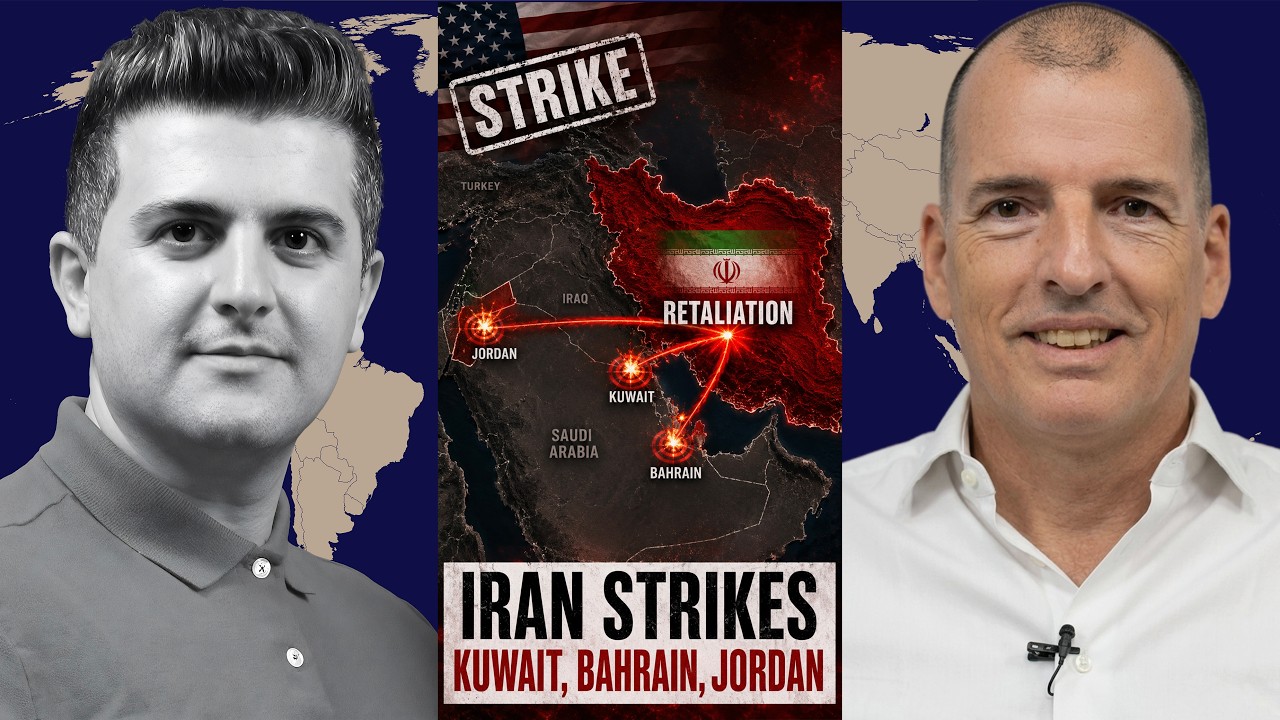
Alex Krainer: US STRIKES Iran – Iran RETALIATES Against Kuwait, Bahrain & Jordan!
"Amidst escalating US-Iran conflict and Iranian retaliation against regional US allies, this episode argues that US foreign policy is deeply controlled by an 'Anglo-Zionist conspiracy' led by the Rothschild banking dynasty, prioritizing Israeli interests over American ones."

Iran Update: Israel’s Newest Bombing Campaign, the Oncoming War With China and How to Avoid It
"Colonel Wilerson reveals how the US and Israel are actively bombing China's strategic infrastructure in Iran, escalating a covert economic war that Beijing intends to win without direct military conflict by dismantling the dollar's global dominance."

Patrick Henningsen: Hezbollah JUST Fired Back at Israel - Iran Vows to “Crush” All Attacks
"Patrick Henningsen argues that the US and Israel initiated an illegal war against Iran, driven by Trump's incompetence and Israeli influence, leading to an inevitable escalation with severe global economic repercussions."
What happens to Trump voters when Trump is gone?
"The David Pakman Show explores the contentious path forward for Trump voters after his political era, exposing alleged corruption, economic misrepresentation, and the necessity of media literacy."