All Roads Lead To the South: Nat’l Day Of Action For Voting Rights | Mass Rally | Montgomery, AL
YouTube · -3LjFcUgx-o
Quick Read
Summary
Takeaways
- ❖The 'All Roads Lead to the South' rally in Montgomery, Alabama, is a direct response to Supreme Court decisions perceived as undermining Black voting rights.
- ❖Gerrymandering and court rulings are described as a 'war' on voting, leading to the largest disenfranchisement of Black political power since Reconstruction.
- ❖A national movement, 'Freedom Summer 2026,' is launching to achieve the largest Black voter registration and mobilization since the 1965 Voting Rights Act.
- ❖Speakers emphasize the need for massive voter turnout, not just registration, and call for engagement from all demographics, including white voters.
- ❖The loss of Black political power is directly linked to lost economic resources and neglect of critical issues like healthcare and education.
- ❖The Supreme Court is characterized as an 'extreme court' doing the work of the Republican party, making inexplicable and partisan decisions on elections.
- ❖Organizers stress the importance of year-round, on-the-ground community engagement, rather than just last-minute campaign spending, especially in Southern states.
Insights
1Supreme Court's Role in Decimating Black Political Power
The Supreme Court's *Louisiana But versus Clay* decision is identified as a primary driver behind the current wave of gerrymandering and disenfranchisement. Speakers assert that this ruling, along with others like *Shelby County v. Holder* and *Bernovich*, has systematically dismantled protections, leading to a 'new Jim Crow' that uses gerrymandered maps, voter roll purges, and polling place closures to suppress Black votes. This is framed as an 'existential threat' to Black political power across the South.
Roland Martin states, 'All of this is a result of the Supreme Court's Louisiana But versus Clay decision that completely is decimating black political power all across the South.' () Senator Cory Booker refers to the Supreme Court doing 'what they did in pie versus Ferguson.' ()
2Economic Impact of Lost Political Representation
The discussion highlights that the erosion of Black political power directly translates to significant economic losses for Black communities. Wiping out Black congressional seats means a reduction in the ability to secure funding for projects, influence budgets, and address specific issues like Black maternal mortality. This is presented as a 'sophisticated and calculated strategy' to defund Black America.
Montgomery Mayor Steven Reed explains, 'when you lose this type of black political power, that means you are potentially losing billions of dollars.' () Congresswoman Ayanna Pressley adds, 'When we don't have black representation, there are issues that are never called to the table, like the black maternal morbidity crisis... like the racial wealth gap.' ()
3The Call for 'Freedom Summer 2026' and Massive Voter Mobilization
The rally serves as the kickoff for 'Freedom Summer 2026,' a national movement aimed at achieving the largest Black voter registration and turnout since the 1965 Voting Rights Act. Speakers emphasize that this is the only effective response to the current attacks, urging not just Black voters but also white voters and a 'rainbow coalition' to engage. The strategy involves sustained, year-round, on-the-ground organizing and education, rather than just last-minute campaign efforts.
Roland Martin declares, 'This is the beginning of Freedom Summer 2026. This is the beginning of us having the largest black voter mobilization since the 1965 Voting Rights Act.' () Senator Cory Booker stresses, 'This generation's moment... We need the largest voter reg black voter registration since 65 voting rights act.' ()
4The Fight for Voting Rights as a Historical Continuum
Speakers repeatedly frame current voter suppression efforts, such as gerrymandering and restrictive laws, not as isolated incidents but as direct continuations of historical patterns seen in cases like Dred Scott, Plessy v. Ferguson, and Jim Crow. This historical context underscores the deep-seated nature of the struggle and the need for sustained, evolving resistance.
Senator Booker references historical injustices (Dred Scott, Plessy v. Ferguson, Coram Nobis) and states, 'the solution in those days was not to sit back and agonize. It was to stand up and organize and mobilize.' Tequila Ruck notes, 'it's the same play that they've run before. After slavery ended... backlash came quickly. Laws were rewritten. Political systems were reshaped.'
5Voting as the Entryway to Power and Resources
The rally emphasizes that voting is not an end in itself but a crucial entry point to broader political power, which in turn dictates access to essential resources and services. Diluting the vote is presented as a direct attack on economic and social progress for Black communities.
Chenet Jackson states, 'vote. Not because voting is the be all end all... because the vote is the entryway and that's what we get what we want.' Congresswoman Joyce Beatty explains how Black representation on committees like Financial Services impacts funding for Black banks, housing legislation, and wealth creation. AOC adds, 'When black Americans have the right to vote and that vote is protected, our schools get funded... healthcare gets expanded... our country moves forward.'
6The Centrality of Black Women's Leadership and Ancestral Resilience
Multiple speakers highlight the indispensable role of Black women in sustaining the civil rights movement, past and present. They advocate for tapping into this 'ancestral playbook' of resistance, emphasizing that Black women's organizing, policy analysis, and leadership are vital for overcoming current challenges.
Amber Sherman states, 'Black women have sustained this movement... we need to study the lessons left by these brilliant organizers.' She specifically mentions Fanny Lou Hamer, Pauli Murray, and Claudette Colvin. Tequila Johnson asserts, 'in my DNA is resistance,' drawing on ancestors who 'navigated trouble water by using the stars.'
7The South as the Frontline and Crucible of Democracy
The rally positions the American South as the primary battleground for the future of democracy, where coordinated attacks on voting rights are most pronounced. There is a call for national solidarity, urging people from other regions to support the fight in Southern states.
Eric Poke proclaims, 'The South got something to say.' Wanika Fernandez notes, 'what's happening in Florida is deeply southern... deeply connected to the same fight communities in Alabama have been fighting for generations.' AOC declares, 'It is time for the North to pull up to the south... Alabama is the crucible. Georgia is the crucible. Tennessee, Louisiana, Mississippi is the crucible.'
8The Strategy of Mass Mobilization and Consistent Action
Beyond a single rally, speakers outline a comprehensive strategy involving continuous voter registration, education, and turnout. They stress that sustained, high-volume participation is the only way to counteract systemic voter suppression and make politicians accountable.
Roland Martin outlines the strategy: 'First, we got to inform, enlighten, and educate people. Then, we got to get them registered. Then, we got to get them to vote.' Congresswoman Terri Sewell states, 'the assignment is to organize, mobilize, and vote. We should be doing voter registration drives at every state capital.' Senator Raphael Warnock calls for voting 'like you've never voted before' and for the Black church to mobilize for 70% minimum turnout.
9The 'Third Reconstruction' and the Urgency of Now
Speakers articulate the current fight for voting rights as a 'third reconstruction,' a critical period following the original Reconstruction and the Civil Rights Movement. They warn against taking decades to regain lost rights, emphasizing that the recent Supreme Court decision on the Voting Rights Act represents a severe setback, potentially the largest wipeout of Black political power since the first Reconstruction.
Rebecca states, 'It took almost 90 years for black folks to get their rights back. 17 days ago, the Supreme Court gave us the final death nail of the Voting Rights Act. We're not going to take 87 years to get our rights back.' Roland Martin declares, 'This is the kickoff of Freedom Summer 2026. This is the kickoff of a massive national voter registration campaign.'
10Voting Smart and the Full Ballot Strategy
Beyond simply voting for a party, attendees are urged to 'vote smart' by researching all candidates on the ballot, from top-tier federal races to local positions like probate judge and sheriff. This granular approach is vital because local officials control election administration and resource allocation, directly impacting community well-being.
Cherylyn Eiffel advises, 'You need to know who you're voting for and what you're voting for. You walking in a booth and pressing a button cuz it says D next to it is not what time it is.' She adds, 'If you are not knowledgeable about who's running for probate judge in Alabama, who are the officials who are in charge of elections in the counties, then you are doing yourself no service.'
11Voting Rights as a Foundation for All Issues
The speakers connect voting rights and political representation directly to everyday concerns such as gas prices, housing affordability, employment, and maternal mortality. They argue that a lack of representation leads to policies that are 'anti-Black' and detrimental to community health and economic well-being, making voting rights a foundational issue.
A speaker explains, 'If you're upset because gas prices are highs or or or housing affordability, guess what? That's a function of not having representation or of being represented by people who are antilack, who are anti- your life.'
12The Southern Battleground and National Political Power
The South is identified as the crucial battleground for democratic progress, not just for Black Americans but for national political power. With over 50% of Black people living in the South, maintaining and expanding their representation is essential for Democrats to achieve majorities in Congress, making the fight in states like Mississippi, Alabama, and Tennessee nationally significant.
Justin Pearson states, 'The litmus test for our country's progress isn't Massachusetts and California. It's what's happening in Mississippi, Alabama, Tennessee, Texas.' He adds, 'There is no way to get a majority for Democrats without the seats in the House... if the South does not have representation.'
13Funding the Movement: A Billion-Dollar Imperative
The movement requires substantial financial investment, comparable to the well-funded opposition. There's a call for high-net-worth Black individuals and white progressives to create a 'billion-dollar legal fund' and for Black communities to invest in their own institutions and media, while also divesting from corporations that fund anti-Black causes.
Roland Martin emphasizes, 'Leonard Leo is sitting on a $1.6 billion fund... we've got to create that similar fund.' Damon Hewitt adds, 'We need that private equity, that private money. There are black people of wealth and the means.' Rashad Robinson suggests, 'What if the governors and the comprollers and the state treasurers in those places started using the money for around procurement? What if we started using the money to divest from companies that were putting us in harm's way?'
14Youth Voting Disparity and Call to Action
Despite being the largest demographic, Black individuals aged 18-39 constituted only 9% of early voters in a recent Georgia race, compared to 55% for those 65+. This highlights a critical gap between demographic potential and actual electoral participation. Roland Martin urges Gen Z, Millennials, and Gen Alpha to translate their social media presence into tangible votes, emphasizing that mobilization doesn't require permission.
Gerald Griggs' social media post on Georgia early voting data: 55% of Black voters were 65+, 9% were 18-39, before reaching one million total votes.
15Grassroots Power and Rapid Mobilization
The National Day of Action for Voting Rights demonstrated that significant, widespread movements can be organized rapidly (in six days) without relying on mainstream media, celebrity endorsements, or substantial initial funding. The event involved over 80 self-organized actions across the country, including Alaska, and brought together diverse groups, showcasing the inherent power of community-led initiatives.
Latasha states, 'we were able to do this in six days... We didn't use we we didn't go to the mainstream media. We didn't list a famous name... It was over 50 75. How many? It was 80. It was close to 80. We had 80 actions that were self-organized all around the country, including in Alaska.'
16Collective Action as the Antidote to Systemic Oppression
Drawing on Dr. Martin Luther King Jr.'s 1968 sermon, the segment asserts that Black people, while individually the poorest, collectively represent one of the world's largest economies. This collective power, when mobilized politically and economically, is the only effective way to combat anti-Black agendas and overwhelm systems of oppression. The focus is on a 'Black agenda' rather than partisan politics.
Roland Martin quotes Dr. King from April 3rd, 1968: 'Black people individually are the poorest people in the country, but collectively we represent one of the largest economies in the world.' He adds, 'The only way we're going to fight what's happening... if we move as a collective.'
Bottom Line
Alabama is framed as a 'blueprint for resistance' against democratic attacks, mirroring its historical role as a 'testing ground' for suppressing votes.
This perspective suggests that the strategies developed and implemented in Alabama to counter voter suppression and gerrymandering could serve as a model for other states facing similar challenges, turning a site of oppression into a center of innovation for civil rights activism.
Activists and organizations can study and adapt the organizing tactics, legal challenges, and community mobilization efforts from Alabama for use in other regions experiencing democratic backsliding, fostering a network of resistance.
The Democratic Party is criticized for not investing sufficiently in Southern states year-round, relying instead on last-minute, television-focused campaigns.
This lack of sustained, on-the-ground investment is seen as a critical failure that contributes to the vulnerability of voting rights in the South, despite the region's growing political importance due to projected congressional seat gains.
Political strategists and parties can re-evaluate their investment models, shifting towards continuous, community-based organizing and education in Southern states to build long-term political power and counter anti-democratic efforts effectively.
Anti-black racism is identified as a tactic used to 'feed the masses their own demise,' distracting from corruption and allowing for policies that harm broader populations.
This insight suggests that racial division is not merely a byproduct but a deliberate tool to enable broader political and economic exploitation, impacting white voters who are 'getting screwed by policies' but are misdirected by racial tropes.
Advocacy groups can develop messaging and organizing strategies that explicitly connect anti-black racism to broader societal harms, building multi-racial coalitions by demonstrating how divisive tactics ultimately undermine the interests of diverse communities.
The opposition's strategy is to reframe racial gerrymandering as 'partisan' to make it legal, thereby diluting Black political power without appearing overtly racist.
This legal maneuver makes it harder to challenge discriminatory maps, as courts may uphold them under the guise of partisan politics, even if the impact is disproportionately racial.
Advocates must expose and challenge this re-characterization, demonstrating the racial intent and impact behind ostensibly 'partisan' redistricting efforts, and educate the public on this tactic.
Black political power is not just about the number of elected officials but also about economic power, health, and education, as elected officials control resource allocation.
Losing political representation directly translates to a 'starving and choking' of Black communities, as funds are diverted elsewhere, impacting every aspect of life.
The movement should explicitly link voting rights campaigns to economic development, health equity, and educational funding, making the tangible benefits of political power clear to all citizens and mobilizing support based on these broader impacts.
The attack on Black voters and political power since 2008/2012 (post-Obama elections) is a direct response to high Black turnout, particularly evidenced by the Shelby v. Holder decision.
This reframes voter suppression efforts not as isolated incidents but as a calculated, systemic backlash against demonstrated Black political efficacy, suggesting that increased turnout directly provokes counter-measures.
Activists should anticipate and prepare for intensified opposition following successful mobilization efforts, using historical context to inform future strategies and messaging around the 'backlash' narrative.
The movement's 'true power' is rooted in faith and a 'highest power,' rather than solely in constitutional or legal frameworks.
This spiritual grounding provides a resilient, intrinsic motivation that transcends political disappointments and legal setbacks, offering a deep wellspring of commitment for activists.
Organizers can leverage the faith community more explicitly, integrating spiritual resilience and moral conviction into their messaging and mobilization efforts, recognizing it as a fundamental pillar of historical and ongoing movements.
Opportunities
Establish a Billion-Dollar Legal and Advocacy Fund
Create a massive, well-funded legal and advocacy fund, similar to those on the conservative side, to deploy resources for fighting voter suppression, gerrymandering, and other civil rights battles. This fund would support litigation, research, training, and community organizing efforts.
Strategic Divestment and Procurement Leverage
Governors, comptrollers, and state treasurers in 'blue states' should use their control over pension funds, endowment funds, and procurement to divest from companies that fund anti-Black causes or engage in practices that harm Black communities. This leverages economic power to exert pressure.
Targeted Corporate Accountability Campaigns (e.g., FedEx)
Launch specific campaigns targeting corporations based in states or cities where voter suppression or gerrymandering is rampant. The goal is to pressure these companies to use their influence to protect voting rights, or face disruption and boycotts if they remain silent or complicit.
Black Media Investment & Ownership Fund
Establish a collective fund specifically for investing in and acquiring Black-owned media platforms. The goal is to ensure that critical information and narratives are controlled by the community, reducing reliance on external funding sources and ensuring editorial independence, as highlighted by Roland Martin's emphasis on owning the broadcast infrastructure.
Youth Political Education & Mobilization Tech Platform
Develop a dedicated technology platform or app to engage young Black voters (Gen Z, Millennials, Gen Alpha) beyond social media. This platform would provide clear direction for mobilization, voter registration tools, and 'citizenship education training events,' directly addressing the low turnout among 18-39 year olds and the need to translate online engagement into offline action.
Key Concepts
Civic Altar Call
A spiritual and moral imperative to engage in civic action, treating participation in democracy as a sacred duty, akin to a religious calling for collective good.
Ancestral Playbook
A framework for contemporary organizing and resistance that draws upon the historical strategies, resilience, and wisdom of past Black leaders and communities who overcame systemic oppression.
If You're Not at the Table, You're on the Menu
A principle emphasizing that political representation is essential for protecting one's interests; without a voice in decision-making, a group becomes vulnerable to policies that exploit or disadvantage them.
Voting as a Prayer with Legs
A metaphor that connects the act of voting to a spiritual commitment, suggesting that active participation in the electoral process is a tangible expression of one's desires and hopes for a better world.
The Crucible of Democracy
The concept that the American South, due to its history of intense struggle for civil and voting rights, serves as a critical testing ground or forge where the true strength and future of American democracy are being determined.
Double-Sided Economic Strategy
This model proposes a two-pronged approach to economic empowerment: actively investing resources within the Black community ('we got to invest in us') while simultaneously imposing costs or consequences on systems that perpetuate oppression and suppression ('make them pay').
Cynicism as a Disengagement Tactic
This model frames cynicism not as a valid strategy, but as a tool used by oppressive forces to foster dejection and disengagement. It argues that cynicism prevents individuals from recognizing their inherent power, seeing hope, and acting as 'architects of the future'.
Pain Bursts Possibilities
This model suggests that moments of frustration and struggle are not merely negative, but are fertile ground for innovation and 'best thinking.' It posits that adversity can be a powerful catalyst for new solutions and collective action.
Lessons
- Register to vote and ensure others are registered, aiming for the largest Black voter mobilization since 1965.
- Participate in every election, from primaries to general elections, and consider running for local offices like school board or county commissioner.
- Support businesses and organizations that align with values of fairness, equity, and justice, and consider boycotts against those that do not.
- Commit to continuous organizing, mobilizing, and voter registration efforts daily, not just on election day, across all Southern states.
- Educate communities on the direct link between voting rights, gerrymandering, and their access to essential services like healthcare, education, and economic opportunities.
- Leverage existing community infrastructure, particularly Black churches, to host regular voter education sessions, registration drives, and provide transportation to the polls.
- Actively challenge voter suppression tactics, including unconstitutional gerrymandered maps, and report issues to organizations like the Election Protection Coalition (866-OUR-VOTE).
- Amplify and support the leadership of Black women in the civil rights movement, recognizing their historical and ongoing role in sustaining the fight for justice.
- Register to vote and ensure everyone in your network is registered, emphasizing the importance of every single vote.
- Educate yourself on all candidates on the ballot, not just top-tier races, and understand their positions and impact on local issues.
- Connect with and actively support Black organizations (e.g., Black Voters Matter, NAACP, National Coalition of Black Civic Participation) by volunteering, donating, and amplifying their work.
- Commit to a long-term fight (at least a decade) for voting rights, engaging in continuous citizen education, relational organizing, and 'Saturday schools' to sustain the movement.
- Demand accountability from elected officials by knowing their contact information and actively communicating dissatisfaction with their actions or inactions.
- Invest in Black institutions, media, and content creators to ensure independent platforms can disseminate information and drive messaging, especially through digital streaming of local actions.
- Register every eligible person in your household to vote, then expand efforts to neighbors, blocks, and communities, systematically building local political power.
- Organize or participate in regular 'citizenship education training events' within your community (e.g., churches hosting weekly sessions) to inform, educate, and connect people on voting rights and political issues.
- Support and fund Black-owned media platforms and community initiatives to ensure independent communication channels and reduce reliance on external philanthropy, fostering economic and informational self-sufficiency.
Blueprint for a New Civil Rights Movement: 'Freedom Summer 2026'
**Massive Voter Registration & Turnout:** Launch and sustain the largest Black voter registration and mobilization effort since the 1965 Voting Rights Act, engaging all demographics, including white voters.
**Year-Round, On-the-Ground Organizing:** Shift political investment from last-minute TV ads to continuous, community-based organizing in Southern states, educating and connecting with people on issues year-round.
**Economic Leverage & Strategic Partnerships:** Implement economic strategies by supporting businesses aligned with civil rights values, and consider boycotts against those that undermine them. Foster multi-racial coalitions to amplify impact.
**Legal & Political Counter-Offensive:** Actively engage in litigation against gerrymandering and voter suppression, while also encouraging a new generation to run for and win local political offices to build power from the ground up.
Notable Moments
The singing of 'Lift Every Voice and Sing' led by Bishop William Murphy.
This moment served as a powerful cultural and spiritual anchor for the rally, connecting the contemporary struggle for voting rights to the historical fight for Black liberation and identity, often referred to as the 'Black national anthem.'
A medical emergency involving Miss B. Williams from Georgia, a senior who needed attention due to the heat.
This incident underscored the physical demands and risks associated with participating in such rallies, particularly for older attendees, and highlighted the community's immediate care and solidarity, drawing parallels to the sacrifices of past civil rights foot soldiers.
The 'All Roads Lead to the South' rally in Montgomery, Alabama, served as the official kickoff for 'Freedom Summer 2026,' a massive national voter registration and mobilization campaign.
This moment signifies a strategic, long-term commitment to addressing voter suppression, drawing parallels to historical civil rights efforts and aiming for sustained engagement beyond a single election cycle.
The event was organized in just seven days following a critical Supreme Court decision, demonstrating rapid mobilization capacity and a unified national response.
This highlights the urgency felt by civil rights leaders and their ability to quickly coalesce diverse organizations and communities for collective action in response to perceived threats to democracy.
The rally included over 80 satellite events across the country, with buses bringing people from as far as Ohio, showcasing a broad national reach and solidarity.
This illustrates that the fight for voting rights in the South is viewed as a national issue, emphasizing that the erosion of rights in one region impacts the entire country's democratic landscape.
Latasha's revelation that the National Day of Action was organized in just six days.
This demonstrates the immense power of grassroots, self-organized movements and challenges the perception that major events require extensive planning, celebrity involvement, or mainstream media support. It highlights community resilience and rapid response capability.
Roland Martin's direct challenge to young people to move beyond social media commentary to ballot box action.
This moment directly addresses a critical issue of modern activism: the gap between online engagement and tangible political participation. It provides a clear, actionable directive for a demographic with significant potential but currently low electoral turnout.
Quotes
"This is an absolute attack on the rights of black voters to disenfranchise them. What we are looking at is likely going to be the largest disenfranchisement of black political power since the period of reconstruction."
"We have an extreme court that is doing the work of Republican party."
"This is an existential threat to black political power all across the South."
"The old Jim Crow used pole taxes and literacy tests. The new Jim Crow uses gerrymandered maps, voter role purges, polling place closures, and court rulings that make black communities politically invisible."
"We have come over a way that the tears has been watered. We have come shredding our path through the blood of the slaughtered."
"We got to stop trying to use celebrities and elected officials who are scaring us about what could happen if we don't vote and start telling us what they're going to promise us so that people turn out to vote."
"The South got something to say. We're not going back."
"When you don't cultivate your democracy in times that you think are good, you will lose your democracy when things are bad."
"If my people who are called by my name, shall humble themselves and pray, seek my face, turn from their wicked ways, then will I hear from heaven, forgive their sin, and heal the land."
"When we do not have a seat at the table, we are on the menu."
"If Alabama can be used to test drive attacks on our democracy, then Alabama can be used as a blueprint for resistance."
"They are picking your pockets by telling you to look at us."
"If you can't give us reparations, the least you can do is give us our representatives."
"When voting rights are under attack, what do we do? Stand up. We fight back."
"The power of the people is greater than the people in power."
"Respectability is appealing to the morals of people who don't have none."
"Decorum is erasure with a gaggle. Be quiet. Be small. Be orderly while they destroy you."
"Politicians should not be deciding who their voters are. The voters should be choosing their representatives."
"It is our duty to fight for our freedom. It is our duty to win. We must love and protect one another. We have nothing to lose but our chains."
"If you're not at the table, you're on the menu."
"If your vote didn't count, they wouldn't be working so hard to actually change your vote."
"I ain't never needed no map to find power anyway. Do you know who my ancestors are? My ancestors navigated trouble water by using the stars."
"You can redraw the map, but you can't redraw or duplicate my DNA. And in my DNA is resistance."
"A disconnected people are easy to control. But when we come together, they can't stop us."
"Our ancestral playbook is deep and vast with the history of black women leaders organizing in the background. Now, it's time we bring them to the forefront."
"You can rig a map, but you can't rig a movement."
"The snake was moving vigorously, not because it was living, but because it was dying."
"There was no democracy in America until every human being born here was guaranteed and protected the right to vote."
"When black Americans have the right to vote and that vote is protected, our schools get funded. When voting rights are protected, healthcare gets expanded. When voting rights are protected, our country moves forward."
"When they target black voters, when they target black communities, when they target black women, they are targeting progress in America."
"It took almost 90 years for black folks to get their rights back. 17 days ago, the Supreme Court gave us the final death nail of the Voting Rights Act. And I'm here to tell you, we're not going to take 87 years to get our rights back."
"All roads lead to the south, but we're at a fork in the road. Are we going to take that fork that curves around and goes back to the dark days of Jim Crow and the Confederacy? Or are we going to take the fork in the road that leads to what Dr. King called the great wells of democracy that the founders dug deep?"
"You walking in a booth and pressing a button cuz it says D next to it is not what time it is. What time it is is you knowing who these candidates are and what they stand for. What time it is is you voting not just the top of the ballot, but voting the whole ballot."
"This decision could be the largest wipeout of black political power since the end of reconstruction. That's how devastating this decision is."
"If you care about national politics, there's no national political power for Democrats if black people don't have power. And at least 50% of black people in the United States of America live in the South. So this isn't a place that can be abandoned."
"They're not trying to compete for black votes. They're trying to steal black representation or or or dilute black political power because they don't want to let go of white supremacy."
"This is prolonged getbacks. That's what this is. It's really like the lost cause, not of the Confederacy, but of the old Dixierat South."
"They say that justice moves slowly. I say sometimes it needs an accelerant. Sometimes you have to throw some gas on that flame. And what we did today did just that."
"Vote black. Buy black. Be black or an ally. Put your money in black banks. Take care of black institutions."
"If you don't use technology to now speak to people who couldn't make it here, you blowing the opportunity. So that's why what I keep telling people if you're having a local action, stream it. Don't just talk to the room because the people who can't show up in the room but they can still get the information."
"Cynicism is not a strategy. That is not a strategy. Matter of fact, it keeps you from seeing a sense of hope. It keeps you from seeing what you got in your hand, what you can work with. It's keeps you from seeing yourself as of of builders of the future."
"What's happening to black folks is not happening to black folks. What's happen what's happening has happened to America but we're taking the the the the hardest hit."
"Pain bursts possibilities. And so when it is a moment like this that many of us are frustrated, this is when our best thinking comes."
"Black people individually are the poorest people in the country, but collectively we represent one of the largest economies in the world."
"It does not mean that we will agree with everything a politician says or does... But what it does mean is that if you have a black agenda, that means you are opposing those who are antilack."
Q&A
Recent Questions
Related Episodes
George Floyd 6 Years Later. Redistricting War in The South. Talarico Senate Campaign
"This episode exposes the ongoing legislative battles and strategic resistance against efforts to diminish Black political power, from federal policing reform to state-level gerrymandering and calls for economic boycotts by Black athletes."
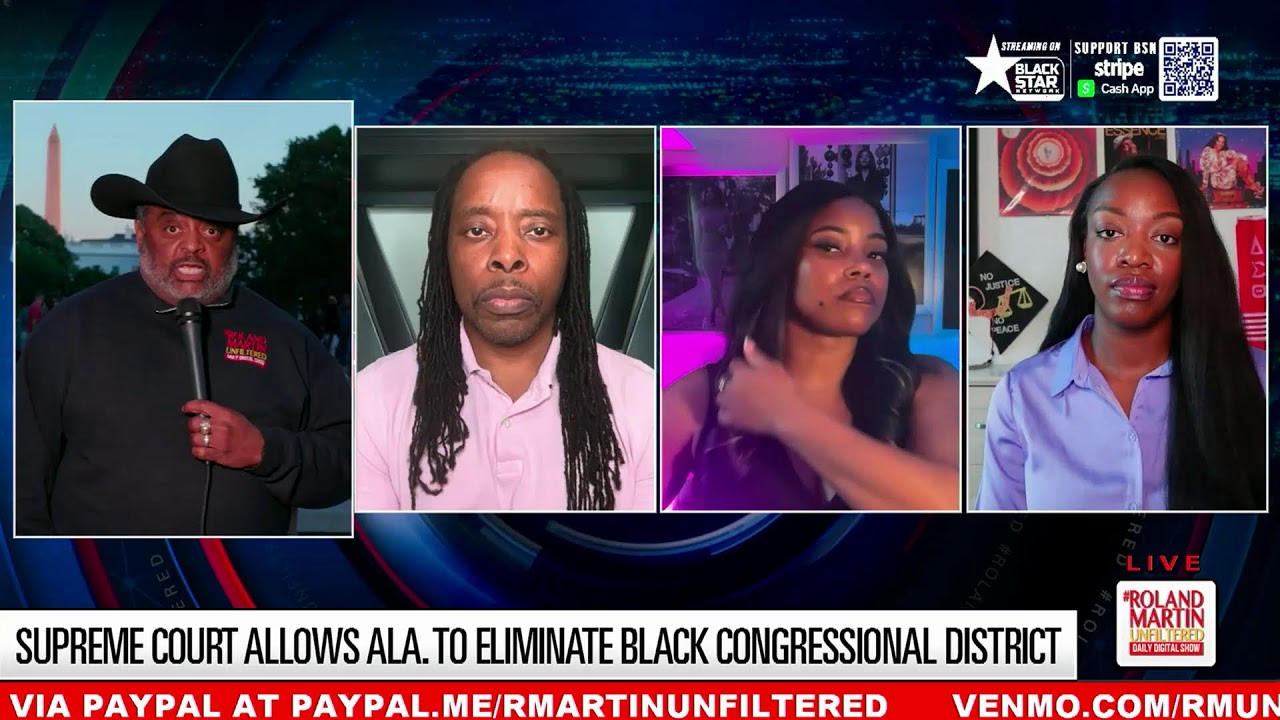
Moral Monday at BLM Plaza. Cleo Fields Sounds Alarm on Louisiana & Gary Chambers Pushes Turnout
"Activists and faith leaders gathered at Moral Monday to denounce 'policy violence' in various forms, from war and budget cuts to voter suppression and healthcare denial, urging sustained mobilization against a 'hijacked' democracy."

PBS News Hour full episode, May 8, 2026
"This episode unpacks escalating US-Iran military actions in the Strait of Hormuz, a resilient yet divergent US jobs market, the ongoing political battle over congressional redistricting, and the controversial new US counterterrorism strategy."

“Explosive!” New Republican ballot scandal SURGES INTO NEWS
"A California sheriff and gubernatorial candidate seized over half a million ballots, an act the hosts frame as a dangerous escalation in Republican efforts to undermine election integrity and normalize ballot seizures."