
Col. Jacques Baud: The World Is Entering a Lawless Era
YouTube · -62UrB2Nyl0
Quick Read
Summary
Takeaways
- ❖Colonel Baud's EU sanctions are a 'unique case' of foreign policy measures applied to an EU resident, depriving him of basic living rights without due process or clear legal grounds.
- ❖The international system has shifted from a 'law-based order' to a 'rules-based order,' where powerful nations like the US define arbitrary rules, as demonstrated by the fabricated case against Venezuelan President Maduro.
- ❖The EU's decision-making is characterized by 'teenager decision-making,' lacking thorough analysis and foresight, prioritizing weakening others over developing its own capabilities.
- ❖China's strategy of innovation and self-improvement contrasts sharply with the US and EU's approach of trying to keep competitors down, indicating a fundamental difference in competitive philosophy.
Insights
1Arbitrary EU Sanctions and Deprivation of Rights
Colonel Jacques Baud, an EU resident, has been sanctioned by the EU as a 'foreign policy measure,' a unique application that deprives him of access to his bank accounts, preventing him from buying food or paying bills. These sanctions were applied without trial, specific legal breaches, or an opportunity to defend himself, based on vague accusations like 'propaganda' or being on 'pro-Russian websites,' which are not legally defined offenses. This highlights a fundamental weakness and arbitrary nature in EU decision-making.
Baud describes his case as unique because he lives within the EU and is subjected to foreign policy measures. He states he cannot access bank accounts, buy food, or pay bills since December 15, living off neighbors' solidarity. He emphasizes no trial, no breached law, no open accusation, and no defense opportunity. He notes German government representatives admitted approving sanctions without full knowledge. He theorizes France targeted another citizen, making him 'collateral damage.'
2Shift from Law-Based to Rules-Based International Order
The world has transitioned from an international system governed by established laws to one based on arbitrary 'rules' defined by powerful actors, primarily the US. This shift means decisions are no longer anchored in verifiable legal articles but in subjective perceptions of 'legitimacy,' allowing for arbitrary actions and fabricated cases against perceived adversaries.
Baud states, 'We have shifted from the international lawbased order to the international rulesbased order.' He explains that rules are defined by 'whoever,' in this case, the US, which uses its power and clandestine assets. He contrasts 'legality' (following defined laws) with 'legitimacy' (perception of legality), arguing that the latter is undefined and easily manipulated to suit policy.
3US Actions in Venezuela as a Case Study of Rules-Based Coercion
The US attempt to 'kidnap' Venezuelan President Maduro and fabricate charges against him (e.g., the 'cartel of the suns,' later admitted not to exist) serves as a clear example of the 'rules-based order.' Such actions disregard international law and rely on arbitrary justifications to impose will, demonstrating a policy of coercion over diplomacy.
The host mentions the Trump administration's decision to 'kidnap' President Maduro. Baud confirms the US 'tried to fabricate literally a case against Venezuela.' He points out that charges like the 'cartel of the suns' were dropped after Maduro's trial, with the US admitting the cartel never existed, proving the case was 'fabricated from A to Z.'
4EU's 'Teenager Decision-Making' and Strategic Weakness
The EU's decision-making process is characterized by a lack of thorough analysis, superficial understanding, and an inability to foresee mid- to long-term consequences, akin to 'teenager decision-making.' This strategic deficiency leads the EU to prioritize weakening rivals (like Russia) rather than focusing on its own development and competitive improvement.
Baud criticizes the 'fundamental weakness of decision making within the EU,' calling it 'incompetent' and 'immature.' He states decisions are based on 'superficial perception' rather than 'thorough analysis,' and leaders 'don't even measure the consequence of the decisions.' He explicitly calls it 'the hallmark of teenager decision making.' He notes the EU 'pay more attention to weaken Russia than to develop Europe.'
5China's Innovation-Driven Rise vs. Western Decline
While the US and EU adopt a strategy of 'keeping others down' through coercion and sanctions, China focuses on self-improvement through innovation, engineering, and scientific output. This difference in competitive philosophy—building oneself up versus tearing others down—is allowing China to gain a significant edge in emerging technologies and industrial processes.
Baud argues the US is 'no longer able to compete' through innovation and instead 'try to impose their will to others.' He contrasts this with China, which has 'understood the idea that they need to be better,' being 'more creative, more innovative.' He cites China's high number of patents, engineers, scientific papers, and advanced industrial processes like 'dark factories' using AI, demonstrating their competitive advantage.
Bottom Line
The US's reliance on coercion, fabricated cases, and arbitrary rules to maintain global dominance is a sign of fundamental weakness, not strength.
This suggests that the US is losing its ability to compete through innovation and superior products, resorting instead to undermining rivals. This strategy is unsustainable and alienates potential partners.
Nations and businesses can identify this weakness and seek alternative alliances or develop strategies that prioritize genuine innovation and collaboration over coercive tactics, potentially finding new markets or diplomatic avenues.
Switzerland's participation in sanctions, despite its neutrality, compromises its historical role as a mediator and neutral ground for diplomacy.
This erodes trust in Switzerland's neutrality, making it less effective as a facilitator for dialogue in international conflicts. It signals a broader trend of nations aligning with dominant powers even at the expense of their traditional foreign policy principles.
Other neutral or non-aligned nations could step into the void left by Switzerland to offer genuine mediation, gaining diplomatic influence and fostering stability in a polarized world.
Key Concepts
Law-Based vs. Rules-Based Order
The distinction between an international system governed by verifiable, defined laws and one governed by arbitrary 'rules' set by dominant powers. The former provides clear boundaries and due process, while the latter allows for flexible, policy-driven justifications that can be changed at will, leading to lawlessness.
Teenager Decision-Making
A metaphor used to describe decision-making processes that lack thorough analysis, foresight into long-term consequences, and strategic understanding, often driven by superficial perceptions rather than deep insight. This leads to impulsive and ultimately self-damaging policies.
Competitive Strategy: Self-Improvement vs. Weakening Others
Two distinct approaches to maintaining or gaining a competitive edge. One involves focusing on internal development, innovation, and becoming 'better' than competitors. The other involves maintaining one's position by actively undermining or 'keeping down' competitors, often through coercive measures like sanctions, which is framed as a sign of underlying weakness.
Lessons
- Critically evaluate claims of 'legitimacy' in international discourse, recognizing it as a subjective perception often used to justify arbitrary policies, rather than a legal standard.
- Recognize that a nation's reliance on sanctions and coercive measures, rather than diplomatic engagement or economic competition, may signal underlying strategic weakness.
- Investigate and support initiatives promoting a return to international law-based order, as opposed to arbitrary rules-based systems, to safeguard individual freedoms and national sovereignty.
Notable Moments
A German government representative, when questioned in parliament about sanctioning Colonel Baud, appeared embarrassed and admitted they 'didn't know' the details but were 'convinced it's right.'
This moment starkly illustrates the superficial and uninformed nature of decision-making within the EU regarding sanctions, highlighting a lack of due diligence and accountability.
The US dropped charges against Venezuelan President Maduro, specifically admitting that the 'cartel of the suns' (the basis for some accusations) 'never existed.'
This admission provides concrete evidence of the fabrication of cases by powerful states to justify political actions, underscoring the arbitrary nature of the 'rules-based order' over international law.
Quotes
"You can deprive someone from its liberty, its freedom of movement, its freedom of feeding... without any trial, without having breached any law, without having been confronted to any open accusation, without having been able to defend myself."
"We have shifted from the international lawbased order to the international rulesbased order."
"It's no longer the law that is the the reference. It's just the rules that you establish."
"You make it better. You are better than the others. You are the best. And that's the best way to win the competition. But the other way is that you stay as you are but you try to weaken the others."
"When you are not able to impose yourself through your intelligence, your ability to be better than others, well then you just need to be worse than the others. And that's exactly what this case demonstrates."
Q&A
Recent Questions
Related Episodes

Patrick Henningsen: Hezbollah JUST Fired Back at Israel - Iran Vows to “Crush” All Attacks
"Patrick Henningsen argues that the US and Israel initiated an illegal war against Iran, driven by Trump's incompetence and Israeli influence, leading to an inevitable escalation with severe global economic repercussions."
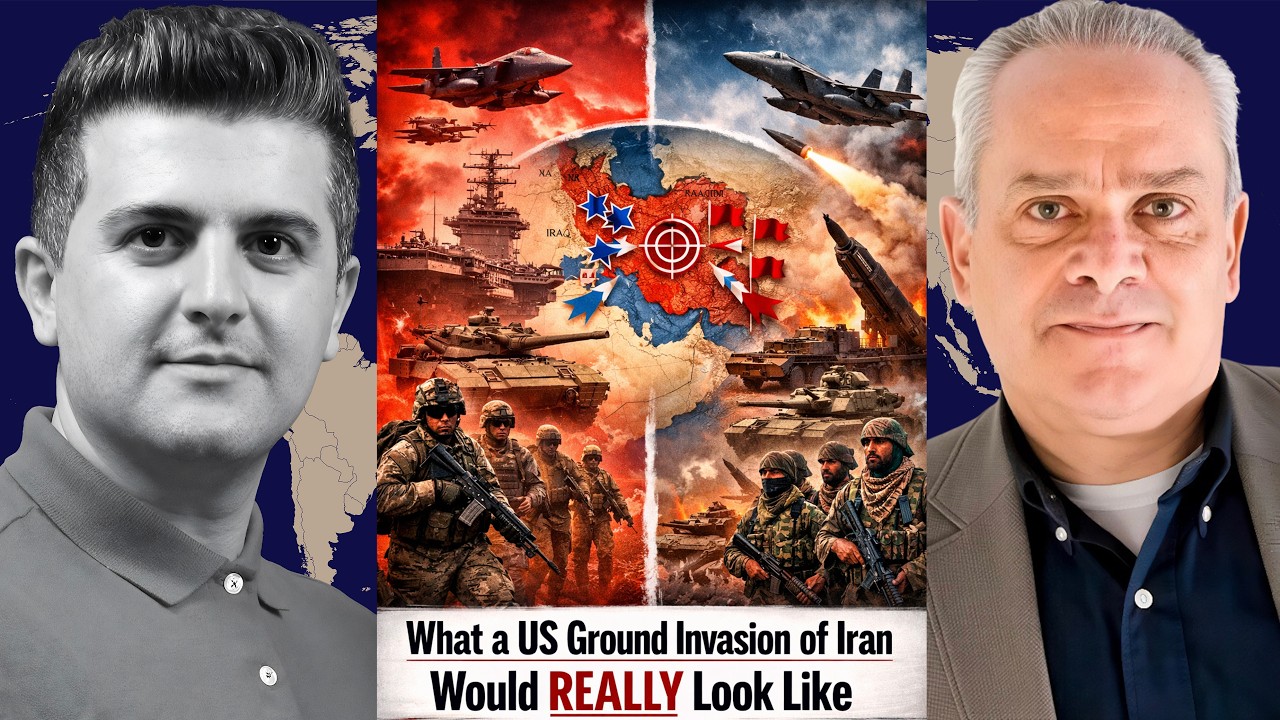
Col. Jacques Baud: What a US Ground Invasion of Iran Would REALLY Look Like
"Colonel Jacques Baud dissects the strategic futility of a US ground invasion of Iran, arguing that current troop levels are insufficient and such an action would backfire, exposing US allies and potentially leading to Iran's nuclearization."

BREAKING: Iran Threatens To END Talks; U.S. Vows Retaliation; Hezbollah Collapsing? | TBN Israel
"Iran is leveraging Hezbollah and the Strait of Hormuz to manipulate US negotiations, while Israel asserts its right to dismantle Hezbollah's eroding but still dangerous infrastructure in Lebanon, independent of international talks."

Alex Krainer: US STRIKES Iran – Iran RETALIATES Against Kuwait, Bahrain & Jordan!
"Amidst escalating US-Iran conflict and Iranian retaliation against regional US allies, this episode argues that US foreign policy is deeply controlled by an 'Anglo-Zionist conspiracy' led by the Rothschild banking dynasty, prioritizing Israeli interests over American ones."