
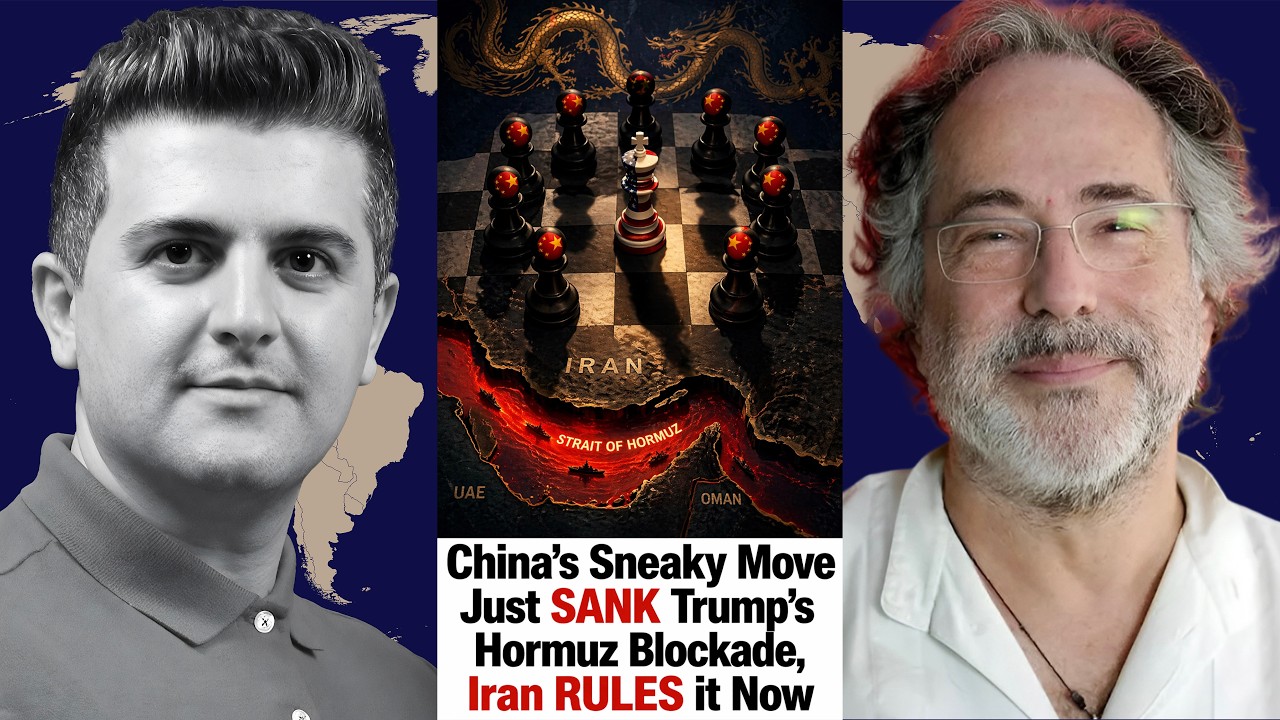
Pepe Escobar: China JUST Humiliated Trump’s Sanctions – Iran NOW Controls Hormuz
YouTube · 0o-JVoW2io8
Quick Read
Summary
Takeaways
- ❖Iran, Russia, and China have formed a 'new Primakov Triangle,' actively building a multipolar international system.
- ❖Iran has implemented a new 'Persian Gulf Authority' for the Strait of Hormuz, requiring payment in Rial (or Yuan as backup) and bank guarantees from Iranian banks.
- ❖Countries that caused damage to Iran during the recent war must pay reparations before obtaining passage permission through Hormuz.
- ❖The US's 'Project Humanitarian' blockade attempt lasted less than two days due to lack of participation and perceived ineffectiveness.
- ❖China has officially declared the US-initiated war against Iran 'illegitimate,' signaling strong diplomatic support.
- ❖The UAE is identified as an 'Arab Israel,' closely aligned with the US and Zionists, and faces potential severe retaliation from Iran for its wartime collaboration.
- ❖The US's strategic objectives in Iran (regime change, resource takeover, Hormuz control) were not achieved; instead, US military bases in West Asia were largely destroyed.
- ❖The next major geopolitical flashpoint for US containment efforts is predicted to shift from the Strait of Hormuz to the Strait of Malacca.
Insights
1The Emergence of the New Primakov Triangle (Russia, China, Iran)
The speaker asserts that the original Primakov Triangle (Russia, India, China) has been 'revamped' into a new, more focused alliance of Russia, China, and Iran. These three nations are at the forefront of building a new system of international relations, providing diplomatic and even 'invisible' military support to Iran, especially during the recent conflict. Their coordinated actions, like the Iranian Foreign Minister's visits to Moscow and Beijing, signify a united front against US influence.
Iranian Foreign Minister Arashi visited St. Petersburg to meet Lavrov and Putin, then went to Beijing to meet Wang Yi. These three countries are BRICS and SCO members, and two are 'right behind Iran in the war' with diplomatic and military support. [], []
2Iran's Sovereign Control Over the Strait of Hormuz
Iran has unilaterally established a new 'Persian Gulf Authority' to manage transit through the Strait of Hormuz. This new system dictates specific requirements for passage, including payment in Iranian Rial (with Yuan as a potential backup) and bank guarantees from Iranian banks. Furthermore, any country that caused damage to Iran during the recent conflict must pay reparations before being granted passage. This move fundamentally alters the legal and economic landscape of global energy shipping.
Iran has established a 'Persian Gulf Authority' with detailed procedures, including email applications and payment in Rial. Yuan is a likely backup currency if Rial is difficult to obtain. Bank guarantees must be in Iranian banks. Countries that caused damage to Iran must pay before obtaining passage permission. All documents must refer to the 'Persian Gulf.' [], [], [], [], []
3US Strategic Defeat and Trump's Lack of Leverage
The US, particularly the Trump administration, is characterized as having suffered a 'comprehensive strategic defeat' in its conflict with Iran. All initial objectives, such as regime change or control of Hormuz, were not achieved. Attempts to impose a blockade or 'Project Humanitarian' in Hormuz failed within days due to lack of international compliance and the perceived threat of Iranian retaliation. Trump is seen as arriving in China with 'zero cards' for negotiation, further weakening US diplomatic standing.
Trump 'launched a war where he lost in absolutely every vector' and suffered a 'comprehensive strategic defeat.' Objectives like 'decapitation, regime change, a color revolution' and taking over Hormuz were not met. The 'Project Humanitarian' blockade lasted less than two days because 'no insurance company, no tanker owner would dare' follow US instructions. Trump arrives in China 'with zero cards in his hand.' [], [], []
4China's Open Condemnation of the War and Shift to Offensive Stance
China has openly condemned the US-initiated conflict against Iran as 'illegitimate' and 'illegal,' signaling a strong stance against US foreign policy. This public declaration provides significant diplomatic backing to Iran. Furthermore, China is no longer playing defense against US sanctions but is reacting immediately and offensively, as demonstrated by its response to US threats against Chinese oil refineries dealing with Iran.
The 'key adjective the Chinese used after the meeting between Arashi and Wang Yi' was that the war is 'illegitimate,' meaning 'illegal.' China's response to US sanctions targeting Chinese refineries working with Iran was to state that these companies must follow Chinese law and that US actions are illegal. The Chinese are 'not playing defense anymore' but are 'reacting immediately afterwards in an offensive manner.' [], [], []
5The UAE as a Vulnerable 'Arab Israel' and Future Flashpoint
The UAE is portrayed as an 'Arab Israel,' completely aligned with Zionist and Trump administration interests, and a key collaborator in the war against Iran. This alignment makes the UAE a 'burning question' and a primary target for Iranian retaliation. Iran has already begun punishing the UAE by blocking its oil exports from Fujairah, and further, more severe actions are anticipated if the UAE continues its hostile stance.
The UAE is 'turning into an Arab Israel' and is 'completely aligned with the Zionists' and the Trump administration. Netanyahu and MBZ were coordinating next steps. Iran believes the UAE 'collaborated on very targeted attacks against Iran.' Iran is already 'punishing' the UAE by blocking its ports, meaning the UAE 'cannot export oil from Fujairah anymore' without Iranian permission and tolls. [], [], []
Bottom Line
The US's failure to control the Strait of Hormuz will likely shift its focus to attempting to control the Strait of Malacca as the next critical chokepoint against China.
This indicates a geographical pivot in US containment strategy, moving from West Asia to Southeast Asia. It suggests that regional agreements, like the military cooperation between Jakarta and Washington, are early steps in a broader plan to establish military presence and control over Malacca.
Nations in Southeast Asia, particularly Indonesia, face increased geopolitical pressure and must carefully navigate alliances to avoid becoming proxy battlegrounds. Businesses with maritime logistics or energy interests in the region should anticipate heightened tensions and potential disruptions in Malacca, similar to those seen in Hormuz.
Lessons
- Businesses involved in global shipping and energy should monitor Iran's new 'Persian Gulf Authority' regulations for the Strait of Hormuz, including payment methods (Rial/Yuan) and bank guarantee requirements, to ensure compliance and avoid disruptions.
- Companies with operations or investments in the UAE should assess their risk exposure given the escalating tensions with Iran and the potential for further economic or military retaliation.
- Policymakers and analysts should recognize the growing cohesion and strategic alignment between Russia, China, and Iran as a significant challenge to the existing international order, impacting trade, finance, and security doctrines globally.
Quotes
"The new Primakov triangle is definitely Russia, China, and Iran because these three are at the forefront of building a new system of international relations."
"Trump arrives in China with zero cards in his hand."
"This war is illegitimate from a Chinese point of view. Nema, this is immensely serious because this means that everything related to the war is illegal."
"If the empire attacks you, you don't back down, you fight back."
"Hormuz was a test. They lost. So they're going to get even angrier and now driven to okay we couldn't do it in Hormuz, but we we're going to do it in Malacca."
Q&A
Recent Questions
Related Episodes

Patrick Henningsen: Hezbollah JUST Fired Back at Israel - Iran Vows to “Crush” All Attacks
"Patrick Henningsen argues that the US and Israel initiated an illegal war against Iran, driven by Trump's incompetence and Israeli influence, leading to an inevitable escalation with severe global economic repercussions."
Pepe Escobar: “Total Failure”: Trump’s Blockade Just Backfired Disastrously
"Pepe Escobar argues that the US blockade against Iran, spearheaded by Donald Trump, has utterly failed and backfired, accelerating global economic chaos and challenging US geopolitical dominance."

🚨 TOTAL F*CKING CHECKMATE 😂😂😂
"The host argues that Trump's 'ceasefire' with Iran was a calculated '5D chess' move to orchestrate a global energy market reshuffle, while simultaneously lambasting 'woke' domestic policies and the 'freefall' of anti-Trump conservative figures."

Col. Jacques Baud: What a US Ground Invasion of Iran Would REALLY Look Like
"Colonel Jacques Baud dissects the strategic futility of a US ground invasion of Iran, arguing that current troop levels are insufficient and such an action would backfire, exposing US allies and potentially leading to Iran's nuclearization."