A War for Oil: Economist Michael Hudson on U.S. Quest to Control the World's Oil Trade
YouTube · 1L-koEYcufE
Quick Read
Summary
Takeaways
- ❖The US attack on Iran was a preemptive strike to prevent a peace deal and secure control over Near Eastern oil, not to address nuclear concerns.
- ❖Since 1974, US foreign policy has aimed to control world oil trade by ensuring oil profits are recycled into US Treasury securities and priced in dollars.
- ❖US self-sufficiency in oil does not negate its need to control global oil supplies as a diplomatic weapon against other nations like China and India.
- ❖Sanctions against Russia, Venezuela, and Iran are designed to prevent other countries from buying oil outside US control and the dollar system.
- ❖Rising oil prices, driven by US actions, create a windfall for US domestic oil companies while economically squeezing Europe and the Global South.
- ❖De-dollarization efforts by Iran, Venezuela, and Russia (by pricing oil in non-dollar currencies) are a primary driver of US aggression.
- ❖US military spending is the main cause of its balance of payments deficit, which is partially financed by recycled petrodollars.
- ❖The US strategy of 'creating chaos' to deny other countries sovereignty is isolating the US and pushing the world towards a multipolar, de-dollarized system.
Insights
1US Attack on Iran: Oil Control, Not Nuclear Bombs
The US attack on Iran was not driven by concerns over nuclear weapons, as Iran had agreed to unprecedented oversight and reduction of enriched uranium. Instead, the real objective was to prevent a peace deal and consolidate US control over Near Eastern oil, a long-standing strategic goal.
Oman's foreign minister reported significant progress in US-Iran negotiations, including Iran agreeing to not have an atom bomb, reduce refined uranium, and submit to oversight. The US attacked immediately after this progress. General Petraeus's plan to conquer seven Near East countries, culminating in Iran, is cited as evidence of this long-term strategy.
2The 1974 Petrodollar Strategy: Control, Not Ownership
Following OPEC's quadrupling of oil prices in 1974, the US developed a strategy to control the world's oil trade without necessarily owning the oil. The agreement mandated that all OPEC oil profits be priced in dollars and recycled back into the US economy via investments in US Treasury securities and stocks.
Hudson states he 'sat in on meetings in the White House in 1974' where this strategy was discussed, based on his expertise at Chase Manhattan for US balance of payments and the oil industry.
3Leveraging Global Oil Supply for Diplomatic Control
Despite US self-sufficiency in oil, controlling Middle Eastern oil supplies remains a critical tool for exerting influence over other oil-dependent nations like China and India. The US can use this control to enforce its foreign policy and sanctions.
The US blocked Europe from buying Russian oil and gas, leading to the downsizing of German industries and recession. The recent German oil price jump after the Iran attack further illustrates this leverage. The US uses sanctions against Russia, Venezuela, and Iran to prevent countries from buying oil outside its control.
4De-dollarization as a Catalyst for US Aggression
A primary driver of US military and economic aggression against countries like Iran, Venezuela, and Russia is their efforts to de-dollarize by pricing oil in non-dollar currencies, particularly the Chinese yuan. This threatens the petrodollar system and the US ability to finance its military spending.
Iran was pricing its oil in Chinese currency. Venezuela announced it would stop pricing oil in dollars. Russia shifted international transactions to non-dollar currencies after its savings were confiscated by Europe. This reduces the dollar inflows that finance US military diplomacy.
5US Military Policy: Targeting Civilians for Regime Change
The US military strategy in conflicts like Iran, Gaza, Syria, and Ukraine focuses attacks on civilian infrastructure, believing that this will cause populations to overthrow their existing regimes and install pro-US governments. Hudson argues this strategy is historically flawed and counterproductive, instead galvanizing national support for the targeted government.
Historical examples of England bombing German cities and Germany bombing London are cited, which reinforced opposition rather than leading to surrender. Iran turning off the internet and Starlink further prevented US-coordinated political demonstrations, leading to overwhelming support for the existing government.
Bottom Line
The economic squeeze on Global South countries due to rising oil prices and existing dollar-denominated foreign debts could trigger a widespread debt moratorium.
This could lead to a 'complete disruption of financial markets' if these countries collectively decide to prioritize domestic stability over paying dollar bondholders, fundamentally challenging the existing global financial order.
For investors, this signals potential volatility in emerging markets debt and a need to reassess exposure to dollar-denominated assets. For policymakers, it highlights the urgency of exploring alternative financial aid mechanisms or debt restructuring frameworks that do not exacerbate economic instability in developing nations.
China's upcoming ultimatum to the US regarding oil trade blockades and Taiwan support could escalate into a trade war involving essential material exports.
If China halts exports of critical materials, it would severely impact US industries and supply chains, forcing a re-evaluation of US foreign policy tactics. This suggests a direct economic retaliation rather than military, leveraging China's manufacturing dominance.
Businesses reliant on Chinese exports should diversify supply chains and explore domestic or alternative international sourcing. Policymakers should prepare for potential economic shocks and consider strategies to de-risk critical supply dependencies.
Key Concepts
Oil as a Choke Point
The concept that oil is an essential commodity for every country's industry, transportation, and electricity, making its control a powerful leverage point in international diplomacy. By controlling the world's oil trade, a nation can effectively 'turn off the lights' for others.
Petrodollar Recycling
A system established in 1974 where oil-exporting countries, particularly OPEC members, agree to price oil in US dollars and recycle their vast dollar profits back into the US economy, primarily by investing in US Treasury securities, bonds, and stocks. This mechanism finances US deficits and maintains dollar hegemony.
Lessons
- Analyze geopolitical events through an economic lens, particularly focusing on energy control and currency dynamics, rather than solely stated political or security objectives.
- Monitor de-dollarization efforts by major oil producers and consumers as a key indicator of shifts in global financial power and potential US foreign policy responses.
- Evaluate the stability of global financial markets, especially regarding sovereign debt in the Global South, given the potential for widespread debt moratoriums triggered by energy price shocks.
Notable Moments
Oman's foreign minister directly addressed the American public via US press to convey significant progress in US-Iran nuclear negotiations, bypassing distrusted US envoys.
This highlights a rare diplomatic maneuver to counter perceived misinformation or lack of trust within US government channels, underscoring the urgency and sincerity of the peace efforts from the Iranian side and its allies before the US attack.
Michael Hudson's personal account of attending White House meetings in 1974 where the US strategy to control world oil trade through financial mechanisms was formulated.
This provides direct, first-hand evidence supporting his core thesis, lending significant credibility to his historical reconstruction of US foreign policy motivations regarding oil and finance.
Quotes
"The aim was to control near eastern oil by the United States. And General Petraeus years ago had outlined this whole plan in saying, 'Well, we're going to conquer seven near countries culminating in Iran.'"
"If we can control the world's oil trade, then we are we can use that as an arm of US diplomacy. And it we don't have to own the oil."
"The rise in world oil prices is a windfall for the United States domestic oil companies and gas companies. They're making a killing on the United States."
"The United States will not have the balance of payments inflows from oil to enable it to finance its international military diplomacy and political diplomacy."
Q&A
Recent Questions
Related Episodes
Pepe Escobar: “Total Failure”: Trump’s Blockade Just Backfired Disastrously
"Pepe Escobar argues that the US blockade against Iran, spearheaded by Donald Trump, has utterly failed and backfired, accelerating global economic chaos and challenging US geopolitical dominance."
Patrick Henningsen: Hezbollah JUST Fired Back at Israel - Iran Vows to “Crush” All Attacks
"Patrick Henningsen argues that the US and Israel initiated an illegal war against Iran, driven by Trump's incompetence and Israeli influence, leading to an inevitable escalation with severe global economic repercussions."
Col. Jacques Baud: What a US Ground Invasion of Iran Would REALLY Look Like
"Colonel Jacques Baud dissects the strategic futility of a US ground invasion of Iran, arguing that current troop levels are insufficient and such an action would backfire, exposing US allies and potentially leading to Iran's nuclearization."
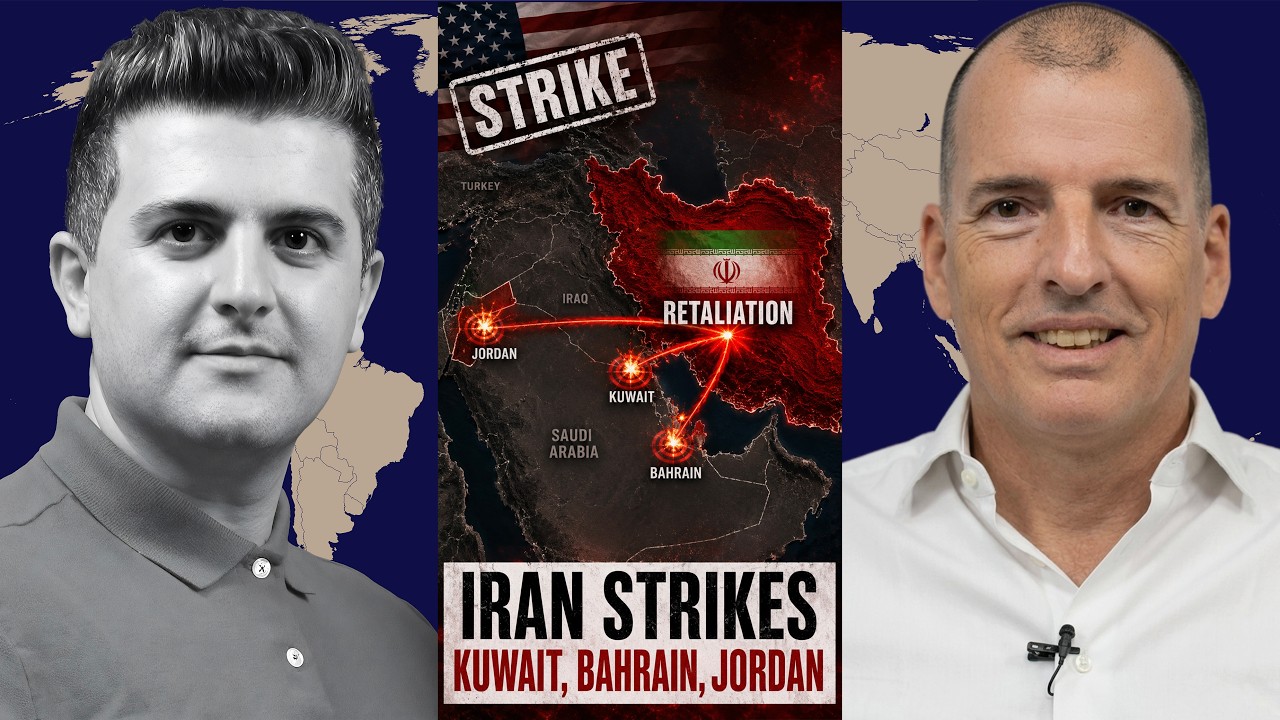
Alex Krainer: US STRIKES Iran – Iran RETALIATES Against Kuwait, Bahrain & Jordan!
"Amidst escalating US-Iran conflict and Iranian retaliation against regional US allies, this episode argues that US foreign policy is deeply controlled by an 'Anglo-Zionist conspiracy' led by the Rothschild banking dynasty, prioritizing Israeli interests over American ones."