
Richard Wolff & Michael Hudson: How Trump’s Iran Blockade Turned Into Total Humiliation
YouTube · 2G_tmui5fag
Quick Read
Summary
Takeaways
- ❖The Trump administration's Iran blockade is seen as an illogical, poorly conceived strategy that failed to achieve its objectives.
- ❖Iran has successfully evaded US sanctions and blockades, demonstrating resilience and military capabilities far exceeding US expectations.
- ❖The US policy is inadvertently strengthening the economic and military ties between Iran, Russia, and China.
- ❖European allies are increasingly hostile towards the US due to its unilateral actions and lack of consultation regarding the Iran conflict.
- ❖The US's declining manufacturing base and massive national debt render it ill-prepared for a prolonged economic or military confrontation with rising powers.
- ❖The guests predict that the US strategy will lead to a global financial crisis, akin to a 'financial winter,' with severe consequences for the world economy.
- ❖The US is perceived as trying to 'stop history' by destroying any country or industry it cannot control, leading to global pushback.
- ❖Iran's strategy is to demonstrate that US aggression will hurt all countries, forcing them to act against the US to protect their own economies.
Insights
1US Iran Blockade is a Failure and Strategic Blunder
The Trump administration's blockade in the Strait of Hormuz and 'Operation Economic Fury' are not working. Iran has already shipped millions of barrels of crude oil from the Gulf of Oman since the blockade began. The US underestimated Iranian solidarity and military capabilities, including advanced missiles and drones that can penetrate defenses and hit US bases. Reinstating sanctions is ineffective as Iran has years of experience in evasion, and new sanctions target importers like China, escalating the conflict unnecessarily.
Tanker.com reported Iran shipped 9 million barrels of crude oil from the Gulf of Oman, with another 2 million departing recently (). Richard Wolff states the US did not understand Iranian solidarity () or their missile/drone capabilities (). Michael Hudson notes the new sanctions are against importers, not Iran ().
2US Actions Alienate Allies and Strengthen Rivals
The US's unilateral actions against Iran, without consulting European allies, have generated significant hostility across Europe. This lack of consultation, especially when Iranian missiles can reach European cities, has effectively dissolved NATO's cohesion. Furthermore, the blockade pushes Iran closer to Russia and China, who share land and sea borders, allowing for alternative trade routes and military supply chains, undermining US containment efforts.
Wolff notes 'greater hostility to the United States coming out of all across Europe in the last 6 weeks' () and declares 'NATO doesn't exist' (). He highlights Russia and Iran's Caspian Sea coastline () and Russia and China's land border () as alternative trade routes.
3US Economic Weakness Undermines Global Confrontation
Despite claims of self-sufficiency in oil and gas, the US lacks the manufacturing base to compete with the combined industrial might of China, Russia, and Iran. The Pentagon's need to ask car manufacturers like Ford and GM to produce missiles highlights a critical munitions shortage. This, coupled with massive deficit spending and rising interest rates, puts the US in a disadvantageous position for a global economic crisis, which could lead to a depression.
Wolff states the US has oil and gas but 'no manufacturing' while Russia, China, and Iran have both (). The Wall Street Journal reported the Pentagon talking to car manufacturers for missile production due to low munitions (). Hudson discusses the US's trillion-dollar military budget and the financial dimension of a global crisis ().
4Iran's Strategy: Collateral Damage as a Deterrent
Iran's defense strategy, recognizing it cannot defeat the US alone, is to make any US attack so costly that it triggers a global economic collapse, particularly by disrupting oil exports from neighboring OPEC countries. This forces other nations, especially those dependent on oil like Japan, Korea, and Europe, to confront the US to protect their own economies from a 'financial winter' and industrial shutdown.
Hudson details Iran's plan to bomb US bases in Saudi Arabia/Emirates and Saudi oil ports on the Red Sea to stop all regional oil exports (). He explains this would close down economies in Asia and Europe, causing a 'financial winter' and depression ().
Bottom Line
The US's 'economic fury' against Iran is fundamentally an attempt to confront China by cutting off its oil supply, but it's being executed at the worst possible time for the US.
This reframes the Iran conflict as a proxy for US-China economic warfare. The US is risking a direct confrontation with a rising economic and manufacturing superpower while its own industrial base is depleted and global alliances are strained.
For China, Russia, and Iran, this creates an imperative to solidify alternative trade routes, financial systems, and military cooperation, accelerating the shift away from US-dominated global structures. For other nations, it highlights the need to diversify energy sources and trade partners to avoid becoming collateral damage.
The US's reliance on 'winging it' and lacking a coherent strategic program is a critical vulnerability that adversaries like Iran, Russia, and China are exploiting.
This suggests that US foreign policy is reactive and driven by short-term political posturing rather than long-term geopolitical goals. This unpredictability makes it difficult for allies to trust the US and for adversaries to negotiate, but also creates opportunities for calculated, long-term strategies from rivals.
Nations with clear, long-term strategic visions (e.g., China's Belt and Road, Russia's energy diplomacy) can gain significant ground by consistently executing their plans while the US oscillates. This also implies opportunities for intelligence gathering and predictive analysis by observing US internal political dynamics rather than expecting rational foreign policy.
Key Concepts
Declining Empire
The US is framed as a declining empire, similar to the British Empire during the Suez Crisis, whose desperate attempts to maintain global dominance through military and economic coercion are ultimately self-defeating and accelerate its loss of influence and power to rising nations like China and Russia.
Economic Fury as Self-Sabotage
The 'economic fury' strategy, involving blockades and sanctions, is viewed as a self-sabotaging act for the US. While intended to cripple adversaries, it instead exposes US economic weaknesses (lack of manufacturing, reliance on debt), alienates allies, and inadvertently strengthens rival economic blocs, leading to a global financial crisis that will also harm the US.
Winging It / Lack of Coherent Strategy
The US administration's foreign policy is characterized as 'winging it,' lacking a coherent, logical, or long-term strategic program. Decisions are made day-to-day, driven by immediate political posturing rather than sound geopolitical or economic calculus, leading to contradictory and ineffective outcomes.
Lessons
- Businesses and investors should assess their supply chain vulnerabilities to potential disruptions in global oil and energy markets, especially those reliant on Middle Eastern oil or exposed to US-China trade tensions.
- Governments outside the US should evaluate their economic and military independence from US influence, considering diversification of alliances, trade partners, and financial systems (e.g., non-dollar transactions) to mitigate risks from US unilateralism.
- Analysts and policymakers should critically examine official narratives regarding international conflicts, considering alternative perspectives that highlight underlying economic motivations and the potential for self-defeating strategies by dominant powers.
Notable Moments
Richard Wolff expresses profound frustration with the perceived lack of logic in US foreign policy, stating he has 'stopped trying to do what I normally do, which is understand the logic... governing the flow of events.'
This sets the tone for the entire discussion, framing US actions as irrational and driven by desperation rather than coherent strategy, which is a core argument of the podcast.
Michael Hudson likens the current US situation with Iran to the British Empire's Suez Crisis, suggesting it marks a similar turning point in global power dynamics.
This historical parallel provides a powerful metaphor for the potential decline of a hegemonic power, emphasizing the long-term consequences of current actions and suggesting a shift in global leadership.
Quotes
"I have stopped trying to do what I normally do, which is understand the logic as best I can governing the flow of events."
"The United States views any other country's growth as enabling it to be independent as a threat to itself."
"We are a declining empire and we can twist and turn and posture and bloiate but we're not changing the declining empire."
"The US wants to destroy any industry or any country that it cannot control."
Q&A
Recent Questions
Related Episodes

Patrick Henningsen: Hezbollah JUST Fired Back at Israel - Iran Vows to “Crush” All Attacks
"Patrick Henningsen argues that the US and Israel initiated an illegal war against Iran, driven by Trump's incompetence and Israeli influence, leading to an inevitable escalation with severe global economic repercussions."
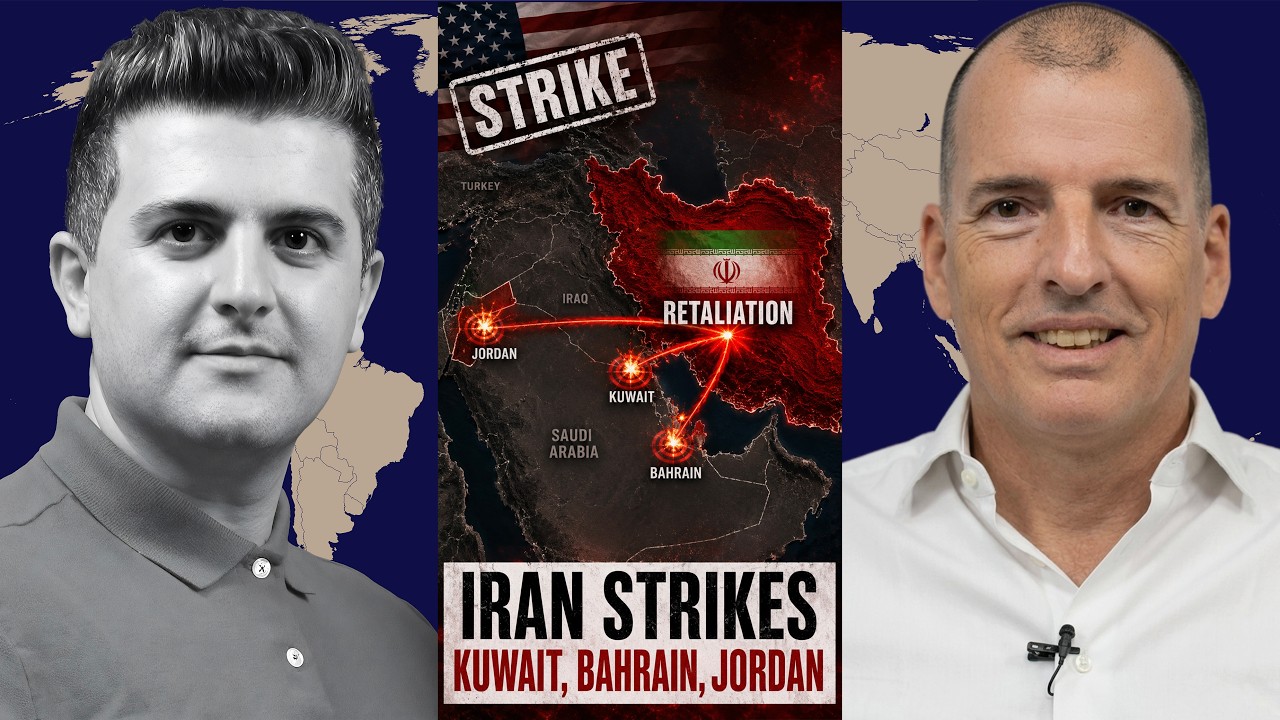
Alex Krainer: US STRIKES Iran – Iran RETALIATES Against Kuwait, Bahrain & Jordan!
"Amidst escalating US-Iran conflict and Iranian retaliation against regional US allies, this episode argues that US foreign policy is deeply controlled by an 'Anglo-Zionist conspiracy' led by the Rothschild banking dynasty, prioritizing Israeli interests over American ones."

🚨 TOTAL F*CKING CHECKMATE 😂😂😂
"The host argues that Trump's 'ceasefire' with Iran was a calculated '5D chess' move to orchestrate a global energy market reshuffle, while simultaneously lambasting 'woke' domestic policies and the 'freefall' of anti-Trump conservative figures."
Robby Soave GOES OFF On ANNOYING Liberal Black Woman Making Emotional Trump Deranged Arguments!
"The host dissects a heated foreign policy debate, arguing that 'left-wing' emotionalism and 'Trump derangement' prevent a rational understanding of US sanction strategies against Cuba and Iran."