Highlights from BillOReilly.com’s No Spin News | January 9, 2026
YouTube · 2hvAmMtEmAY
Quick Read
Summary
Takeaways
- ❖The death of Renee Nicole Good was a result of her 'bad decision' to impede a federal investigation.
- ❖Bill O'Reilly refuses to judge the shooting officer without full forensic evidence and testimony, citing the intensity of split-second decisions.
- ❖The genesis of the Minneapolis incident is attributed to President Biden's immigration policies, which O'Reilly claims allowed a criminal element into the U.S.
- ❖Sanctuary city leaders like Governor Walls and Mayor Fry are accused of 'inciting rebellion' against federal law, contributing to the environment that led to Good's death.
- ❖The Trump administration's deployment of ICE to Minneapolis was justified by a $9 billion fraud perpetrated by illegal migrants and the need to impose order.
- ❖ICE agents involved in the incident did not deescalate the situation, contrary to standard police agency protocols.
- ❖Modern policing is increasingly effective due to technological innovations like drones, license plate readers, and ShotSpotter, which deter and apprehend criminals faster.
- ❖Despite political differences between cities, law enforcement agencies maintain strong inter-agency cooperation and leverage technology to combat crime.
Insights
1The 'Bad Decision' Framework for Renee Good's Death
O'Reilly frames Renee Nicole Good's death as a direct consequence of her 'bad decision' to actively interrupt and impede a federal ICE investigation. He emphasizes that putting oneself in such jeopardy, especially as a mother of three, is irresponsible and dangerous, regardless of one's political motivations.
The first bad decision which led to her death was she should not have been interrupting a federal investigation which she was and she had parked her car to try to impede federal agents. That is a terrible decision particularly have three children.
2Refusal to Condemn the Officer Without Full Evidence
O'Reilly explicitly states his refusal to 'second guess a law officer' or 'pass judgment' on the ICE agent who fired the shot. He argues that such judgments require enhanced videotape analysis (frame-by-frame from every angle) and the officer's testimony to understand their state of mind during a split-second, life-threatening decision, deferring to a federal grand jury.
I'm not going to second guess a law officer. That's cheap and uh I'm not going to do it. All right? I wasn't there... What you would need to make a decision on that is enhanced videotape... and then you would need to hear the agent himself testify what his state of mind was. These are split-second decisions.
3Biden Administration's Immigration Policy as the 'Genesis' of the Tragedy
O'Reilly asserts that the fundamental cause of the Minneapolis incident, and similar events, is the Biden administration's immigration policy. He claims that allowing 'millions of people unsupervised' into the United States introduces a criminal element, necessitating federal intervention like the ICE operation that led to Good's death.
Now, the bad decision-making goes back to Joe Biden. That's where it goes. that that is the genesis of this story. So you allow millions of people unsupervised to come into the United States, you're going to have a criminal element come in and they're going to kill people, which they have.
4Sanctuary City Leaders Accused of 'Rebellion' and Incitement
O'Reilly accuses leaders in sanctuary states and cities, specifically Minnesota Governor Tim Walz and Minneapolis Mayor Jacob Frey, of 'rebellion' against federal law by refusing to cooperate with ICE. He argues their rhetoric and policies 'incited' individuals like Renee Good to act against federal agents, directly contributing to her death. This is likened to actions of Southern states in the 1850s.
The people who run states like California, Illinois, Minneapolis, um Minnesota, Massachusetts, and others made a decision not to obey federal law. We are not going to obey federal law. This is rebellion... That decision-making on the part of Governor Walls and Mayor Jacob Fry in Minneapolis did contribute to the death of Miss Good because those two men incited Miss Good.
5Technology's Transformative Role in Modern Policing
Former police chief Jeffrey Hollstead details how technological advancements are significantly improving law enforcement's ability to prevent and solve crimes. Innovations like drones as first responders, widespread license plate reader technology, and ShotSpotter systems enable faster response times, broader surveillance, and quicker apprehension of serial criminals, making it harder for them to evade capture.
Now, we have drones as first responders where our goal in law enforcement will get to emergency calls in less than 5 minutes. Drones are there in 30 seconds. And then with license plate reader technology deployed all over major, you know, city and metropolitan regions, they're scanning thousands of license plates per second... it's bad days for serial criminals because they even talk on some of their criminal podcast how much they hate drones and advancing technology because they can't get away fast enough.
Bottom Line
The FBI distrusts local law enforcement in Minneapolis and is reportedly withholding evidence from local authorities in the Renee Good case.
This suggests a significant breakdown in inter-agency trust and cooperation, potentially hindering a comprehensive investigation and fueling local-federal tensions. It implies a belief that local authorities might mishandle evidence or be politically biased.
This situation creates an opportunity for independent oversight or federal intervention to ensure transparency and accountability, or conversely, for local authorities to publicly challenge the FBI's distrust and demand full disclosure to restore public confidence.
Despite lenient prosecution policies in some major cities (e.g., California's $1,000 felony threshold), law enforcement is adapting by forming public-private partnerships with retail associations and focusing on serial offenders by lumping together multiple offenses for prosecution.
This indicates a strategic shift in policing to circumvent policy limitations that might otherwise embolden petty criminals. It shows resilience and innovation within law enforcement to maintain effectiveness even when facing political or legal hurdles.
Businesses, especially retail, can proactively engage with law enforcement to establish these partnerships, leveraging technology and data sharing to protect assets and contribute to community safety, even in jurisdictions with 'soft on crime' policies. Technology providers can develop solutions tailored to aggregate evidence for serial offender prosecution.
Key Concepts
People Believe What They Want to Believe
This mantra suggests that approximately 90% of the human population forms opinions based on emotion and preconceived notions, rather than facts, particularly in politically charged situations. This leads to immediate polarization and demonization of opposing sides.
Chain of Causation / Bad Decisions Lead to Bad Outcomes
This model posits that individual actions and policy choices create a domino effect, where initial 'bad decisions' at various levels (individual, local government, federal government) can cumulatively lead to tragic or undesirable outcomes. O'Reilly applies this to explain the Minneapolis shooting, tracing it from the victim's actions to local policies and federal immigration decisions.
Lessons
- Avoid actively impeding law enforcement or federal agents during investigations, as such actions can lead to dangerous and potentially fatal outcomes.
- When evaluating incidents involving law enforcement, consider the full 'chain of causation' rather than isolated events, examining contributing factors from individual decisions to broader policy implications.
- Understand that modern policing increasingly relies on advanced technology (drones, LPRs, ShotSpotter) for crime prevention and apprehension, which significantly alters the risk landscape for criminal activity.
Quotes
"Our mantra is people believe what they want to believe. And that's about 90% of the population, the human population. So, you know, facts, not a lot of facts matter. It's all emotion. They believe what they want to believe."
"You do not impede authorities on the job anywhere, anytime. You do not do that. That's not protest."
"The bad decision-making goes back to Joe Biden. That's where it goes. that that is the genesis of this story."
"We are not going to obey federal law. This is rebellion. That's what it is. It's like what South Carolina and other southern states did in the 1850s."
"Descalation is the rule of the land in police agencies. A lot of people don't understand that and that did not happen in Minneapolis yesterday."
"It's bad days for serial criminals because they even talk on some of their criminal podcast how much they hate drones and advancing technology because they can't get away fast enough."
Q&A
Recent Questions
Related Episodes

Judge REJECTS DESPERATE Democrat STUNT As Trump Threatens To INVOKE Insurrection Act In Minneapolis!
"A Minnesota judge rejected a Democratic lawsuit to block ICE operations, while former President Trump threatened to invoke the Insurrection Act in Minneapolis amid escalating protests against federal immigration enforcement, sparking debate on state vs. federal authority and de-escalation tactics."
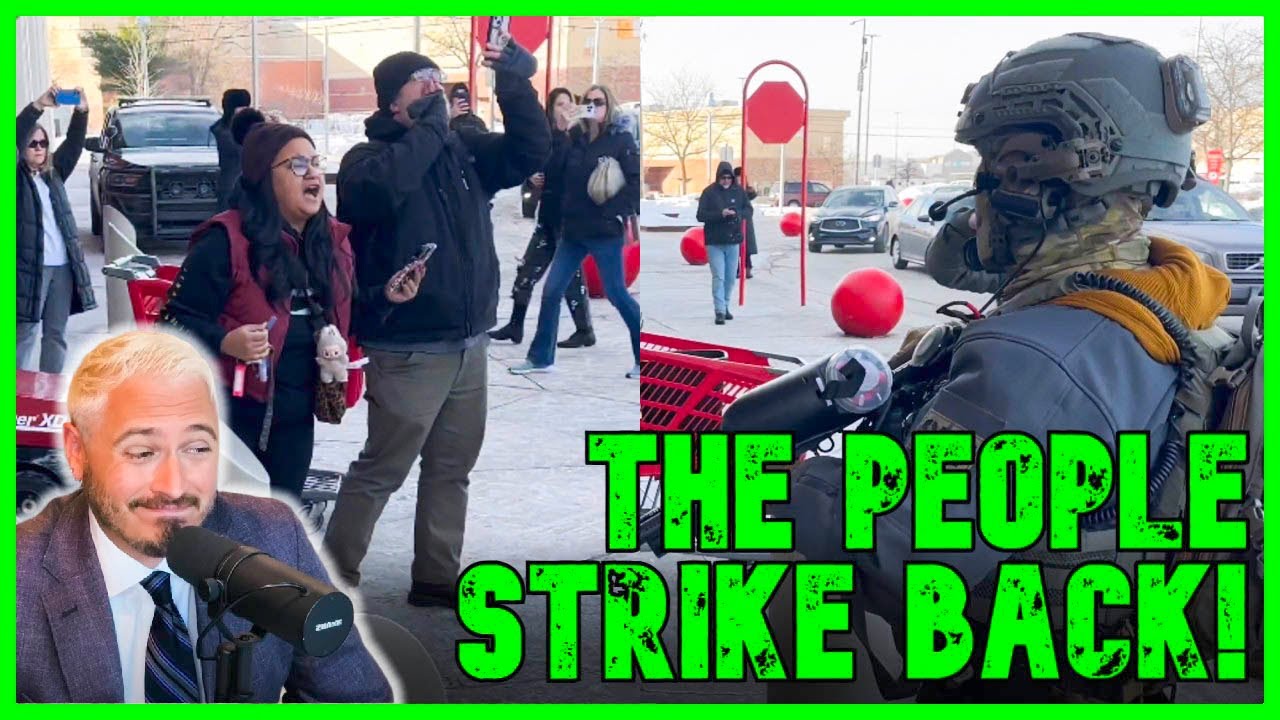
‘YOU’RE A B*TCH!’: Americans EXPLODE At ICE Thugs TO THEIR FACE | The Kyle Kulinski Show
"Host Kyle Kulinski presents multiple graphic videos and eyewitness accounts of alleged ICE abuses, including assaults, illegal detentions, and sexual misconduct, arguing that these actions are galvanizing widespread public resistance and exposing a growing authoritarian state."

Iran Deal Skepticism. Whoopi Vs Vance. Potomac Park Invasion. Racist Hurls Slurs At Black Boy.
"This episode dissects multiple instances of alleged anti-Black policies and racial injustice, from the Trump administration's legal challenges to reparations and the Iran deal, to police brutality and the erasure of Black history."

PBS News Hour full episode, June 12, 2026
"The U.S. and Iran inch closer to a contentious peace deal amidst conflicting terms, while President Trump hosts a UFC cage fight on the White House lawn, and Gaza's children struggle for education in war-torn conditions."