
Mark Sleboda: Iran’s New Missiles SLAM Israel & US Bases - Saudi & UAE Involved as Bases Open
YouTube · 2sK4uoW8I8c
Quick Read
Summary
Takeaways
- ❖US/Israel's decapitation strikes against Iran's leadership failed to achieve regime change, as Iran had a robust succession plan and mosaic defense strategy.
- ❖US military capabilities are constrained by critically low stockpiles of air defense interceptors (Patriot, THAAD) and precision standoff munitions (Tomahawk, JASSM).
- ❖Iran has effectively closed the Strait of Hormuz to Western and Gulf traffic, while increasing its own oil exports and those to China/India.
- ❖Iran's retaliatory strike destroyed 17% of Qatar's LNG refinement capacity, causing permanent damage and long-term gas market disruption.
- ❖Iran responded to US/Israeli attacks on its nuclear sites by firing a warning shot at Israel's Dimona nuclear weapons facility.
- ❖Proposed US ground operations in Iran (e.g., Kark Island) are deemed militarily absurd and a 'death trap' given Iran's defenses and troop numbers.
- ❖The conflict has spread across the Middle East, reigniting tensions in Iraq and involving Hezbollah and Houthi forces, further disrupting global trade routes.
- ❖Russia and China are geopolitically and economically benefiting from the conflict, with Russia reportedly providing intelligence and military assistance to Iran.
Insights
1US/Israel Regime Change Attempt Failed Due to Iranian Resilience
The US and Israel believed decapitation strikes against Iran's supreme leader and top military/political figures would cause the regime to collapse within days. However, Iran had implemented a 'mosaic defense mode' and a four-level chain of succession, allowing replacements to step in immediately and regional commands to operate autonomously. The new Supreme Leader, Mojtaba, is described as a 'hardliner' with a more 'grounded' vision, and his family's death in the attacks makes diplomacy highly unlikely.
US/Israel believed 100% of Iran's military capabilities were destroyed (), but Iran continued launching missiles and drones (). Ayatollah Ali Hidi set up a four-level chain of succession (). Mojtaba, the son, stepped in as Supreme Leader (). Decapitation strikes continued, killing the National Security Council secretary, intelligence minister, IRGC spokesperson, and head of Basij in the last week (-).
2US Military Faces Critical Munitions Shortages in Attrition War
The US military's Achilles' heel is its low stockpiles and slow production rates of critical munitions, particularly air defense interceptors (Patriot, THAAD) and precision standoff missiles (Tomahawk, JASSM). Iran's continued missile and drone launches force the US to expend these limited resources, while US bases in the Middle East are under constant attack, making resupply difficult.
US has low stockpiles and production rates of Patriot (620/year) and THAAD (less than 100/year) interceptors (-). US ships fired 'just about' all Tomahawks () which cannot be reloaded at sea (). JASSM air-launched cruise missiles also have limited supply (a few thousand before conflict) (-). An F-35 stealth fighter was hit by Iranian air defense (-).
3Iran Weaponizes Global Energy Markets, Achieving Escalation Dominance
Iran's primary strategy is to make global energy markets 'scream' by damaging the energy infrastructure of US Gulf state allies and de facto closing the Strait of Hormuz. This 'sanction option' or 'nuclear option' gives Iran significant leverage, as the US Navy cannot unblock the strait without severe losses, and allies are unwilling to intervene.
Iran is hitting Gulf state energy facilities and has de facto closed the Strait of Hormuz to Western traffic (-). Iran's own and China/India-bound tankers are still passing through (-). The US Navy refused Trump's order to clear the strait, deeming it a 'death trap' (-). Trump's allies (UK, France, Japan, South Korea, China) refused to help free the strait (-).
4Iran's Retaliation on Qatar's LNG Facilities Causes Permanent Global Gas Market Damage
In response to US/Israeli attacks on its South Pars gas field, Iran immediately retaliated by destroying 17% of Qatar's Ross Leafan LNG facilities. This caused permanent damage, costing tens of billions to install and taking years to repair, leading to a long-term surge in global gas prices, particularly impacting Europe, South Korea, and Japan.
US/Israel attacked Iran's South Pars gas field (). Iran retaliated by destroying 17% of Qatar's Ross Leafan LNG facilities (-). Qatar is the world's second-biggest LNG exporter (). Damage is 'extensive' and 'permanent,' costing tens of billions and taking years to repair (-).
5Iran Targets Israeli Nuclear Site in Escalatory Response
Following US/Israeli attacks on Iran's Bushehr and Natanz nuclear sites, Iran immediately escalated by firing a 'warning shot' at Israel's Dimona nuclear power plant, which is also used for nuclear enrichment and weapons production. This demonstrates Iran's willingness to target sensitive nuclear facilities in a tit-for-tat escalation.
US/Israel attacked Iran's Bushehr nuclear plant () and Natanz enrichment site (). Iran responded by hitting Dimona, Israel's nuclear power and weapons site (-). The strike was likely a 'warning shot' (-).
Bottom Line
The conflict is forcing Gulf Arab states to re-evaluate their security relationship with the US, as US presence now makes them targets rather than protectors.
This could lead to a significant realignment of regional alliances, potentially reducing US influence and increasing the autonomy of Gulf states or their alignment with other powers.
Nations like China and Russia could expand their security and economic partnerships in the Gulf, offering alternative security frameworks or investment opportunities in a less US-centric region.
The Houthi declaration of war on the US and their ability to close the Bab-el-Mandeb Strait poses a 'double whammy' to global energy and trade, compounding the Strait of Hormuz closure.
This threatens to further exacerbate global hyperinflation, as oil, gas, and fertilizer prices surge due to dual chokepoint closures, impacting supply chains worldwide.
Companies and nations should accelerate investments in alternative energy sources, diversify supply chains away from Middle Eastern chokepoints, and explore new trade routes less vulnerable to regional conflicts.
The conflict is reigniting civil conflict dynamics in Iraq, with US forces targeting pro-Iranian Shia Iraqis and Iran targeting anti-Iranian Kurdish Iraqis.
This creates extreme instability in Iraq, risking a full-blown civil war that could further destabilize the region and create new humanitarian crises.
Regional powers and international organizations could focus on diplomatic initiatives to de-escalate tensions in Iraq and support internal stability, potentially creating opportunities for reconstruction and peace-building efforts if the conflict de-escalates.
Key Concepts
Escalation Dominance
The ability of one party in a conflict to consistently raise the stakes in a way that the other party cannot or will not match, thereby gaining leverage. Iran demonstrates this by hitting critical energy infrastructure and nuclear sites, knowing the US/Israel cannot escalate further without unacceptable global economic or political consequences.
Asymmetric Warfare (Economic Weaponization)
A conflict between belligerents whose military power differs significantly, where the weaker side uses unconventional strategies. Iran's strategy involves weaponizing global energy markets and trade routes (Strait of Hormuz, Gulf state infrastructure) against the US and its allies, leveraging economic pain to achieve political objectives rather than direct military parity.
Mosaic Defense
A decentralized military command and control structure where power is devolved to regional commands operating with minimal central oversight, following pre-arranged orders. This allows for continued effective operations even after decapitation strikes against top leadership, as demonstrated by Iran.
Lessons
- Monitor global energy markets closely for continued volatility and price surges in oil, natural gas, and fertilizer, as these will directly impact production costs and consumer prices worldwide.
- Re-evaluate supply chain resilience and diversification strategies, particularly for goods reliant on Middle Eastern trade routes (Strait of Hormuz, Bab-el-Mandeb) or energy-intensive production.
- Assess geopolitical risk exposure in investment portfolios, considering the potential for prolonged conflict, hyperinflation, and shifts in international alliances and trade relationships.
- Businesses with operations or significant trade in the Middle East should develop contingency plans for escalating conflict, including potential disruptions to infrastructure, labor, and logistics.
- Governments and international bodies should prepare for increased diplomatic efforts and potential humanitarian crises stemming from regional destabilization and economic fallout.
Notable Moments
US/Israel launch decapitation strikes against Iranian leadership, believing it would cause rapid regime collapse.
This initial miscalculation by the US and Israel underestimated Iran's resilience and led to a protracted, escalating conflict rather than a swift victory.
Iran retaliates against Qatar's Ross Leafan LNG facilities after its South Pars gas field is attacked.
This marked a significant escalation, demonstrating Iran's willingness and capability to inflict permanent, multi-billion dollar damage on critical energy infrastructure of US allies, directly impacting global gas markets for years.
Iran fires a 'warning shot' at Israel's Dimona nuclear site following attacks on Iranian nuclear facilities.
This indicates a dangerous escalation to targeting nuclear sites, raising the specter of nuclear conflict and demonstrating Iran's 'tit-for-tat' escalatory response strategy.
US military leaders reportedly warn against ground invasion of Iran, deeming it a 'death trap'.
This highlights the severe military limitations and risks faced by the US in a direct confrontation with Iran, despite political rhetoric suggesting otherwise.
Quotes
"The US has destroyed 100% of Iran's military capabilities. However, that it's that 0% of Iran's military capabilities that is destroying Middle Eastern Gulf Arab state energy infrastructure, closing the Strait of Hormuz, and sending the global energy markets and economy into a crisis."
"Phase one, drop some bombs and kill some people. Phase two, question mark. Phase three, regime change. Of course, it didn't happen that way because the US government operates from a caricatured assessment of all of its adversaries."
"The US has met another geopolitical hard limit. And that is right now Iran has escalation dominance in this conflict through keeping the Strait of Hormuz closed and the ability to inflict damage on the energy infrastructure of the US's Gulf state vassals."
"Iran is in an existential situation and they have the means and they have hit back at the global energy markets, the global economy and weaponized the global economy against the United States."
"It would be stupider than the cursed fools crusade. It would be stupider than that."
Q&A
Recent Questions
Related Episodes

Col. Jacques Baud: Middle East on Fire — Is This the Start of Something Bigger?
"Colonel Jacques Baud dissects the escalating conflict between the US, Israel, and Iran, arguing that Western misunderstanding of Iranian culture and strategic duplicity have forced Iran into a position of necessary escalation, ultimately degrading the West's own strategic posture."

Patrick Henningsen: Hezbollah JUST Fired Back at Israel - Iran Vows to “Crush” All Attacks
"Patrick Henningsen argues that the US and Israel initiated an illegal war against Iran, driven by Trump's incompetence and Israeli influence, leading to an inevitable escalation with severe global economic repercussions."
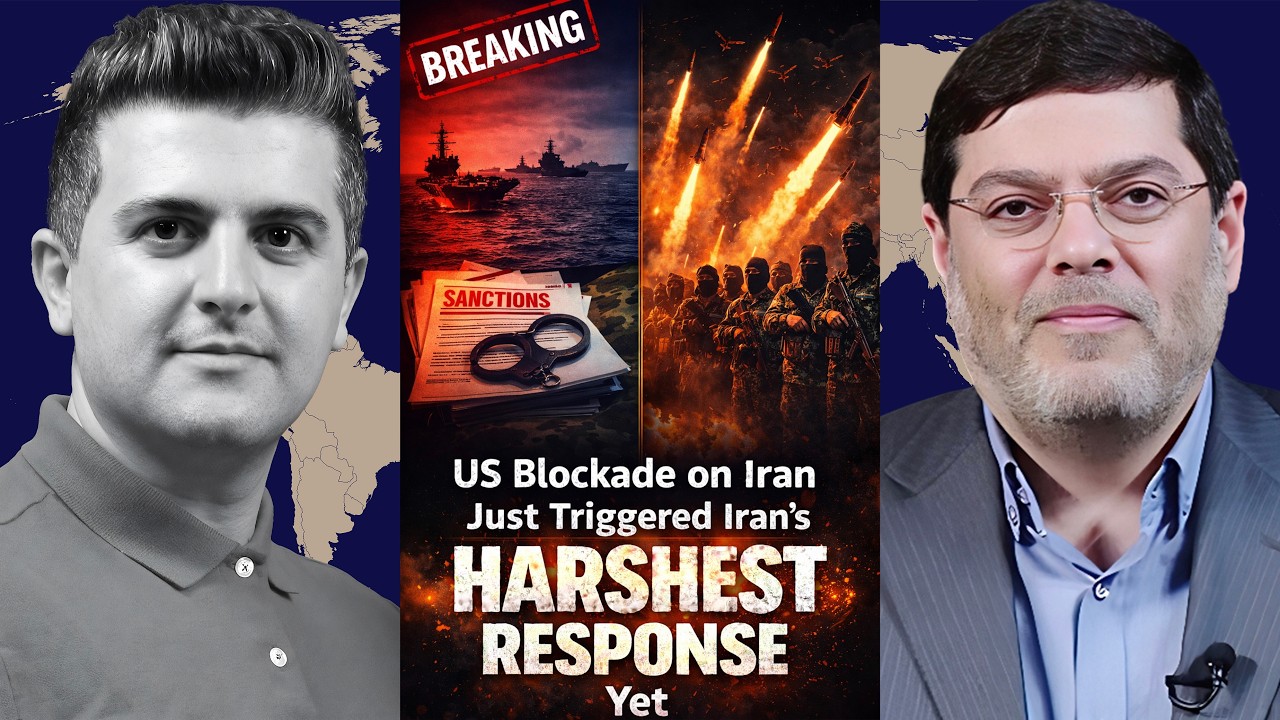
Seyed M. Marandi: US Blockade on Iran Just Triggered Iran’s HARSHEST Response Yet
"An Iranian professor details how US demands and an imposed blockade triggered Iran's harshest response, exposing American strategic missteps and the vulnerability of Gulf Arab states."

🚨 TOTAL F*CKING CHECKMATE 😂😂😂
"The host argues that Trump's 'ceasefire' with Iran was a calculated '5D chess' move to orchestrate a global energy market reshuffle, while simultaneously lambasting 'woke' domestic policies and the 'freefall' of anti-Trump conservative figures."