
Good Luck Spinning Trump's Speech, Fox News! (w/ Michael Weiss & Marc Polymeropoulos)
YouTube · 3njlIlPayYg
Quick Read
Summary
Takeaways
- ❖Donald Trump, at the G7, declared Iran 'rational' and open to a deal, reversing previous 'war' objectives regarding ballistic missiles, uranium enrichment, and frozen funds.
- ❖This policy reversal is seen as a 'surrender document' by Iran hawks and has caused 'apocalyptic meltdown' among Israeli intelligence partners.
- ❖US intelligence sharing with Ukraine has not only persisted but deepened and expanded under the Trump administration, despite his public animosity towards Zelensky.
- ❖Key figures like John Ratcliffe have 'managed' Trump by framing Ukrainian success in terms of Russian casualties, appealing to Trump's desire to 'chop down' adversaries.
- ❖Ukraine's intelligence services, initially seen as compromised, proved their worth by providing critical intelligence on Russian interference in the 2016 US election.
- ❖The use of American weapons systems by Ukraine against Russia provides invaluable military intelligence on Russian responses and adaptations, serving as a 'lab experiment' for US defense.
- ❖Ukrainian intelligence officers, like Kyrylo Budanov, have deep, long-standing personal relationships with their CIA counterparts, fostering trust and enabling difficult conversations.
- ❖The longer the Russia-Ukraine war continues, the worse it is for Putin and Russia's economy, forcing potential mass mobilization or a dismal deal.
- ❖Europeans are increasingly emboldened to drive negotiations and support Ukraine, as US attention wanes, with less American involvement potentially being beneficial for Ukraine.
Insights
1Trump's Radical Iran Policy Reversal
At the G7, Donald Trump announced a dramatic shift in US policy towards Iran, declaring the regime 'rational' and capable of a deal. He stated Iran has a right to ballistic missiles (previously a casus belli), may enrich uranium for civilian purposes (previously a red line), and that frozen funds are 'their money' to be returned. These positions directly contradict the hawkish stance previously championed by his administration and the Republican party, which had accused the Obama administration of similar 'treasonous' normalization efforts.
Trump's statements at the G7 press conference, including declaring the Iranian regime 'no longer radical, it is rational,' and affirming their right to ballistic missiles and uranium enrichment.
2US-Ukraine Intelligence Cooperation Deepens Despite Trump's Antipathy
Despite Donald Trump's public dislike for Ukraine and President Zelensky, intelligence sharing between the CIA and Ukraine's military intelligence (GUR) has not only persisted but deepened and expanded. This covert assistance includes providing targeting packages for strikes against Russian troops in occupied territories and even inside Russia, targeting energy infrastructure. This continuity is attributed to figures like John Ratcliffe, who reportedly 'managed' Trump by appealing to his desire to see Russians 'chopped down,' framing Ukrainian successes in terms of enemy casualties.
Confirmation from both American and Ukrainian sources that intelligence sharing has deepened; Ratcliffe's alleged strategy of playing golf with Trump and highlighting Russian casualties to maintain support.
3Ukraine as a Strategic 'Lab Experiment' for US Military Intelligence
The conflict in Ukraine provides an unprecedented opportunity for the US to gather military intelligence on Russian capabilities and adaptations. As Ukraine uses American and NATO-interoperable weapon systems against Russia, it generates a 'windfall' of data on how Russian forces respond, adapt, and how their electronic warfare operates. This real-world combat data is invaluable for preparing the United States for any future confrontation with Russia, a scenario that was hypothetical throughout the Cold War.
The hosts' discussion of Ukraine being a 'lab experiment' on Russian EW and the 'windfall of military intelligence' gained from observing Russian responses to American weapon systems.
4Long-Term US Investment in Ukrainian Intelligence Pays Off
The US, particularly the CIA, began 'putting in the plumbing' in Ukraine's intelligence services over a decade ago, building capacity, training, and identifying reliable officers. This long-term investment, initially cautious due to Russian infiltration concerns, proved critical during the 2022 invasion, with CIA communications and targeting assistance helping to stem the initial Russian assault. Key Ukrainian figures, like Kyrylo Budanov, who was trained by CIA ground branch, have developed deep personal relationships with American counterparts, fostering trust and continuity.
Discussion of building capacity since 2014-2015, Adam Entous's New York Times piece, Ukrainian intelligence's frantic calls to CIA during the initial assault, and the close relationship with Budanov.
Bottom Line
The US intelligence community's long-standing, personal relationships with Ukrainian counterparts, cultivated over a decade, provided a critical backchannel and foundation for continued support even when the political leadership was hostile.
This highlights the resilience and strategic importance of 'deep state' institutional relationships, which can buffer against abrupt political shifts and ensure continuity of vital national security interests.
Governments should prioritize and protect these long-term, non-political intelligence liaisons as essential components of national security, recognizing their value in maintaining stability and strategic advantage across administrations.
Ukraine's ability to 'maggyver' and improve US-provided munitions to be more lethal and resistant to Russian electronic warfare demonstrates a unique innovation capacity.
This suggests that partner nations, especially those in active conflict, can offer valuable R&D insights and improvements to advanced military technology, rather than merely being recipients.
Defense industries and military planners should establish formal feedback loops and collaborative development programs with combat-experienced allies like Ukraine to accelerate innovation and adapt technologies for real-world effectiveness.
Key Concepts
David vs. Goliath Story
The hosts frame Ukraine's struggle against Russia as a 'David vs. Goliath' narrative, resonating with US intelligence officers who see it as a righteous cause after years of 'mixed feelings' from the Global War on Terrorism.
Ask Forgiveness, Not Permission
This model describes how Israel and Ukraine often operate, taking decisive action (like bombing a nuclear reactor or striking inside Russia) and then dealing with the diplomatic fallout, rather than waiting for explicit approval from allies like the US.
The 'Plumbing' of Intelligence
Refers to the foundational, often unglamorous work of building intelligence capacity, training, and identifying reliable officers within a partner nation's intelligence service, which proved critical for Ukraine's defense.
Lab Experiment
Ukraine's conflict with Russia is viewed as a real-world 'lab experiment' for testing Russian electronic warfare, military tactics, and how they respond to NATO-interoperable weapon systems, providing invaluable data for US defense planning.
Lessons
- Recognize that stated foreign policy positions, especially from unpredictable leaders, may not fully reflect ongoing covert intelligence operations or long-term strategic partnerships.
- Understand that 'deep state' institutional relationships and intelligence cooperation can provide a critical, resilient backbone for national security, often insulated from political rhetoric.
- Leverage conflicts involving adversaries as 'lab experiments' to gather invaluable military intelligence on their capabilities, tactics, and responses to modern weaponry, informing future defense strategies.
Notable Moments
Trump's G7 press conference where he reversed long-standing US policy on Iran, granting them rights to ballistic missiles and uranium enrichment, and affirming frozen funds as 'their money.'
This moment signifies a dramatic and unexpected shift in US foreign policy, directly contradicting previous objectives and causing alarm among allies and domestic political factions.
The revelation that US intelligence support to Ukraine is 'actually better' under the Trump administration than under Biden, particularly in providing targeting assistance for strikes inside Russia.
This counterintuitive fact challenges common narratives about Trump's stance on Ukraine and highlights the enduring, and even enhanced, strategic cooperation between intelligence agencies despite political friction.
The story of Kyrylo Budanov, a CIA-trained Ukrainian military intelligence officer, orchestrating the Afghan withdrawal for the US and now serving as Zelensky's chief of staff.
This illustrates the deep personal and professional trust built between US and Ukrainian intelligence, demonstrating Ukraine's reliability as an ally and the long-term payoff of capacity-building efforts.
Quotes
"Iran has every right to have ballistic missiles because Saudi Arabia has them. Like one of the operational objectives of going to war with Iran was to eliminate the missile program. Now, no, they can have it."
"It's almost as if Donald Trump is acting as a democratic plant right now. I mean, that press conference was so out there."
"This is a complete reversal of all the things we set out to accomplish with this operation, Epic Fury."
"When Rackcliffe says to Donald Trump, 'This is how many Russians are being killed per month, and we're helping the Ukrainians do it,' Donald Trump's eyes widen. He gets excited by this."
"It's a lab experiment. It's a lab experiment on Russian EW, electronic warfare, and everything they're doing."
"The Ukrainians are using them, and they're showing us this is how the Russians respond to it. This is invaluable stuff."
"We look at the Ukrainians the way that, you know, we used to look at Cuban exiles after 1959. You know, we're going to use them as proxies. They're going to be operatives."
"What military, what special operations capable uh units were on the ground at Hammed Carzai airport uh helping the Afghan withdrawal and you know what that is. It's the Ukrainians."
Q&A
Recent Questions
Related Episodes
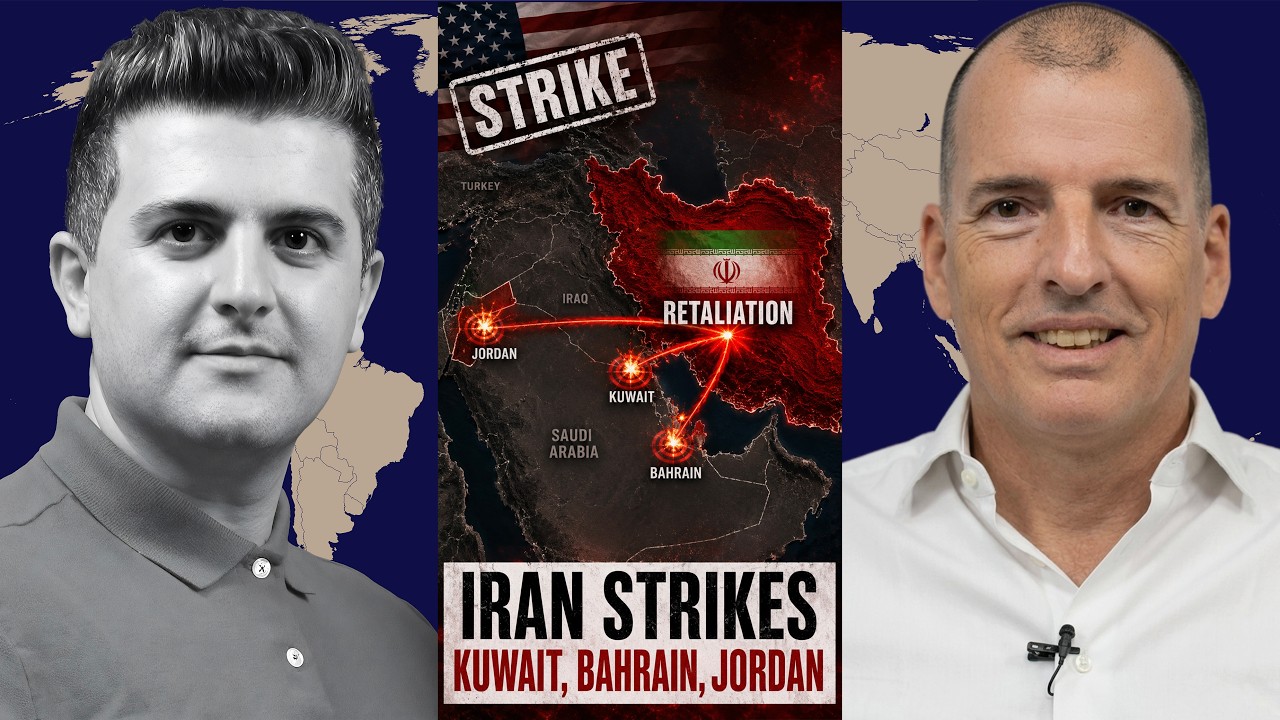
Alex Krainer: US STRIKES Iran – Iran RETALIATES Against Kuwait, Bahrain & Jordan!
"Amidst escalating US-Iran conflict and Iranian retaliation against regional US allies, this episode argues that US foreign policy is deeply controlled by an 'Anglo-Zionist conspiracy' led by the Rothschild banking dynasty, prioritizing Israeli interests over American ones."

Col. Jacques Baud: The World Is Entering a Lawless Era
"Colonel Jacques Baud details his personal experience with arbitrary EU sanctions and argues that the world has shifted from a law-based international order to a dangerous, rules-based system dictated by powerful actors, exemplified by US actions in Venezuela and the EU's 'teenager decision-making'."

BREAKING: Iran Threatens To END Talks; U.S. Vows Retaliation; Hezbollah Collapsing? | TBN Israel
"Iran is leveraging Hezbollah and the Strait of Hormuz to manipulate US negotiations, while Israel asserts its right to dismantle Hezbollah's eroding but still dangerous infrastructure in Lebanon, independent of international talks."

Iran Deal Skepticism. Whoopi Vs Vance. Potomac Park Invasion. Racist Hurls Slurs At Black Boy.
"This episode dissects multiple instances of alleged anti-Black policies and racial injustice, from the Trump administration's legal challenges to reparations and the Iran deal, to police brutality and the erasure of Black history."