Don't Count on Trump Coming to the Rescue (w/ Michael Weiss)
YouTube · 40D6ATnJVj4
Quick Read
Summary
Takeaways
- ❖Trump's approach to Iran is seen as a psychological operation, with external actors influencing his decisions to postpone direct military action.
- ❖The US strategy in Venezuela is described as 'oil imperialism,' aiming for remote control of the regime through figures like Deli Rodriguez, a known Cuban intelligence asset.
- ❖Cuban intelligence (DI) is a formidable 'foreign deep state' in Venezuela, making US attempts to remove them highly challenging.
- ❖The 'Pearl' system allows NATO and non-NATO countries to purchase US weapons for Ukraine, aligning with Trump's transactional view of alliances.
- ❖Covertly, the CIA assists Ukraine in targeting Russian assets, including oil tankers, while publicly, Trump expresses animosity towards Zelensky.
- ❖Havana Syndrome is strongly linked to Russia's GRU Unit 29155, with evidence of their operatives present at attack locations and research into acoustic weapons.
- ❖The US intelligence community initially dismissed Havana Syndrome as 'mass hysteria,' despite medical evidence of traumatic brain injuries, constituting a major scandal.
Insights
1Trump's Unpredictable and Transactional Iran Policy
Trump's foreign policy decisions regarding Iran are highly unpredictable, driven by a desire for 'spectaculars' and avoiding the 'paper tiger' label, rather than a coherent strategy. His actions are influenced by psychological factors, such as his disdain for Barack Obama, and external pressures from allies like Israel and Arab governments who advise caution or specific targets. This leads to a situation where public statements might contradict covert actions, creating uncertainty for both adversaries and the Iranian populace.
Trump encouraged Iranian protesters with promises of 'help on the way' but then seemed to climb down, with reports of assurances to Iran. The New York Times reported Netanyahu and Israelis advised postponing an attack due to insufficient assets and fear of retaliation. Trump's psychological motivation to avoid being compared to Obama's 'red line' failure is a significant factor. (, , )
2Venezuela: 'Oil Imperialism' and the Cuban Deep State
The US approach to Venezuela under Trump is characterized as 'oil imperialism,' prioritizing access to oil and control over migration rather than democracy promotion. This strategy involves working with figures like Deli Rodriguez, a known Cuban intelligence asset, through back channels. The pervasive influence of Cuban intelligence (DI) within Venezuela's security apparatus creates a 'foreign deep state,' making genuine regime change or removal of Cuban influence extremely difficult, despite US efforts to manipulate the regime remotely.
Trump's Venezuela policy is 'naked' about oil, with no pretense of democracy promotion (). Deli Rodriguez, a 'died in the wool Marxist guerrilla' and 'asset of Cuban intelligence,' has a back channel with Marco Rubio (). John Bolton noted Cubans prevent military mutiny (). The Cubans have 20-30,000 assets, many as deep cover 'illegals' (). Qataris brokered initial contacts and handle oil proceeds ().
3Ukraine: A 'Groundhog Day' Cycle of US Ambivalence and Covert Support
US policy towards Ukraine is stuck in a repetitive cycle, heavily influenced by Trump's personal animosity towards President Zelensky due to his first impeachment. While publicly, Trump often blames Ukraine and expresses pro-Russian sentiments, covertly, US intelligence agencies like the CIA continue to provide critical support, including targeting packages for strikes inside Russia. European allies are encouraged to increase their self-reliance and financial contributions through mechanisms like the 'Pearl' system to offset US unreliability.
Trump views Zelensky and Ukraine as 'inextricable from his first impeachment' and has 'never forgiven him' (). Russia uses nuclear fear-mongering, which 'works very powerfully with Donald Trump psychologically' (). The 'Pearl' system allows NATO and non-NATO countries to purchase US weapons for Ukraine, which Trump 'likes' because it aligns with his transactional nature (). The CIA coordinates targeting packages for Ukrainian drone strikes inside Russia and helps target Russia's shadow oil fleet (, ).
4Havana Syndrome: Russian GRU Attacks and US Government Cover-up
Havana Syndrome, or Anomalous Health Incidents (AHI), is not psychosomatic but involves real physiological harm, including traumatic brain injuries, caused by directed energy weapons. Evidence strongly implicates Russia's GRU Unit 29155, a kinetic operations unit, with operatives geolocated at attack sites and research into acoustic weapons. The US government, particularly elements within the CIA, initially dismissed and even mocked victims, leading to a 'conspiracy' to downplay the incidents, which is now being exposed by new intelligence and congressional reports.
The intelligence community's expert panel concluded plausible explanations for AHI symptoms using radio frequency or acoustic devices (). Medical records show 'traumatic brain injuries' and severe ailments (). Unit 29155 of the GRU was found researching acoustic weapons and radio frequency, and two operatives were geolocated at attack sites in Frankfurt (2014) and Tbilisi (2021) (). The House Permanent Select Committee on Intelligence criticized the IC for 'analytic rigor' failure and stated foreign adversary involvement is 'increasingly likely' ().
Lessons
- Recognize that US foreign policy can be highly personalized and unpredictable under certain leadership, requiring allies and adversaries to adapt to inconsistent messaging and actions.
- Understand that 'remote control imperialism' and the manipulation of foreign regimes can involve complex networks of intelligence assets and third-party brokers, often prioritizing economic interests over stated democratic values.
- For countries reliant on US support, develop robust domestic defense capabilities and strengthen alliances with other partners to mitigate the risk of US abandonment or policy shifts, as exemplified by Ukraine's strategy.
- Demand transparency and accountability from government and intelligence agencies regarding incidents affecting personnel, especially when initial dismissals contradict medical evidence and investigative journalism.
Quotes
"This is not a guy who is interested in regime change. Right. I mean, he goes into Venezuela, he snatches Maduro, beautifully waged, almost flawless operation. Um, you know, one aircraft helicopter was sort of strafed and somebody got shot in the leg, but no, no fatalities and mission accomplished. And then we discover actually there was a deal struck with Deli Rodriguez, who is one of the most hardline of hardliners, also very close to Cuban intelligence, to basically have regime continuity. So you get Maduroism without Maduro and very clearly this is about the oil."
"The best case scenario is this. You buy yourself time. You allow this Groundhog Day process to play out. So you you you know he comes out and he starts bashing Zalinsky over the head blaming Ukraine for the war that Russia started. You know what's going to happen, right? You go on the charm offensive. The Europeans come in uh Rut Maloney Macron Starmer. They do their their their thing with Trump. It's humiliating. I know they look like Cortiier, but this is the process. Suddenly, you know, the worst case scenario is averted. you seem to be making progress. And then either Putin picks up the the phone and calls Trump or whatever happens. Somebody whispers in his ear, JD Vance, Bridge, Colby, whoever. Oh, it's the Ukrainians. Let's get rid of them or let's sell out Donbas. And then the cycle repeats itself."
"This is a very cynical and malevolent thing. And the good news is in addition to the acquisition of this device, which now, as you can imagine, it's created a feeding frenzy in my profession, everyone wants to know more about where this came from. In addition to that, other things have come to light. Number one, the A uh the intelligence community assessment uh a year ago, two agencies in the intelligence community, one of them is the NSA, the other one is questioned, uh changed their assessment. So it went from very unlikely that such a device exists, much less that a foreign adversary has been wielding it against American personnel, to oh, it's 50/50."
Q&A
Recent Questions
Related Episodes

🚨 LEFTISTS ARE F*CKING SEETHING 😂😂😂
"The host aggressively celebrates perceived 'wins' for the right-wing, from global conflicts and domestic politics to cultural shifts, framing them as a 'humiliation' for the 'leftist world order' and a testament to Donald Trump's influence."

Will Venezuela Be Trump's Vietnam?
"An expert breaks down three perilous pathways for Venezuela under potential US intervention, from a 'Panamanian model' to a 'Libyan-style civil war,' and the broader geopolitical fallout for Latin America."
BREAKING: Protests ERUPT In Iran Over IRGC Surrendering To Trump - Infighting Clashes In Tehran
"Iran is experiencing severe internal infighting and protests as hardline IRGC elements clash with government figures over a perceived 'surrender' to the US, while mainstream Western media misrepresents the situation."
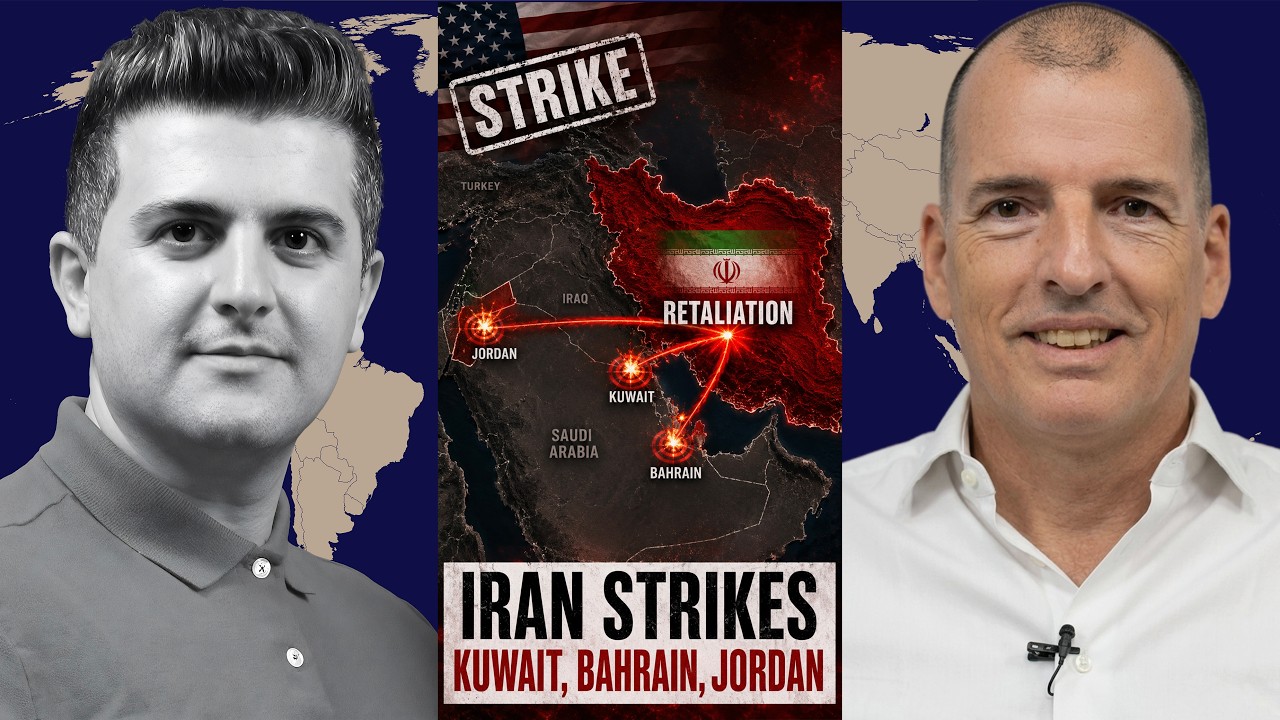
Alex Krainer: US STRIKES Iran – Iran RETALIATES Against Kuwait, Bahrain & Jordan!
"Amidst escalating US-Iran conflict and Iranian retaliation against regional US allies, this episode argues that US foreign policy is deeply controlled by an 'Anglo-Zionist conspiracy' led by the Rothschild banking dynasty, prioritizing Israeli interests over American ones."