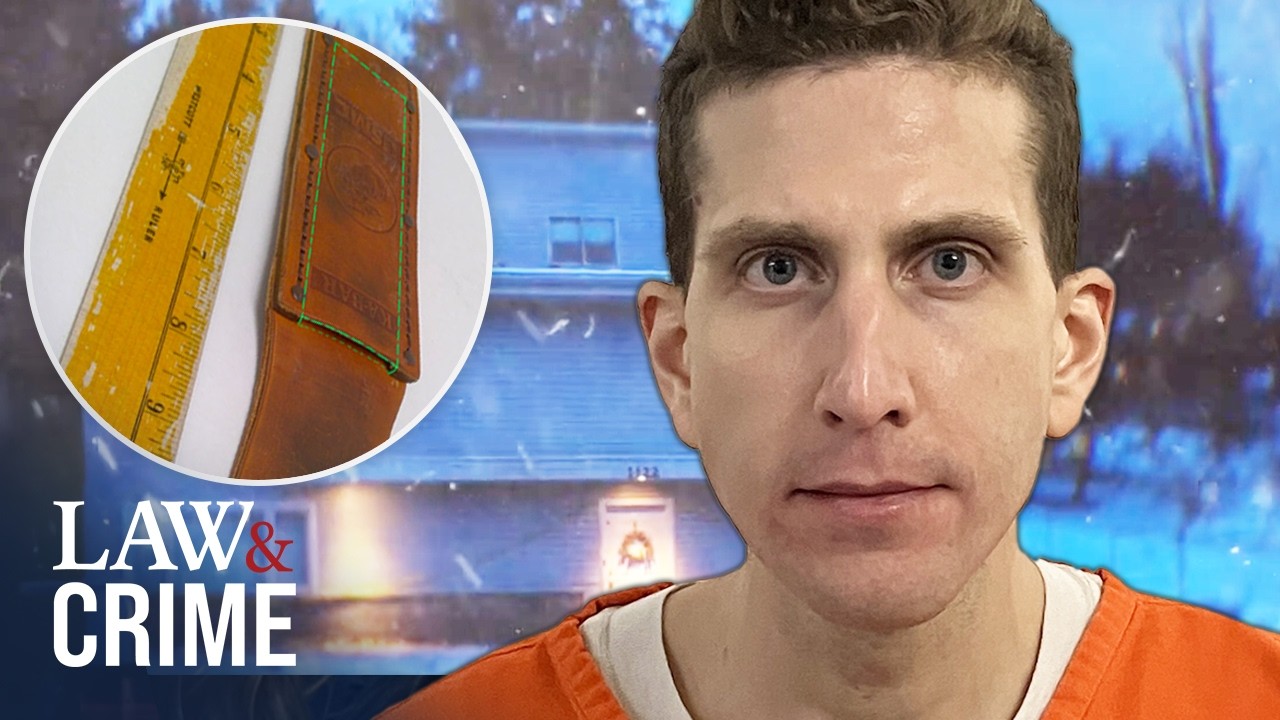
Bryan Kohberger Had Help Committing Idaho Murders: Expert Witness
YouTube · 4wYi-oQtBYA
Quick Read
Summary
Takeaways
- ❖Defense expert Dr. Brent Turvy's report suggested two attackers due to simultaneous victim attacks and the unlikelihood of Ethan Chapen remaining in bed during Xanna Kernodal's assault.
- ❖Turvy also argued the crime required hours for cleanup, contradicting the state's 15-20 minute timeline.
- ❖State expert Pette Sutton and forensic investigator Joseph Scott Morgan maintained a single assailant could use one KBAR knife for multiple types of lethal force and manage blood evidence with protective gear.
- ❖Prosecutors chose not to compel Bryan Kohberger to provide details of the murders during his guilty plea to ensure a 'solid' conviction, despite the opportunity for a proffer.
- ❖Unknown male DNA samples found at the scene (on a handrail and a glove) were not run through CODIS, with the state deeming them 'not probative' compared to Kohberger's DNA on the knife sheath.
- ❖Joseph Scott Morgan argues that the unknown DNA should have been fully investigated to eliminate doubt and address public speculation about additional perpetrators.
Insights
1Defense Expert's Two-Attacker Theory
Dr. Brent Turvy, a crime scene reconstruction expert for the defense, believed it was 'likely' there were two people and two weapons involved. His report cited that Ethan Chapen would not have remained in bed while Xanna Kernodal was attacked, suggesting a second assailant. He also pointed to multiple types of lethal force used against Kaylee Goncalves and the simultaneous attacks on Ethan and Xanna.
Dr. Turvy's report stated, 'It is not reasonable to think that Ethan would have remained in his bed after waking up or being awake while Zana was being attacked in front of him. This evidence and context begin to suggest the existence of a second attacker.' He also noted, 'Multiple weapons were used against Kaye, that multiple types of lethal force were used against Kaye, and that Ethan and Zanna appear to have been attacked at the same time.'
2Rebuttal to Multiple Weapons and Attackers
State expert Pette Sutton and forensic death investigator Joseph Scott Morgan countered that a single perpetrator could use multiple weapons or apply various types of lethal force with one weapon. Morgan specifically detailed how a KBAR combat knife, a utility knife, could be used for stabbing, blunt force trauma (using the handle or side), and incising, explaining Kaylee Goncalves' diverse injuries.
Pette Sutton commented, 'One assailant could contain two people in close proximity to each other, especially if the assailant is armed. A single perpetrator can certainly use more than one weapon and can use multiple types of lethal force.' Joseph Scott Morgan elaborated, 'The KBAR combat knife is a utility knife... it has multiple utilities... it is meant to kill, but it is also meant to be used in the field.' He added, 'The thing can be actually turned on its side and used to thrust with like in a punching motion. It can use to hammer down if you invert it and start to slam it down onto somebody's face.'
3Contested Crime Scene Cleanup Time
Dr. Turvy argued that the extensive blood transfer and precautionary acts (like cleaning hands, feet, clothing, and disposing of items) would have required 'perhaps hours' at the scene, contradicting the state's timeline of less than 15-20 minutes. Pette Sutton, however, stated that 'washing or wiping hands takes little time' and 'removal of protective clothing and shoe coverings takes seconds.'
Dr. Turvy's report detailed, 'All of this would have required an extensive amount of time at the scene to clean, perhaps hours, which is inconsistent with the state's theory that these crimes were committed within a time interval less than 15 to 20 minutes subsequent to a.m.' Sutton's rebuttal: 'Washing or wiping hands takes little time, especially if preparations for cleaning are made beforehand. Removal of protective clothing and shoe coverings takes seconds.'
4Prosecutor's Decision Not to Compel Allocation
Prosecutor Bill Thompson explained that Kohberger was not compelled to provide details of the crime during his guilty plea. This decision was made to ensure a 'solid, sustainable guilty plea' because, in their experience and based on FBI profiler advice, defendants often minimize or cannot be trusted for truthfulness when asked to explain such bizarre crimes.
Bill Thompson stated, 'We made a decision that we wanted to make sure that the guilty plea itself was solid if he was going to plead guilty. Our experience... is that frequently when defendants are being asked to explain... they start to minimize... they can't be trusted for the truthfulness of what they say.' He also cited FBI profilers who advised that 'even if we were to get the person who committed these crimes to try to explain why it happened, that it wouldn't make sense to normal people like us.'
5Unexamined Unknown Male DNA Samples
The defense planned to highlight unknown male DNA samples found on a handrail inside the house and a glove outside, which were never run through CODIS. The state deemed these samples 'not probative' because Kohberger's DNA on the knife sheath was considered direct evidence. Joseph Scott Morgan argued this was a significant oversight, as it fuels speculation and leaves doubt.
The host stated, 'These unknown male DNA samples that were never run through COS and one was found on a handrail inside the house and then one was found on a glove outside the house.' The state's reasoning was that 'the KBAR knife sheath DNA was probative... These other other samples were not considered probative, so we didn't enter them into COTUS.' Joseph Scott Morgan commented, 'I think that it would have been worth their time to have plugged these in... this could have been cleared up if they had been plugged in and really pursued.'
Bottom Line
The prosecutor's strategic decision to forgo compelling Bryan Kohberger to detail his crimes (allocation) was a calculated move to secure an unchallengeable guilty plea, prioritizing legal certainty over a full narrative for the victims' families and public.
This approach, while legally sound for conviction, leaves significant unanswered questions about the crime's specifics, potentially fueling public speculation and creating grounds for future appeals based on incomplete information or perceived lack of due diligence regarding other evidence.
Legal teams and policymakers could explore mechanisms to balance the need for 'solid' pleas with the public and victims' right to a comprehensive understanding of crimes, perhaps through structured, non-compulsory proffers that do not jeopardize the plea's integrity.
Unknown male DNA samples found at the crime scene were not fully investigated or entered into CODIS because they were deemed 'not probative' compared to the direct DNA evidence linking Kohberger to the knife sheath.
This decision, while logical from a prosecution standpoint focused on a primary suspect, leaves open questions that could be exploited by defense in future appeals or by public discourse, suggesting potential investigative gaps or unexplored leads that could point to other individuals.
Investigators should consider a more exhaustive approach to all forensic evidence, regardless of initial perceived 'probative' value, to preemptively address potential doubts and strengthen cases against future challenges, possibly by running all viable DNA through databases even if not directly linked to the primary suspect.
Lessons
- Legal teams should thoroughly investigate all forensic evidence, including seemingly 'non-probative' DNA samples, to preemptively address potential challenges and eliminate doubt in high-stakes cases.
- Prosecutors must weigh the strategic benefits of a 'solid' guilty plea against the public and victims' need for a complete understanding of the crime, considering the long-term implications of unallocated pleas.
- Forensic experts should be prepared to articulate how a single weapon can inflict diverse injuries and how a perpetrator can manage a bloody crime scene without leaving extensive transfer evidence, to counter multi-perpetrator theories.
Notable Moments
The revelation of Dr. Brent Turvy's expert report detailing arguments for two attackers and multiple weapons, directly contradicting the state's single-perpetrator theory.
This shows the significant forensic debate that would have occurred at trial, highlighting how different experts can interpret the same crime scene evidence to reach vastly different conclusions.
Prosecutor Bill Thompson's explanation for not compelling Bryan Kohberger to 'allocate' or provide details of the crime during his guilty plea.
This moment exposes the strategic legal considerations that can override the public's desire for a full confession, revealing a trade-off between securing a conviction and gaining complete answers.
Quotes
"Your honor, we have produced an expert that believes that it's likely that there were two people, two weapons."
"The only thing that will never lie to you is the physical evidence. It's always telling you the truth. You've simply got to learn how to read that evidence."
"It is not reasonable to think that Ethan would have remained in his bed after waking up or being awake while Zana was being attacked in front of him. This evidence and context begin to suggest the existence of a second attacker."
"A single perpetrator can certainly use more than one weapon and can use multiple types of lethal force."
"Our experience, and Judge Hipper talked about this as well, is that frequently when defendants are being asked to explain uh they start to minimize uh what occurred, they can't uh be trusted for the truthfulness of what they say."
"If you believe that there is somebody else out there that perpetrated this horror show, please let us know who that is because obviously you had some kind of insight that that the police didn't."
"Your job is to eliminate doubt as an investigator. Not let it hang out there."
Q&A
Recent Questions
Related Episodes
Bryan Kohberger Experts Make EXPLOSIVE Claims in Idaho Murders
"A former FBI agent and author of 'Broken Plea' reveals critical, previously undisclosed issues with evidence in the Bryan Kohberger Idaho murder case, suggesting the plea deal may have circumvented major defense challenges."

LIVE | Kohberger Defense Statement and Investigation. TikTok defamation litigation continues....
"The Idaho murder case sees unusual post-plea developments with a defense expert accused of leaking confidential information, while the TikTok psychic defamation case progresses to appeal with the defendant's motions challenged for untimeliness and lack of merit."

Kohberger’s Back, More Dirty Duggar Details & Quad Amputee Charged with Murder
"Newly released surveillance footage of Bryan Kohberger at the DMV, unsettling details of a triple murder by Jenna Struble, and the perplexing case of a quadruple amputee charged with murder are explored."

Will possible Nancy Guthrie accomplice be tempted by reward money? Day 29 on the scene
"A retired FBI agent analyzes the Nancy Guthrie disappearance, focusing on how a million-dollar reward could compel an accomplice to come forward and the advanced investigative techniques employed by law enforcement."