
The Final Days Of The U.S. Empire! – Full Interview w/ Professor Jiang
YouTube · 61z1rB3UvPc
Quick Read
Summary
Takeaways
- ❖The US National Security Strategy aims to secure the Western Hemisphere, contain China, leverage allies, and ramp up wartime industrial production.
- ❖This strategy seeks to create regional balances of power (e.g., Japan vs. China, Russia vs. NATO, Gulf States/Israel vs. Iran) dependent on US resources and armaments.
- ❖Professor Jiang predicts the US plan will fail due to systemic corruption, extreme political polarization, and growing nationalism among bullied allies.
- ❖The decline of the US empire is projected to occur in three stages, with initial short-term economic boosts followed by overextension, a national draft, and eventual multi-front global war.
- ❖A US civil war is seen as a likely outcome of imperial decline, potentially continuous due to a lack of external peer competitors.
- ❖The aging US elite is described as increasingly authoritarian, prioritizing control and self-preservation, which contributed to COVID-19 lockdowns and future energy rationing.
- ❖The rise of AI and data centers is linked to the establishment of a technocratic surveillance state, digital currency, and digital ID for population control.
- ❖The host and guest suggest that political events like Trump's alleged assassination attempts and Charlie Kirk's assassination were staged rituals by the deep state.
- ❖The only hope for the world and America is seen in the American people resisting the deep state, potentially through a galvanized labor movement.
Insights
1US National Security Strategy for Global Dominance
Professor Jiang details the Pentagon's National Security Strategy for the next 5-10 years, comprising four pillars: securing the Western Hemisphere, containing China, better utilizing allies for global defense, and ramping up wartime industrial production. The ultimate goal is to establish a 'Fortress America' (a 'technate' or 'Greater North America') that is self-sufficient and sells resources, weapons, and financing to other regions, creating a balance of power in each (e.g., Japan/China, Russia/Europe, Gulf States/Israel vs. Iran) to ensure their dependence on the US.
Professor Jiang states this strategy is 'in black and white' on the Pentagon website, announced in January by the Trump White House. He describes its real-time implementation through actions like the Iran conflict.
2Three Pillars of US Escalation Against Iran
If the war escalates, the US will employ a three-pronged approach against Iran: 1) Economic strangulation through naval blockades, seizing strategic locations like Kharg Island and the Iranian coastline to dislodge Iran from the Strait of Hormuz and control oil exports. 2) Stirring ethnic tensions by establishing forward operating bases in regions like Baluchistan and Kurdish areas, arming and encouraging ethnic insurgents. 3) Suffocating Tehran by bombing power plants, reservoirs, and railways to limit access to food, water, and electricity, forcing the population into submission and a political settlement.
Professor Jiang outlines this military perspective on escalation, stating these are the strategies to force Iran into a settlement where it surrenders uranium, ballistic weapons, abandons proxies, and installs an American puppet leader.
3Three Problems Leading to Empire Decline
Despite the US National Security Strategy appearing strong on paper, Professor Jiang argues it will fail due to three internal problems: 1) Corruption: The financialization of the US system leads to speculation over production, with massive Pentagon budgets being stolen rather than used for actual weapons. 2) Political Polarization: Declining empires split into factions focused on domestic politics, undermining global standing (e.g., Democrats sniping at Trump during wartime). 3) Nationalism: Bullying allies (e.g., Europeans, South Koreans, Japanese) will lead to increased nationalism and anti-American sentiment.
Professor Jiang cites historical patterns of empire decline and current US political and economic conditions, including examples of market manipulation after Trump's announcements and the internal political divisions.
4Three Stages of US Empire Decline
The US empire's decline will unfold in three stages: 1) Lashing Out: The empire cannibalizes allies, appearing strong in the short term as the dollar soars and the world becomes dependent on US resources (e.g., LNG). This stage might see Trump appear as a 'political genius.' 2) Overextension: The empire becomes overleveraged, overextended, requiring a national draft, and its economy overheats into a 'Ponzi scheme.' The world begins to recognize the need to unite against the US. 3) Multi-Front War: The world goes to war with America on economic, diplomatic, and military fronts, leading to the empire's collapse and internal civil war.
Professor Jiang draws parallels with historical empire declines, noting that the initial stages might look like success, but the long-term consequences are dire.
5Technocracy and AI Surveillance State
The US is moving towards a technocracy, a government ruled by AI, necessitating the construction of expensive data centers that don't generate profit. This AI surveillance state will enable digital currency, digital ID, national drafts, and the rationing of energy and food, serving as a control grid for the population.
Professor Jiang mentions 'Operation Stargate' and $500 billion for data centers, connecting it to the broader plan for an AI-controlled society, drawing comparisons to China's existing surveillance systems.
Bottom Line
The aging leadership in Washington D.C. (baby boomers) contributes to an increasingly authoritarian society, driven by a fear of germs and a desire to live longer, leading to policies like global lockdowns.
This suggests that policy decisions, even those with massive societal impact like pandemic responses, might be influenced by the personal anxieties and generational characteristics of the ruling elite, rather than purely rational or strategic considerations.
Understanding this dynamic could inform strategies for younger generations to challenge established power structures and advocate for policies that prioritize long-term societal well-being over short-term control or elite comfort.
The 'intellectual class' (professors, journalists, academics) are the 'parasites of the system,' most dedicated to maintaining the status quo because their power and privilege derive from proximity to the elite, making them vocal protectors of the system's legitimacy.
This explains why many educated individuals might resist challenging dominant narratives, even when evidence suggests otherwise, as their professional and social standing is tied to upholding the existing power structure. The rise of AI threatens these white-collar jobs, increasing their desperation to justify their existence through control of the masses.
This highlights the importance of independent media and alternative intellectual spaces that are not beholden to the 'power elite' for fostering critical thinking and genuine debate, as well as the potential for AI to disrupt the traditional gatekeepers of knowledge and influence.
The alleged assassinations of political figures like Charlie Kirk, and even staged attempts on Trump, are described as 'religious rituals' or 'Masonic rituals' by the deep state to anoint or remove figures, often with public displays.
This theory suggests a hidden, ritualistic dimension to political power plays, implying that certain events are not merely political acts but have symbolic or esoteric significance for those orchestrating them. It points to a deeper, more conspiratorial layer of control.
For those seeking to understand power, this perspective encourages looking beyond surface-level political explanations and considering the potential influence of secret societies or occult beliefs on geopolitical events, though evidence for such claims is often speculative.
Lessons
- Critically examine mainstream media narratives and official government statements, especially regarding foreign policy and national security, as they may serve a long-term imperial agenda.
- Support and engage with independent media and alternative voices that challenge establishment viewpoints, as these are crucial for fostering critical thinking and resisting indoctrination.
- Consider the potential for a galvanized labor movement to resist the technocratic state and deep state control, as essential workers hold significant power that AI cannot easily replace.
Notable Moments
Professor Jiang's prediction of a US-Iran conflict and US loss in 2024, based on historical patterns and game theory, which gained international attention.
This establishes his credibility as a geopolitical analyst with a track record of accurate, contrarian predictions, setting the stage for the rest of the discussion.
The discussion of the US attack on an Iranian cargo ship in the Strait of Hormuz, framed as an act of piracy and psychological operation by Scott Ritter, and Professor Jiang's agreement.
This event is used as a concrete example of the US's aggressive, non-peaceful intentions despite a ceasefire, fitting into the larger narrative of deliberate escalation.
The theory that Saudi royal family are 'crypto Jews' and creations of the British Empire, working with 'Dome' (followers of Sabbatai Zevi) to destabilize the Ottoman Empire.
This highly speculative theory offers a conspiratorial explanation for the close ties between Gulf States, Israel, and the US, suggesting a hidden historical agenda influencing current alliances.
The assertion that extreme Islamic movements like ISIS and Wahhabis were creations of the Anglo-American Empire and never attacked Israel.
This challenges the conventional understanding of Middle Eastern conflicts, suggesting that certain 'enemies' are manufactured or controlled by Western powers to serve their geopolitical interests, particularly in relation to Israel.
The host's personal experience using Grok (AI) for Jungian dream analysis, finding it more comprehensive and efficient than a human psychologist.
This anecdote serves as a practical example of AI's disruptive potential for white-collar, intellectual professions, reinforcing the guest's point about the vulnerability of the 'intellectual class' to AI and their desperation to maintain relevance.
Quotes
"A naval blockade is considered an act of war and so it breaks the spirit of a ceasefire."
"This ceasefire, it's pure theater. It's just a pretext to build up forces in the Middle East."
"What it means is that the Americans can impose terms. So what this means is that the Iranians will have to surrender their uranium all their Iranian. They will have to surrender the ballistic weapons program. They will have to abandon the proxies and they will have to install the shaw as their new leader American puppet."
"If you don't believe anything I say then I then go to the the um Pentagon website, the front of war website and download the national security strategy. It is in black and white. It tells you exactly what the plan is."
"When empires are in decline, they usually split up into different factions that fight um um that fight each other. They really don't care about the consequences for America's position in the world stage. All they are concerned about are domestic politics."
"The point is not to have successful wars. The point is have never ending wars because what wars do is they transfer taxpayer money into the pockets of a transnational elite."
"The people who graduate from the Ivy League and I know cuz I went to Yale are the biggest ass kissers in the world. They're not smarter than you. They're not better than you. they just happen to stick up to authority better than than you."
"If you find yourself angry at someone lower on the economic ladder than you, it's a good chance you're being manipulated by someone higher on the economic ladder than you."
Q&A
Recent Questions
Related Episodes

Iran Update: Israel’s Newest Bombing Campaign, the Oncoming War With China and How to Avoid It
"Colonel Wilerson reveals how the US and Israel are actively bombing China's strategic infrastructure in Iran, escalating a covert economic war that Beijing intends to win without direct military conflict by dismantling the dollar's global dominance."
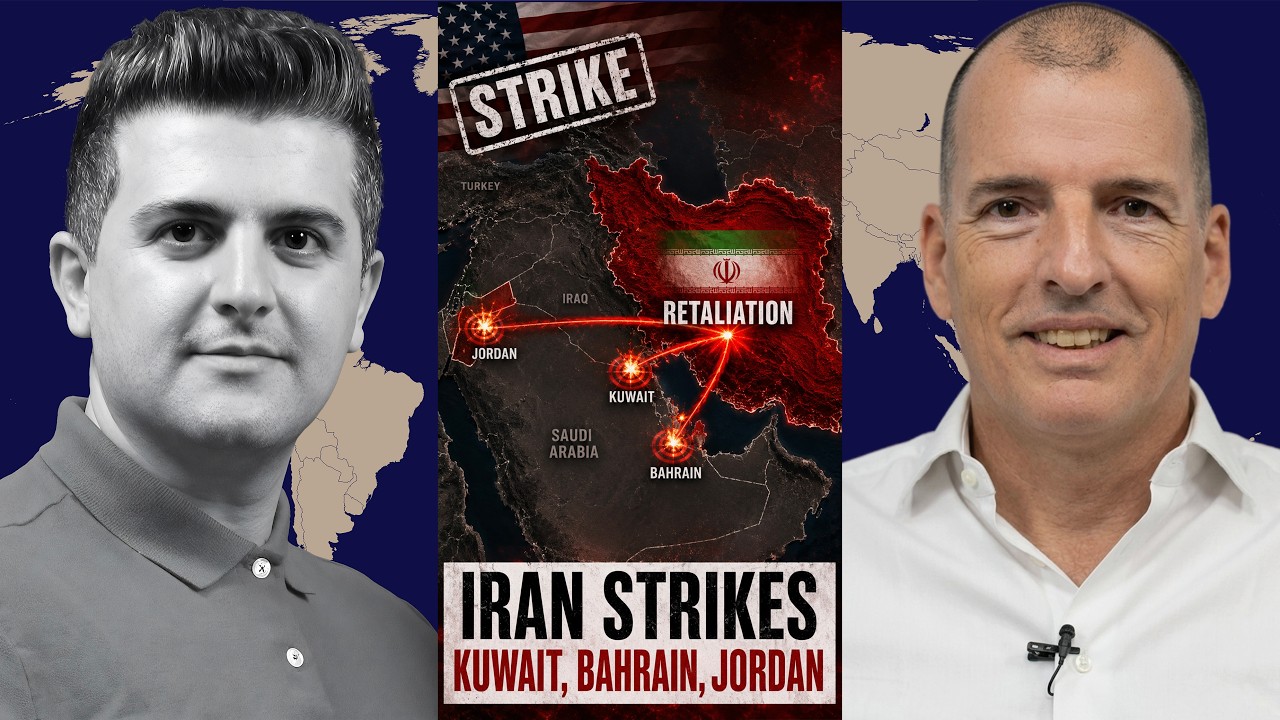
Alex Krainer: US STRIKES Iran – Iran RETALIATES Against Kuwait, Bahrain & Jordan!
"Amidst escalating US-Iran conflict and Iranian retaliation against regional US allies, this episode argues that US foreign policy is deeply controlled by an 'Anglo-Zionist conspiracy' led by the Rothschild banking dynasty, prioritizing Israeli interests over American ones."

HANTAVIRUS PANDEMIC PANIC, Human To Human Spread Feared | Timcast IRL
"Tim Pool and his guests dismiss the Hantavirus panic as media desperation, pivot to discussing escalating political polarization, the rise of technocracy, and the weaponization of social issues."

Will Venezuela Be Trump's Vietnam?
"An expert breaks down three perilous pathways for Venezuela under potential US intervention, from a 'Panamanian model' to a 'Libyan-style civil war,' and the broader geopolitical fallout for Latin America."