Megyn Kelly on Venezuela, Ben Shapiro’s Treachery, and Mark Levin’s Mental Illness
YouTube · 7HgM0aI3IK8
Quick Read
Summary
Takeaways
- ❖The US government's actions in Venezuela mark an explicit declaration of empire, prioritizing resources over traditional pretexts.
- ❖This shift centralizes power in the executive branch, diminishing Congress's role in foreign policy decisions.
- ❖The new imperial posture invalidates previous moral arguments against other great powers' actions (e.g., Russia in Ukraine, China in Taiwan).
- ❖International bodies like the UN and NATO are rendered obsolete in this new era of overt national interest.
- ❖An empire requires serious, wise leadership to avoid hubris and unintended consequences, especially the risk of nuclear war.
- ❖The host criticizes figures like Lindsey Graham, Ted Cruz, and Mark Levin for emotionally driven, bellicose foreign policy stances.
- ❖Megyn Kelly expresses skepticism about the Venezuela intervention, fearing chaos and unintended consequences, drawing parallels to Libya.
- ❖Both hosts highlight a growing threat to free speech in the US, particularly concerning criticism of Israel, citing examples from US officials and media figures.
- ❖The 'Israel first' faction within conservative media and politics actively pressures individuals to condemn critics of Israel, leading to 'cancellation' attempts.
- ❖Fox News is criticized for its unwavering pro-Israel and pro-war stance, which is seen as out of touch with younger conservative audiences.
Insights
1US Shifts to Explicit Empire in Venezuela
The host asserts that the US government's actions in Venezuela, specifically the removal of its head of state and explicit justification based on resource control (oil) and geopolitical rivalry with China, constitute an open declaration of the US as an empire. This marks a departure from historical pretexts of human rights or democracy.
The president 'just said it out loud' that Venezuela's oil is 'in our hemisphere. It's going to go to us.' () This contrasts with past interventions cloaked in 'human rights or democracy.' ()
2Erosion of Free Speech and 'Israel First' Pressure
Both hosts detail how free speech is being undermined, particularly when it involves criticism of Israel. They cite instances of US officials advocating for European-style 'hate speech' laws and describe intense pressure from an 'Israel first' faction within conservative media to 'deffriend' or 'cancel' anyone questioning Israeli policies or associating with critics.
Florida Lieutenant Governor Jay Collins stated, 'You don't have the right to harm other people with your words... When you want people to destroy Israel, that matters.' () Megyn Kelly recounts Ben Shapiro calling her a 'coward' for not condemning Candace Owens, despite their prior agreement on friendship not depending on whom else they associate with. ()
3The Necessity of a US-Russia Alliance Against China
In anticipation of a 'big war soon' and a world cleaving into blocs, the host argues that the US must align with Russia due to its vast resources and landmass. He contends that allowing Russia and China to form a united bloc would create an insurmountable challenge for the US, encompassing the majority of the world's population, land, and economy.
The host states, 'The United States has to have a relationship with Russia in order to survive anything like that.' () He adds, 'The number one thing you can't do... is allow Russia and China to become a block because if you do, then you are facing off against the majority of the world's population.' ()
4Media Complicity and Self-Censorship on Foreign Policy
Megyn Kelly describes how major news outlets, specifically Fox News during her tenure, actively suppressed dissenting voices and promoted a pro-war, pro-Israel agenda. She recounts personal experiences of being discouraged from questioning foreign policy narratives and witnessing the removal of critical reporting.
Kelly states that at Fox News during the Iraq War, 'we didn't allow people who were criticizing the war a platform. We mocked them and made fun of them because I think we thought it was our duty to defend the war.' () She also mentions Fox News deleting a series on 'dancing Israelis' after 9/11 and the firing of Judge Napolitano for criticizing Israel. ()
Bottom Line
The explicit declaration of US empire, justified by national interest, inadvertently provides a moral framework for other great powers (e.g., Russia, China) to act similarly without apology, effectively dismantling the post-WWII international order based on sovereignty.
This shift eliminates the US's moral high ground, making it difficult to condemn actions by rivals as 'unprovoked' or 'illegitimate,' potentially leading to a more volatile, multi-polar world where 'might makes right' is the openly accepted norm.
For nations seeking to challenge US hegemony, this new US stance provides a clear precedent and justification for their own 'national interest'-driven interventions, potentially accelerating a global power redistribution.
The 'Israel first' political and media faction actively works to 'cancel' or ostracize individuals within conservative circles who question Israeli policies, even if those individuals are otherwise strong Israel supporters.
This creates a chilling effect on open debate, even among allies, and risks alienating a growing segment of the conservative base, particularly younger Republicans, who are increasingly skeptical of unquestioning support for Israel.
Independent media platforms that allow for open, critical discussion of US-Israel relations and foreign policy without fear of reprisal could capture a significant audience disillusioned by mainstream and partisan outlets.
Key Concepts
Imperial Life Cycle
The idea that civilizations, once prosperous, inevitably transition from a republic to an imperial phase, characterized by centralized executive power, expansionism, and eventual corruption or collapse. The host frames current US actions as entering this 'imperial phase'.
Realpolitik (Overt)
A foreign policy approach where national interest, power, and resources are the primary drivers, rather than ideology, ethics, or international law. The host argues the US has moved from a covert to an overt realpolitik stance.
Lessons
- Critically evaluate foreign policy justifications: Do not accept 'human rights' or 'democracy' pretexts at face value; question if underlying national interests (e.g., resources, geopolitical leverage) are the true drivers.
- Defend free speech rigorously: Recognize that calls to limit speech, even from within conservative circles, especially concerning criticism of foreign nations, are a direct threat to fundamental American liberties. Be prepared to push back against such efforts.
- Be skeptical of media narratives: Understand that major news outlets, including those on the right, may have entrenched agendas (e.g., pro-war, pro-Israel) that shape their coverage and suppress dissenting voices. Seek out independent sources for diverse perspectives.
Notable Moments
The host's detailed breakdown of the US's shift to an explicit empire, using the Venezuela intervention as a prime example, and the implications for international law and domestic power.
This moment fundamentally redefines the perceived nature of US foreign policy, moving from a veiled to an overt imperial stance, which has cascading effects on global relations and internal governance.
Megyn Kelly's personal account of Fox News's suppression of dissenting voices during the Iraq War and the removal of critical reporting on Israel after 9/11.
This provides concrete, insider evidence of how media outlets actively shape narratives and limit debate on critical foreign policy issues, influencing public opinion and potentially leading to disastrous outcomes.
The discussion about the 'Israel first' faction's efforts to 'cancel' conservative figures like Megyn Kelly and Candace Owens for not condemning critics of Israel.
This exposes a significant internal conflict within the conservative movement, highlighting how loyalty to a foreign nation can supersede principles of free speech and personal relationships, impacting political discourse and alliances.
Quotes
"The United States has been an empire for a long time... But the difference between the last 120 years and earlier this week is that we never before admitted it. And now we are."
"Once you say out loud, we're grabbing Venezuela because we're annoyed they're selling what is our oil to the Chinese, our rival... it's kind of hard to make the case that... Russia doesn't have an interest in what happens in eastern Ukraine."
"If Donald Trump wants to commit one act as president that will secure him a place in history forever as a hero, it would be to bring Russia back into alliance with the United States."
"You have a right to free speech, but you don't have the right to harm other people with your words. And you don't have the right to say things that have really negative, really horrible meanings. When you want people to destroy Israel, that matters."
"I'd rather die than do that. I'd rather die than do that. And now that they've made that the stakes of my so-called friendships with them, I really won't do it."
"The more you try to criminalize that or ruin someone's life over those thoughts, the more you engender the very hatred you say you're objecting to."
Q&A
Recent Questions
Related Episodes

Will Venezuela Be Trump's Vietnam?
"An expert breaks down three perilous pathways for Venezuela under potential US intervention, from a 'Panamanian model' to a 'Libyan-style civil war,' and the broader geopolitical fallout for Latin America."

🚨 THEY F*CKED AROUND FOR THE LAST TIME 😭😭😭
"This episode unleashes a torrent of highly opinionated commentary on the US-Iran deal, Israel's role, and a scathing critique of 'leftist' policies and immigration, particularly highlighting the UK grooming gang report as evidence of Western societal decay."
BREAKING: Protests ERUPT In Iran Over IRGC Surrendering To Trump - Infighting Clashes In Tehran
"Iran is experiencing severe internal infighting and protests as hardline IRGC elements clash with government figures over a perceived 'surrender' to the US, while mainstream Western media misrepresents the situation."
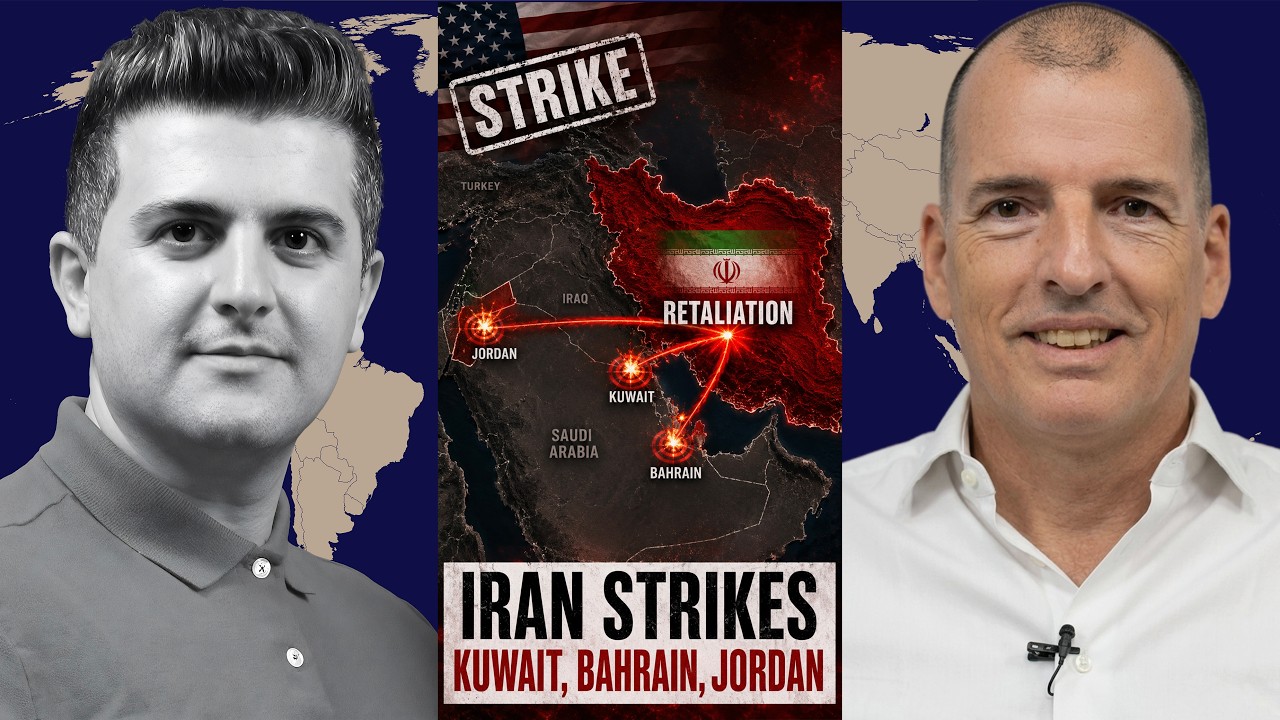
Alex Krainer: US STRIKES Iran – Iran RETALIATES Against Kuwait, Bahrain & Jordan!
"Amidst escalating US-Iran conflict and Iranian retaliation against regional US allies, this episode argues that US foreign policy is deeply controlled by an 'Anglo-Zionist conspiracy' led by the Rothschild banking dynasty, prioritizing Israeli interests over American ones."