Roland, Howard Bryant talk "Kings and Pawns: Jackie Robinson and Paul Robeson in America"
YouTube · 7e2SvUiZYeA
Quick Read
Summary
Takeaways
- ❖Paul Robeson, a singer, athlete, lawyer, actor, and activist, was a titanic figure of the 20th century whose immense influence was intentionally erased from American and Black history.
- ❖Jackie Robinson and Paul Robeson were strategically pitted against each other by figures like Branch Rickey and the House Un-American Activities Committee (HUAC) during the Cold War, despite never having met.
- ❖Branch Rickey's decision to integrate baseball with Jackie Robinson was a calculated business move, not a purely progressive act, driven by a desire to find the best talent after failing to find suitable non-American players, and to counter Robeson's radical voice.
Insights
1Paul Robeson's Intentional Erasure from History
Paul Robeson, a multi-talented Renaissance man (singer, athlete, lawyer, actor, activist), was a globally renowned figure and arguably the most prominent Black voice in America during his time. Despite his immense stature, he was systematically 'written out' of American and Black history due to his unabashed progressive, anti-capitalist, and pro-Communist views, which were deemed a threat during the Cold War. This erasure was a 'massive campaign' rather than an accidental oversight, aimed at silencing his influential voice.
The host notes the amazement at how many people 'have no clue how huge Paul Robeson was' and how his name is 'rarely ever mentioned' (). Bryant confirms that 'a lot' of Black people he spoke to while writing the book had not heard of Robeson (). He states, 'You can't erase somebody like that by accident. Time didn't just erase him... It was intentional' ().
2Jackie Robinson and Paul Robeson: Pitted Against Each Other
Jackie Robinson and Paul Robeson, two titanic Black American figures, were placed in opposition to each other by external forces, notably when Robinson testified against Robeson in front of the House Un-American Activities Committee (HUAC) in 1949. This was a strategic move by those in power, including Branch Rickey, to use Robinson's emerging influence to counter Robeson's radical voice, despite the two men never having met.
Bryant expresses his embarrassment at having 'kept it moving' past the fact that 'Jackie Robinson testified against Paul Robeson' (). He explains that to 'counter' Robeson's 'number one black voice in America,' they 'go to baseball. You go to Jackie Robinson' (). Roland Martin notes the incredibility that 'those two never met' ().
3Branch Rickey's Strategic, Not Altruistic, Integration of Baseball
Branch Rickey, often celebrated as a progressive ally for integrating baseball, had complex and self-serving motives. His initial intention was not to challenge American segregation directly; he spent considerable money scouting Latino players in other countries, hoping to integrate baseball without upsetting the racial status quo in the U.S. He only turned to American Black players like Jackie Robinson when he realized they were the best talent available. Rickey also used Robinson to undermine Paul Robeson, aligning with right-wing elements.
Bryant states, 'Branch Rickey had no intention of integrating. He hated black baseball... He did not believe that black players were the best minorities to integrate' (). He 'spent $25,000 scouring Mexico and Venezuela in Cuba in the Dominican Republic looking for the right player to integrate' () because 'he had no intention of upsetting American segregation' (). He concludes, 'If Branch Rickey had had his way, he would have left American segregation just the way it was' ().
4The Cold War's Impact on Black Leadership Strategy
During the Cold War, Black leadership, including organizations like the NAACP and the Urban League, strategically decoupled from Pan-African and anti-colonial movements and distanced themselves from figures like Paul Robeson. This was a calculated move to avoid being labeled 'anti-American' or 'communist,' which would jeopardize their efforts to achieve civil rights gains within the United States. This created a political battle over the proper tactics for Black liberation.
Bryant explains that 'black leadership in the United States really did decouple from those movements because they didn't want to be called anti-American' (). He notes the dilemma: 'We need the military to be desegregated. We need civil rights to move forward... And we're not going to get them... if we align ourselves with Robeson' ().
5The Illusion of Merit vs. The Priority of Comfort in Institutions
Institutions, particularly in America, often prioritize 'comfort' and maintaining the racial status quo over 'merit.' This is evident in how baseball owners feared Black players and fans would financially ruin the sport, not because of lack of talent, but because their presence would drive away white fans. This pattern extends to other areas like housing and corporate diversity initiatives, where financial gain is foregone to preserve whiteness or existing power structures.
Bryant states, 'They were convinced that Jackie was going to destroy baseball, not because he couldn't play, but because he could' (). He adds, 'black fans were going to come to the game. And if black fans brought their black money to the sport, white fans wouldn't want to sit next to them' (). Roland Martin reinforces, 'there are numerous examples where they will forego more green to maintain whiteness' (). Bryant concludes, 'We spend a lot of our time trying to prove merit, they hire for comfort. We talk about merit. They talk about comfort' ().
Key Concepts
Narrative Control
The deliberate shaping, suppression, or promotion of historical accounts and public perceptions by powerful entities to maintain social, political, or economic control. This model explains how figures like Paul Robeson were erased and Branch Rickey's motives were re-framed.
The Illusion of Merit
The concept that institutions often claim to operate on merit-based principles while, in practice, prioritizing comfort, existing power structures, or the maintenance of the racial/social status quo over actual talent or qualifications. This is exemplified by baseball owners' fears of Black fans and their initial reluctance to integrate based on merit.
Lessons
- Critically examine prevailing historical narratives, especially those that simplify complex figures or events, to uncover hidden motives and power dynamics.
- Recognize the strategic use of 'patriotism' as a tool to silence dissent and pressure marginalized groups into conformity, as seen in the Cold War era and contemporary sports.
- Prioritize building and supporting independent institutions within marginalized communities to ensure agency and control over their own narratives and economic futures, rather than solely seeking inclusion in mainstream structures.
Quotes
"It is amazing to me how many people have no clue how huge Paul Robeson was. It's amazing to me that when we talk about these seminal figures of the 20th century in the fight for civil and human rights, rarely is his name ever mentioned."
"If you have somebody that big who's also that erased, the massive campaign required to erase him, what it took to actually erase him."
"We spend a lot of our time trying to prove merit, they hire for comfort. We talk about merit. They talk about comfort."
"The meeting is not the reward. The meeting itself is not the win."
Q&A
Recent Questions
Related Episodes
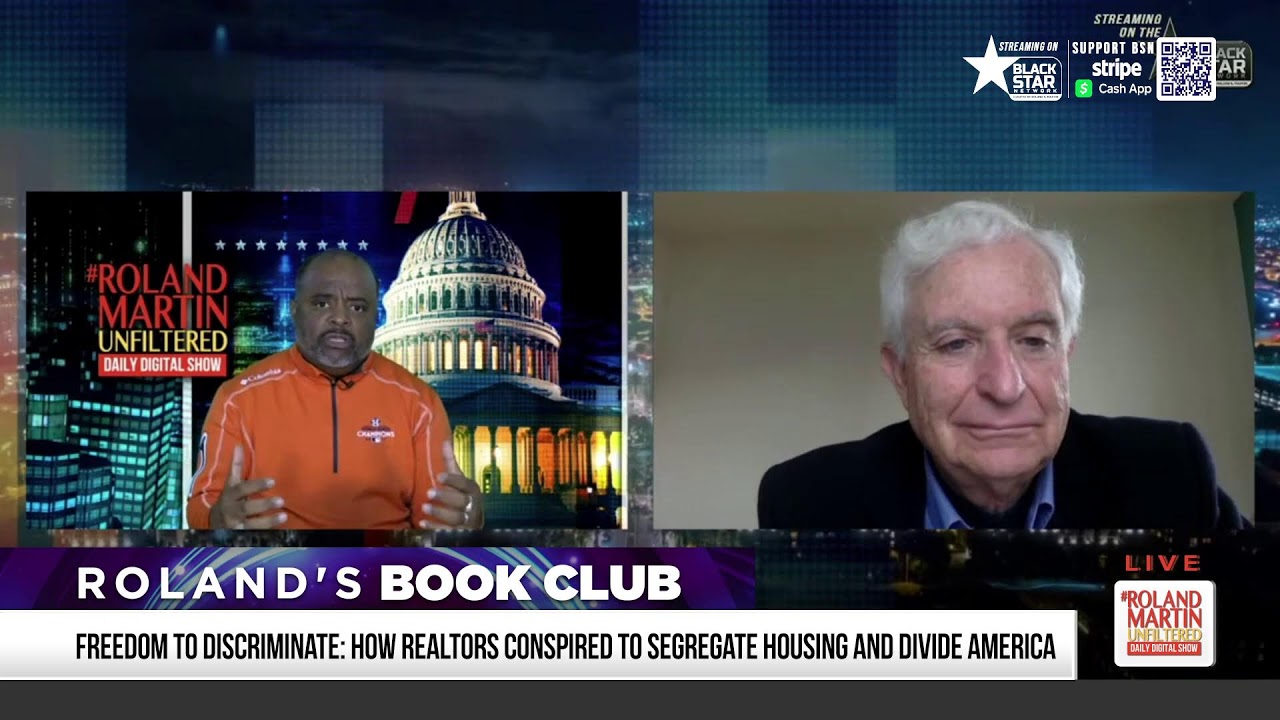
Freedom to Discriminate: Realtors Conspired to Segregate Housing & Divide America |#RolandsBookClub
"This episode exposes how American realtors deliberately invented and institutionalized housing segregation, shaping federal policy and ultimately redefining the concept of 'freedom' to fuel a political ideology that continues to divide the nation."

Obama Center Opens. Fox Expert Wants More Teen Pregnancy. Viral Black Doll Trend Backlash
"The opening of the Obama Presidential Center sparks discussions on legacy, while a Fox News expert's call for more teen pregnancies exposes deeper anxieties about declining white birth rates and the global shift of power to Africa, revealing a systemic effort to dismantle civil rights and maintain white dominance."

Obama Center Opens. Fox Expert Wants More Teen Pregnancy. Viral Black Doll Trend Backlash
"This episode unpacks the opening of the Obama Presidential Center, exposes a Fox News expert's call for more teen pregnancies, and reveals the global geopolitical implications of declining white birth rates and the ongoing dismantling of civil rights infrastructure in the US."

🚨 HOLY F*CK HE WAS RIGHT 😂😂😂
"The host celebrates perceived conservative victories and the exposure of 'leftist' and 'communist' elements in American politics and culture, from Trump's enduring influence to alleged government fraud and societal decay."