
Back To Iran, Gaza Reborn, & A Happy New Year | The Tim Dillon Show #477
YouTube · 7gtmUwXS6cA
Quick Read
Summary
Takeaways
- ❖Jared Kushner and Steve Whitkov are spearheading a $12 billion 'Project Sunrise' to rebuild Gaza into a futuristic international destination.
- ❖The plan for Gaza is presented as a luxury 'smart city' with AI-optimized features, but lacks details for housing the two million displaced Palestinians.
- ❖The host suggests the destruction of Gaza is being euphemistically described as 'profound' to sanitize the investment opportunity.
- ❖A potential war with Iran, framed as 'rescuing' protesters, is linked to securing the Gaza redevelopment from regional threats.
- ❖The US student loan crisis, with millions facing wage garnishment, is cynically presented as a pipeline for military recruits to fight in Iran.
- ❖The host provocatively suggests Zelensky's death might be a necessary, albeit tragic, path to peace in the Ukraine-Russia conflict due to Putin's personal investment.
- ❖The podcast critiques the media's role in manufacturing consent for wars by portraying foreign populations as ready for 'rescue' while ignoring pressing domestic issues.
Insights
1Gaza's 'Project Sunrise': A Luxury Real Estate Play on 'Incredibly Valuable Land'
Jared Kushner and Steve Whitkov are reportedly leading a $12 billion plan, 'Project Sunrise,' to transform war-torn Gaza into a futuristic 'international destination' with luxury hotels, high-speed rail, and AI-optimized smart grid features. The host cynically views this as a real estate opportunity on 'incredibly valuable land,' designed for investors and not the displaced Palestinian population, whose housing details are notably absent from the plan.
, , , ,
2Iran War as a Precondition for Gaza Redevelopment Security
The host argues that the push for military action against Iran, framed as 'decapitating' the Iranian regime and 'rescuing' protesters, is directly linked to securing the 'Project Sunrise' in Gaza. The narrative suggests that Iran's proxy support in the region poses a threat to the stability and profitability of the proposed luxury smart city, making its removal a prerequisite for safe investment.
, , ,
3Student Loan Crisis as a Military Recruitment Driver
With millions of Americans defaulting on student loans and facing wage garnishment, the host draws a cynical connection between this domestic economic crisis and potential military recruitment. He suggests that joining the military to fight in conflicts like Iran could become a desperate path for indebted individuals to escape their financial burdens, highlighting the human cost of both economic policy and foreign intervention.
,
4Zelensky's Removal as a Path to Ukraine Peace
The host offers a provocative 'realpolitik' assessment of the Ukraine war, suggesting that Vladimir Putin views the conflict as deeply personal. He posits that if Ukrainian President Zelensky were 'taken out' or stepped down, it might create an opportunity for a peace deal, as Putin would be unwilling to negotiate in good faith with Zelensky still in power due to 'too much bad blood.'
, ,
Bottom Line
The host suggests that the branding of Gaza's redevelopment as 'Project Sunrise' (12:06) is a deliberate attempt to create a positive, forward-looking image that distracts from the preceding destruction and displacement, making it more palatable for international investors.
This highlights how language and branding are used to sanitize controversial geopolitical projects, obscuring their true nature and impact on local populations.
Analysts should scrutinize the branding and marketing of large-scale 'redevelopment' projects in conflict zones for underlying motives and potential euphemisms.
The host implies that the US government's focus on 'rescuing' protesters in Iran (07:24) and building a 'futuristic tech hub' in Gaza (10:56) distracts from and takes resources away from addressing severe domestic issues in American cities like Los Angeles (43:05), which are 'doing terribly.'
This suggests a pattern where foreign interventions, often driven by elite interests, are prioritized over the welfare of the average American citizen, leading to further domestic decay.
Advocates could draw stronger parallels between the costs of foreign policy and the underfunding of domestic infrastructure and social programs, pushing for a re-evaluation of national priorities.
Key Concepts
The 'Profound Destruction' Euphemism
The host highlights how the term 'profound destruction' is used to describe the devastation in Gaza, suggesting it's a sanitized, business-friendly euphemism that allows investors to acknowledge tragedy without dwelling on its human cost, paving the way for 'luxury' redevelopment.
The 'Rescue' Fallacy in Foreign Policy
The host defines 'rescuing' in American foreign policy as 'bombing people and a lot of them are going to die,' arguing that military interventions framed as humanitarian rescues often result in widespread death and chaos for the 'rescued' population, serving other strategic or economic interests.
Lessons
- Critically analyze 'redevelopment' plans in conflict zones, especially when they lack clear provisions for existing populations, and question the true beneficiaries.
- Be skeptical of media narratives that frame military interventions as purely humanitarian 'rescues,' and investigate potential geopolitical or economic motives.
- Consider the broader implications of domestic economic policies, such as student loan debt, on national security and foreign policy, including potential impacts on military recruitment.
- Examine how political figures and powerful entities use specific language (e.g., 'profound destruction') to shape public perception of controversial events and projects.
Notable Moments
The host's satirical 'investor presentation' for Gaza's 'Project Sunrise,' complete with a 'solemn nod' to 'profound destruction' before 'licking chops' over opportunities.
This segment vividly illustrates the host's cynical view of how elites commodify tragedy, framing humanitarian crises as lucrative investment opportunities while downplaying the human cost.
The host's definition of 'rescuing' in American foreign policy: 'bombing people and a lot of them are going to die.'
This punchy, dark redefinition challenges the common, altruistic framing of military interventions, forcing listeners to confront the violent realities often masked by diplomatic language.
Quotes
"I don't think this is being built for the people in Gaza. I'm just throwing it out there."
"For the people of Gaza, for the good of the people of Gaza, we must decapitate the regime in Iran so that we can safely build a futuristic tech hub for the children of Gaza."
"Gaza's destruction has been profound, but we believe what lies ahead is not just restoration. It's a chance to develop a gateway of prosperity in the Middle East with state-of-the-art infrastructure, urban design, and technology."
"The opposite of death is luxury. It is a life forever. It is an AI-driven city, a smart city which washes the blood away with AI smart grid features. You will forget these people ever lived here."
"Rescuing in American terms, let's bring out the dictionary. Rescuing means bombing people and a lot of them are going to die."
"They have to kill Zalinski. They have to kill him. Um Putin will not stop unless Zinsky is dead."
Q&A
Recent Questions
Related Episodes
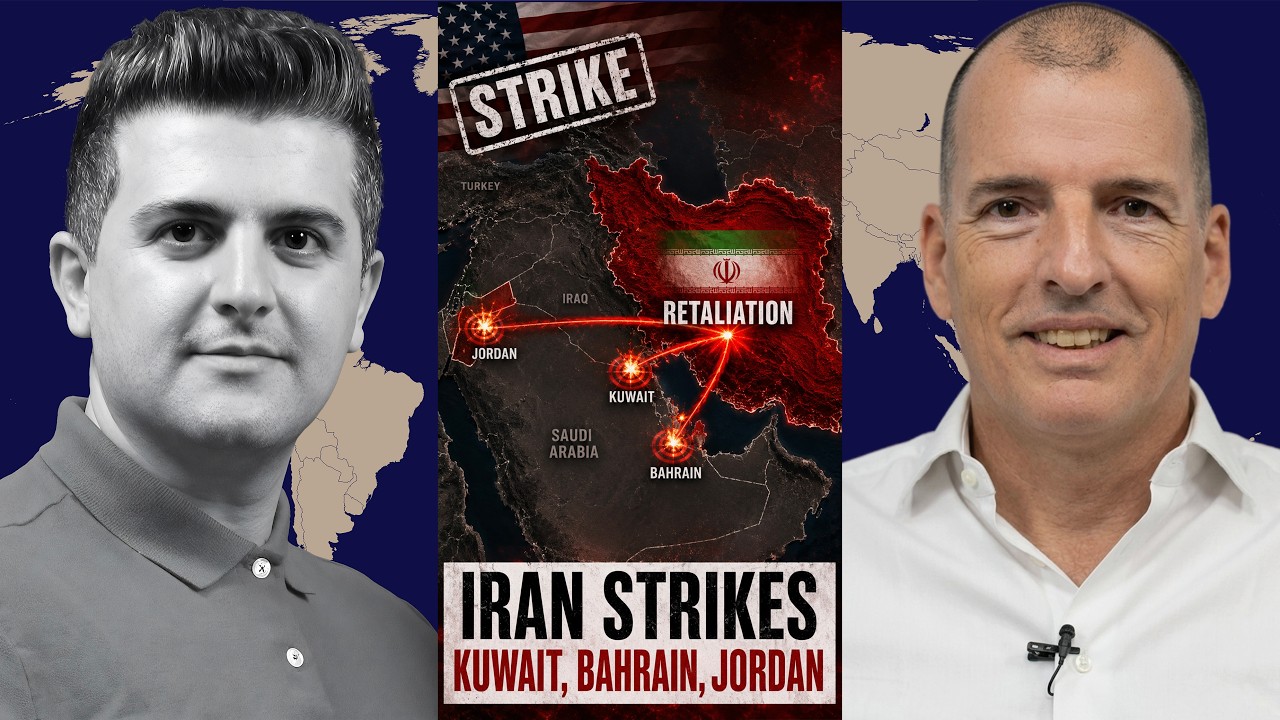
Alex Krainer: US STRIKES Iran – Iran RETALIATES Against Kuwait, Bahrain & Jordan!
"Amidst escalating US-Iran conflict and Iranian retaliation against regional US allies, this episode argues that US foreign policy is deeply controlled by an 'Anglo-Zionist conspiracy' led by the Rothschild banking dynasty, prioritizing Israeli interests over American ones."

LIVE: Trump HIDES FROM PUBLIC as US SOLDIER KILLED!!! 6/2/2026
"The host exposes alleged government cover-ups regarding military casualties, Trump's unexplained public absence, and questionable political appointments, arguing these reflect a 'regime of loser babies' and a failing foreign policy."

Patrick Henningsen: Hezbollah JUST Fired Back at Israel - Iran Vows to “Crush” All Attacks
"Patrick Henningsen argues that the US and Israel initiated an illegal war against Iran, driven by Trump's incompetence and Israeli influence, leading to an inevitable escalation with severe global economic repercussions."

🚨 TOTAL F*CKING CHECKMATE 😂😂😂
"The host argues that Trump's 'ceasefire' with Iran was a calculated '5D chess' move to orchestrate a global energy market reshuffle, while simultaneously lambasting 'woke' domestic policies and the 'freefall' of anti-Trump conservative figures."