ESCALATION OUT OF CONTROL As US Embassies BURN
YouTube · D7CKQj00LkQ
Quick Read
Summary
Takeaways
- ❖US officials Marco Rubio and Mike Johnson publicly stated the US strike on Iran was compelled by Israel's intent to attack, confirming Israel's driving role in the conflict.
- ❖The Trump administration's maximalist goals for Iran amount to a 'regime change manifesto,' based on an unrealistic expectation of quick victory and Iranian collapse.
- ❖Iran views the conflict as existential and has rejected premature ceasefire offers, aiming to prolong the war to make it prohibitively costly for all parties, thus deterring future attacks.
- ❖The initial US war plans failed within days, leading to a loss of control, evidenced by the closure of the Strait of Hormuz, global oil price spikes, and attacks on US embassies.
- ❖Trump's decision was influenced by a 'sugar high' from past perceived successes against conventional wisdom (e.g., moving the embassy, killing Soleimani), leading him to believe Iran was weaker than it is.
- ❖The conflict has rapidly become a full-blown regional crisis, impacting global energy markets, causing humanitarian concerns, and potentially drawing in other global powers like Russia and China.
- ❖Experts like Professor Robert Pape confirm that air power alone has never successfully achieved regime change in 100 years of warfare, highlighting the delusion behind the current US strategy.
Insights
1US Strike on Iran Driven by Israeli Intent
Marco Rubio and Mike Johnson explicitly stated that the US felt compelled to strike Iran because Israel was going to attack Iran regardless of US involvement. This revelation, termed a 'Kinsley gaffe' by the host, confirms that Israel was the primary driver behind the US decision to initiate military action, framing it as an 'Israel first' policy rather than 'America first.'
Statements from Marco Rubio and Mike Johnson cited by the host and guest.
2Trump Administration's Unrealistic Maximalist Goals
Press Secretary Caroline Levit's statement outlined objectives including destroying Iran's missile industry, annihilating its Navy, preventing proxy operations, stopping IEDs, and ensuring Iran never obtains nuclear weapons. The guest characterized this as a 'regime change manifesto,' indicating a complete lack of a realistic off-ramp and an expectation of Iranian surrender or implosion.
Caroline Levit's stated objectives for the Iran operation.
3Iran's Existential War Strategy: Prolongation and Cost
The Iranian regime views the conflict as an existential fight for survival. They rejected multiple ceasefire overtures from the Trump administration, believing a premature ceasefire would allow the US and Israel to regroup and relaunch attacks later. Their strategy is to prolong the war and make it tremendously costly for all sides, ensuring that all parties perceive starting it as a mistake and are deterred from restarting it.
Guest's explanation of Iranian internal logic and rejection of ceasefire offers.
4Profound Miscalculation and Loss of Control
The US administration was reportedly led by Israel to believe the operation would be simple and quickly wrapped up, with the Iranian regime imploding. This miscalculation of Iranian strength and resilience led to a rapid loss of control, evidenced by the closure of the Strait of Hormuz, attacks on US embassies, and significant global economic disruption within days of the war's commencement.
Guest's account of administration's initial expectations, and real-world events like Strait of Hormuz closure and embassy attacks.
5Global Economic and Geopolitical Ripple Effects
The conflict immediately led to the official closure of the Strait of Hormuz, impacting 20% of global oil supply and causing Qatar to cut LNG production, resulting in a 50% spike in European gas prices. US embassies are under attack, and there are reports of US Marines shooting at civilian rioters. The crisis is forcing Europe to reconsider its energy strategy, potentially increasing reliance on Russian gas, and raises concerns about Russia and China being drawn into a global conflict.
Reuters report on Strait of Hormuz closure, Qatar LNG cut, European gas prices, embassy attacks, and guest's analysis of broader geopolitical impacts.
Lessons
- Recognize that stated justifications for military action may mask underlying geopolitical drivers, such as external influence on US foreign policy decisions.
- Understand that adversaries, especially in existential conflicts, may prioritize long-term deterrence through costly resistance over short-term ceasefires.
- Be aware that initial military plans often fail rapidly in complex geopolitical realities, leading to uncontrolled escalation and unforeseen global consequences.
- Consider the profound economic impacts of regional conflicts, particularly on global energy markets and supply chains, which can quickly affect everyday life and international relations.
Notable Moments
Rubio and Johnson's 'Kinsley gaffe' revealing Israel's influence on US war decision.
This moment provided direct, high-level confirmation of a controversial claim regarding the impetus for US military action, shifting it from speculation to admitted fact.
The host's comparison of the Trump administration's maximalist goals to a 'regime change manifesto.'
It succinctly captures the unrealistic and aggressive nature of the stated objectives, highlighting the administration's overreach and lack of a viable exit strategy.
The guest's 'sugar high' theory explaining Trump's decision-making.
This psychological insight offers a specific, episode-anchored explanation for why the administration might have ignored warnings and miscalculated Iranian resilience.
The guest calling out BBC for 'worse than Iraq war propaganda' by only airing pro-bombing Iranian voices.
It exposes media bias and the dangers of selective reporting during wartime, which can mislead the public about internal sentiment and justify military actions.
Quotes
"This is at the end of the day a decision they made. They made a decision to let the Israelis decide. And now they're trying to hide behind that as if that is some sort of a self-defense. At this point there's no speculation valid any longer as to whether Israel is the driving force behind this or not. It is coming out of the mouth of Rubio and it's coming out of the mouth of the speaker of the house as well. It is now clear. This is what they decided. This is not by any definition America first. This is Israel first."
"I mean, they played to his psychology. The Iranians did not."
"If there's to be a ceasefire, it has to be a prolonged and durable one. The only way the ceasefire could be durable, they believe, is if this war ends up being tremendously costly to all sides."
"I said this is worse than the Iraq war propaganda that I've seen because you know very well that there's a diversity of views inside the country. Yet you only aired one type of a voice and give people the impression that everyone is welcoming this war which is absolutely not the case."
Q&A
Recent Questions
Related Episodes

Pentagon Prepares For EXTENDED War With Iran
"This episode dissects the geopolitical maneuvers surrounding potential US-Iran conflict, revealing strategic leaks, Netanyahu's diplomatic sabotage playbook, and the true intent behind economic sanctions."

🚨 THEY F*CKED AROUND FOR THE LAST TIME 😭😭😭
"This episode unleashes a torrent of highly opinionated commentary on the US-Iran deal, Israel's role, and a scathing critique of 'leftist' policies and immigration, particularly highlighting the UK grooming gang report as evidence of Western societal decay."
BREAKING: Protests ERUPT In Iran Over IRGC Surrendering To Trump - Infighting Clashes In Tehran
"Iran is experiencing severe internal infighting and protests as hardline IRGC elements clash with government figures over a perceived 'surrender' to the US, while mainstream Western media misrepresents the situation."
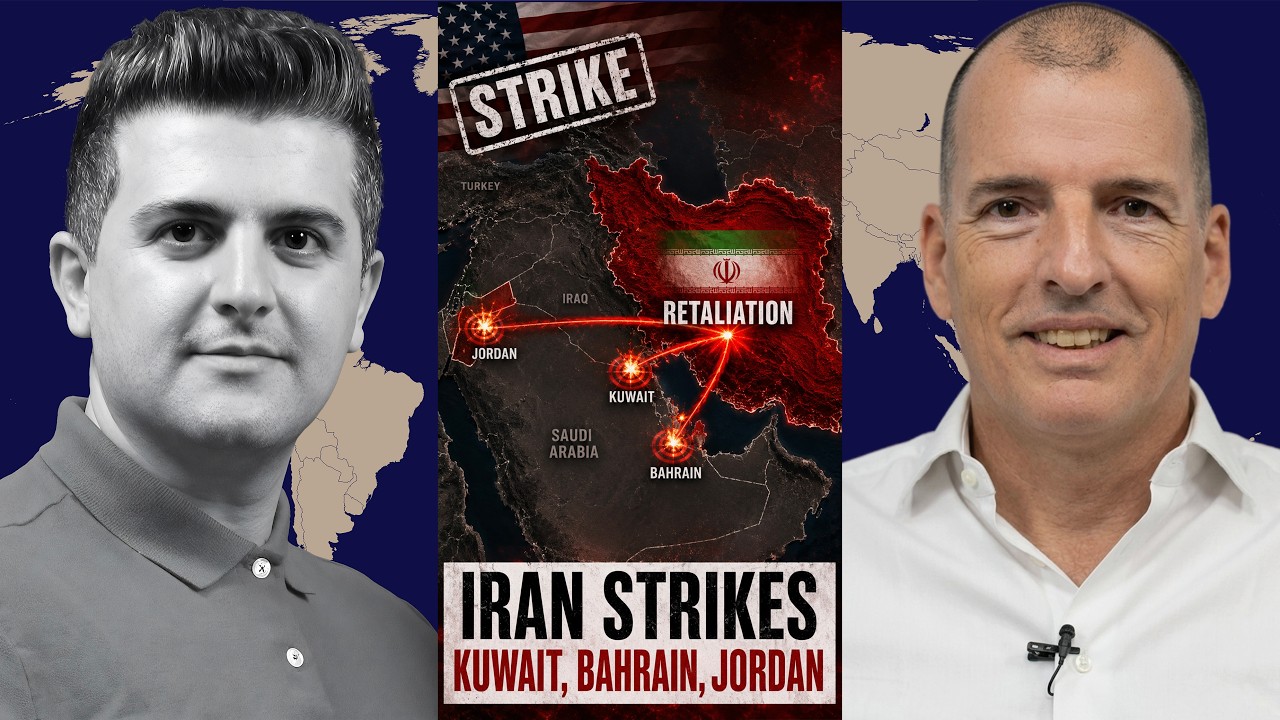
Alex Krainer: US STRIKES Iran – Iran RETALIATES Against Kuwait, Bahrain & Jordan!
"Amidst escalating US-Iran conflict and Iranian retaliation against regional US allies, this episode argues that US foreign policy is deeply controlled by an 'Anglo-Zionist conspiracy' led by the Rothschild banking dynasty, prioritizing Israeli interests over American ones."