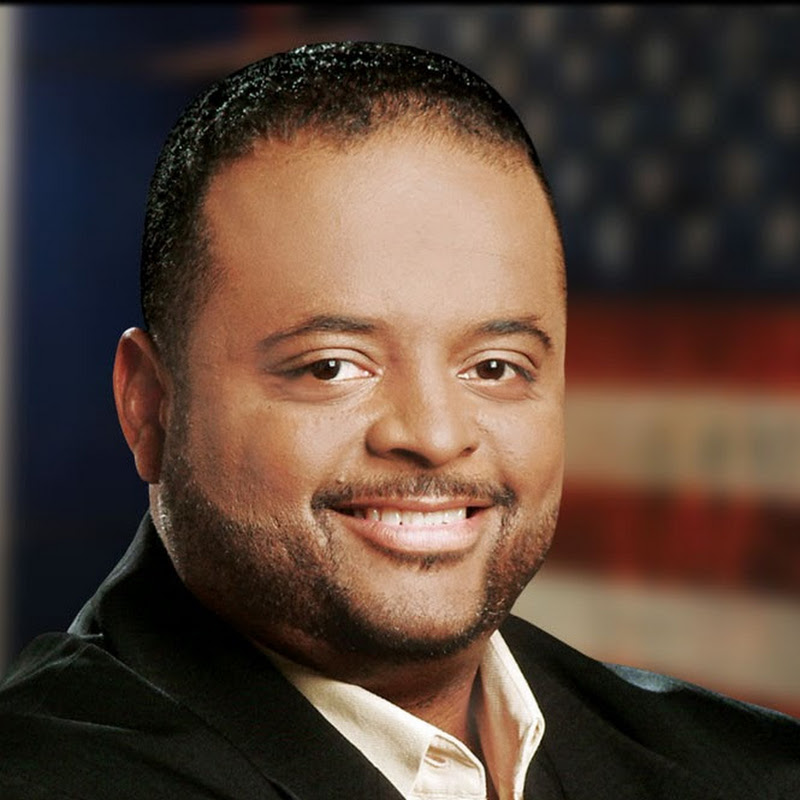
Roland speaks to Northern Va. Baptist Town Hall
YouTube · F0M3VsYEMY0
Quick Read
Summary
Takeaways
- ❖Black-owned media is essential for centering African-American interests and controlling narratives, especially as traditional Black media declines.
- ❖A deliberate plan exists to 'defund Black America,' targeting institutions from academics to civil rights groups through legislative and judicial means.
- ❖The Supreme Court, referred to as the 'Extreme Court,' is actively eroding Black political power and civil rights protections.
- ❖Many Black institutions, including parts of the Black church, are criticized for being too focused on personal gratification or 'hooping' rather than substantive political and economic action.
- ❖Effective boycotts require a strategic plan, negotiation, and escalation, not just an immediate call to action, as demonstrated by Reverend Leon Sullivan's Operation Bread Basket.
- ❖Black leaders and organizations are often settling for 'crumbs' (e.g., small donations) from corporations and political campaigns instead of demanding equitable investment and a share of billions in spending.
- ❖A 'sharecropper mentality' persists where Black communities do the work (volunteering, voting) but white strategists and agencies reap the financial benefits.
- ❖Micro-level, data-driven organizing within local zip codes and precincts is crucial for voter registration, community development, and holding leaders accountable.
- ❖The power to transform communities lies in leveraging existing capacity (e.g., retired educators in churches for tutoring) and fostering collective action, starting with inviting one person at a time.
Insights
1The Erosion of Black-Owned Media and the Imperative of Ownership
Roland Martin highlights the significant decline of traditional Black-owned media (Ebony, Jet, Essence, BET, TV One) and the resulting void in news and analysis centered on African-American interests. He asserts that owning media platforms, like his Blackar Network, is critical to control narratives, make independent editorial decisions, and ensure the community receives vital information without external influence.
Roland Martin's Blackar Network launched eight years ago after TV One canceled 'News One Now' to address the lack of daily news centering African-Americans. He notes that BET is now owned by the 'right-wing Ellison family' and has no news shows, and TV One also lacks news shows. He states, 'I own it. I ain't got to ask nobody... It's a dictatorship.'
2A Coordinated 'War' to Defund Black America
Martin warns that a clear and defined plan, outlined in 'Project 2025,' is actively being executed to defund and dismantle Black American institutions. This attack targets academics, economics, politics, social structures, civil rights, and legal groups, leveraging control of all government levers, including the Supreme Court.
He cites 'Project 2025' and the 'Extreme Court' ruling in Louisiana, which wiped out Black congressional districts. He also mentions Sam Alito's opinion dismissing overtly racial statements as 'race neutral justifications' in a case affecting Haitian and Syrian TPS, contrasting it with Elena Kagan's direct quotes of racist remarks by officials.
3Critique of Black Institutions' Inadequate Response
Martin criticizes the Black church and other Black institutions for their muted and ineffective responses to the ongoing assault on Black America. He argues that many are too focused on internal matters, 'hooping and preaching,' or personal gratification rather than engaging in substantive political and economic activism.
He questions why Black ministers' conferences lack substantive conversations about attacks on Black America, contrasting them with Ralph Reed's 'Faith and Freedom Conference' which has a clear political agenda. He quotes Dr. King's 'Where Do We Go From Here: Chaos or Community?' noting King's critique of the 'Negro Church,' 'Negro Press,' and social/professional groups for not dedicating full resources to liberation.
4The Failure of Unplanned Boycotts and the Need for Strategy
Martin dissects the failure of recent boycotts, like the Target boycott, attributing it to a lack of strategic planning. He highlights Reverend Leon Sullivan's 'Operation Bread Basket' as a historical model for effective boycotts, which involved data collection, negotiation, escalating pressure, and signed agreements.
He recounts a story of a woman demanding a 'convenient boycott' and criticizes the Target boycott for starting without a plan. He details Sullivan's six-point strategy: meet with the company, demand data, negotiate, inform congregations, launch limited pickets, escalate pressure, sign a memorandum of understanding, and monitor demands.
5Combating the 'Sharecropper Mentality' in Negotiations
Martin argues that Black leaders and organizations often accept minuscule financial contributions from corporations and political campaigns, effectively operating with a 'sharecropper mentality.' He advocates for demanding a proportional share of spending (e.g., 5% of a corporation's ad budget) to truly impact Black-owned businesses and communities.
He criticizes four Black Baptist groups for accepting a $300,000 check from Target, calling it a 'crumb' compared to Target's multi-billion dollar market cap. He also recounts how his media company negotiated a $350,000 ad buy from the Kamala Harris campaign, while other Black media were offered much less, and white agencies received hundreds of millions.
6Leveraging Micro-Level Organizing and Data for Political Power
To counter systemic attacks and build political power, Martin proposes a micro-level, data-driven organizing strategy. This involves collecting detailed community data (names, addresses, issues), identifying unregistered voters in specific precincts, and consistently engaging them multiple times, similar to the Nehemiah model of rebuilding 'where you are.'
He suggests gathering data on conference attendees and organizing them by zip code to focus on local precincts. He cites Reverend James Meeks' success in training thousands of voter registrants directly in church after service. He notes Republicans touch voters 12 times, Democrats 4, and 6+ touches increase likelihood of voting. He highlights how small margins (e.g., 7,000 votes for House control, 401 votes for a Supreme Court seat) determine elections.
Bottom Line
The current anti-DEI movement is not just ideological but a direct economic attack, causing 80-90% funding reductions for Black nonprofits and influencing corporate mergers and acquisitions.
This reveals a deliberate strategy to economically cripple Black institutions and businesses, forcing them to either compromise their mission or face collapse. It underscores the urgency for Black communities to develop independent funding mechanisms and collective economic defense strategies.
Create and support Black-owned financial institutions, investment funds, and philanthropic networks that are insulated from mainstream corporate and political pressures. Develop alternative revenue streams and cooperative economic models for Black nonprofits and businesses.
The redefinition of 'minority bank' to include 'disadvantaged' white individuals is a strategic move to dilute and redirect resources intended for historically marginalized groups.
This redefinition threatens to divert crucial capital and support away from genuinely minority-owned banks, further undermining Black economic empowerment and wealth building. It exposes a tactic to legally dismantle affirmative action-like programs.
Advocate for strict definitions of 'minority' in financial and business designations to ensure resources reach intended communities. Develop internal Black banking and credit union networks that prioritize community investment and are less susceptible to external redefinitions.
Opportunities
Blackar Network Model for Niche Media Ownership
Establish and scale niche, unapologetically Black-centered media platforms (like Roland Martin's Blackar Network) that provide news, analysis, and entertainment from an African-American perspective. These platforms should be donor-supported and free to access to maximize reach, ensuring the community controls its narrative and information flow.
Strategic Collective Bargaining for Media Spend
Form a coalition of Black-owned media outlets and civil rights organizations to collectively negotiate with major corporations (e.g., PepsiCo, Comcast, Disney) for a guaranteed percentage (e.g., 5%) of their annual advertising and procurement budgets. This moves beyond 'crumbs' to secure billions in investment for Black businesses and media.
Key Concepts
Sharecropper Mentality
This model describes a situation where Black communities and individuals perform the labor (e.g., voting, volunteering, consumer spending) but do not own the means of production or receive equitable returns, allowing others (e.g., white ad agencies, political consultants, corporations) to profit disproportionately from their efforts. It highlights a lack of ownership and strategic negotiation for collective wealth and power.
Micro-Strategy for Macro Impact (Nehemiah Model)
This model advocates for focusing on small, localized, and data-driven efforts to achieve large-scale change. Instead of attempting broad, uncoordinated movements, it suggests identifying specific needs and capacities within local communities (zip codes, church congregations) and systematically organizing resources and people to address them. This approach, inspired by Nehemiah rebuilding the wall 'brick by brick,' emphasizes building from the ground up, ensuring accountability, and leveraging existing community assets.
Lessons
- **Demand Data and Negotiate Collectively:** When engaging with corporations or political campaigns, demand comprehensive data on their spending with Black-owned entities and negotiate for a significant, measurable percentage of their overall budget, rather than accepting small donations.
- **Implement Micro-Level Organizing:** Focus on organizing within specific zip codes and precincts. Collect detailed contact information and top issues from community members, then assign individuals to target and engage unregistered voters or address local concerns (e.g., school board issues).
- **Leverage Existing Institutional Capacity:** Utilize Black churches and other community organizations as hubs for voter registration drives, citizenship education, and after-school tutoring programs, tapping into the skills of retired professionals within the congregation.
The Nehemiah Model for Community Rebuilding and Political Mobilization
**Survey the Damage & Plan:** Identify specific community needs and areas of weakness (e.g., low voter turnout in certain precincts, lack of educational support). Develop a concrete, data-driven plan for action.
**Mobilize & Assign Local Ownership:** Collect detailed data (name, address, phone, email, top 5 issues) from community members. Organize them by zip code and assign responsibility for specific local areas (e.g., a 0.25-0.5 mile radius around a church).
**Execute & Monitor with Persistence:** Implement the plan (e.g., voter registration, tutoring). Continuously engage target populations (e.g., touch voters at least six times). Be prepared for 'haters' and external opposition, maintaining focus on the building process while defending against attacks.
Quotes
"We will rule the day when we have to ask somebody else to tell our story."
"There is a clear and defined plan to defund Black America. They are targeting every institution."
"The point of a boycott is it's supposed to be inconvenient."
"What I am describing is what is a fundamental problem that we are dealing with and that is we are operating in so many areas as sharecroppers."
"We will never solve our problems if we're fixated on who didn't show up."
Q&A
Recent Questions
Related Episodes

The Immortal Jim Crow. 'Goon Squad' Defamation Suit. Google Race Discrimination Case. #TheBreakdown
"This episode exposes the enduring grip of systemic racism through a Mississippi defamation suit, Google's racial discrimination settlement, and a deep dive into how Jim Crow's legacy still shapes Black America today."
NC Mom Sues Hospital For Negligence. Black NFL Coaches Win Major Ruling. Drug Test Scandal Exposed
"This episode exposes systemic failures and racial disparities across healthcare, professional sports, and politics, featuring a mother's harrowing hospital negligence lawsuit, a landmark NFL discrimination ruling, and alarming findings on flawed drug tests criminalizing new mothers."

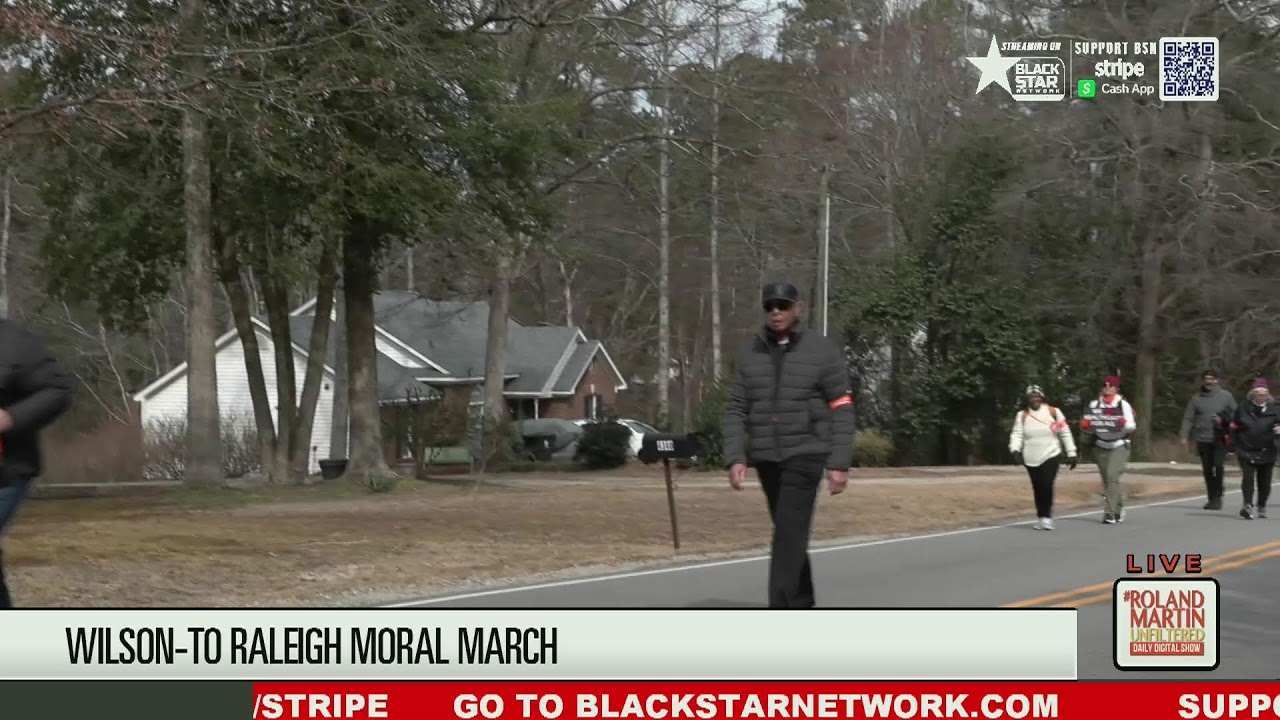
LIVE! Love Forward Together Mass People’s Assembly & Moral March Mobilization In Raleigh, NC
"Thousands marched across North Carolina in the 'This Is Our Selma' movement, led by Reverend William Barber, to combat gerrymandering, voter suppression, and advocate for a proactive, love-driven vision of social and economic justice."
NC Early Voting Push. Cancer Alley Win. NFL Shuts Out Black Coaches.Trump Nominee’s “White Identity”
"Roland Martin Unfiltered dissects systemic racism in politics, sports, and environmental justice, revealing how Black communities are fighting back against gerrymandering, corporate exploitation, and hiring discrimination."