
What Orban’s Loss Means For Fascism; Iran’s Endgame w/ Jason Stanley, Mohammad Ali Shabani | MR Live
YouTube · FaWKMiidFKE
Quick Read
Summary
Takeaways
- ❖Viktor Orban's political success in Hungary was built on cultural politics, anti-Semitism, and 'owning the libs' rhetoric, which served as a smokescreen for enriching his family and allies.
- ❖Hungary became a financial and ideological hub for global far-right movements, including CPAC, bankrolled by taxpayer money.
- ❖The US blockade of the Strait of Hormuz against Iran is logistically difficult to enforce, with Iran leveraging ambiguity and alternative trade routes to mitigate its impact.
- ❖Iran's 'irrationality' in escalating conflicts can be a rational strategy to deter further attacks, given its significant military spending disparity with the US and Israel.
- ❖Defeating 'competitive authoritarianism' requires an overwhelming electoral victory and a focus on exposing corruption and material issues over cultural grievances.
Insights
1Orban's Rise and the 'Owning the Libs' Formula
Viktor Orban's political success in Hungary stemmed from pioneering a 'cultural politics' formula. He discovered that people would sacrifice their material and children's future to gain pleasure from seeing 'liberal elites' (like university professors) suffer. His campaigns were nakedly anti-Semitic, railing against 'globalists' and 'cosmopolitans,' and he explicitly ran on themes of 'making Hungary great again' and vilifying immigrants, predating and influencing Trumpism.
Jason Stanley's account of his experience in Hungary from 2009 to 2010, and his analysis of Orban's 2010 campaign, which was initially met with global shock for its explicit fascism and anti-Semitism.
2Hungary as a Global Hub for Far-Right Movements
Hungary, despite being a small European country, became a global center for Steve Bannon's 'global fascist project.' The Orban government used taxpayer money to fund think tanks like the Danube Institute, bringing in far-right journalists and intellectuals (e.g., Rod Dreher, Tucker Carlson) to export Orban's techniques of destroying institutions, using scapegoating, and targeting universities under the guise of 'anti-wokeism,' all while allies profited.
Stanley detailing the government-funded institutes and the relocation of figures like Rod Dreher to Budapest, and the widespread visits from figures like Tucker Carlson.
3Orban's Defeat Driven by Corruption Exposure
Orban's recent electoral setback (a 14% win for the opposition) occurred because the opposition, led by Peter Maguar, relentlessly focused on exposing the widespread corruption and personal enrichment of Orban's family and allies. This allowed the public to see through the 'cultural politics' as a smokescreen, realizing that 'owning the libs' came at the cost of the nation's future, including a collapsing birth rate and economic decline.
Stanley's analysis of Maguar's strategy and the public's growing awareness of Orban's family profiting from state contracts, alongside Hungary's lowest birth rate in modern history.
4Ineffectiveness of US Blockade in Strait of Hormuz
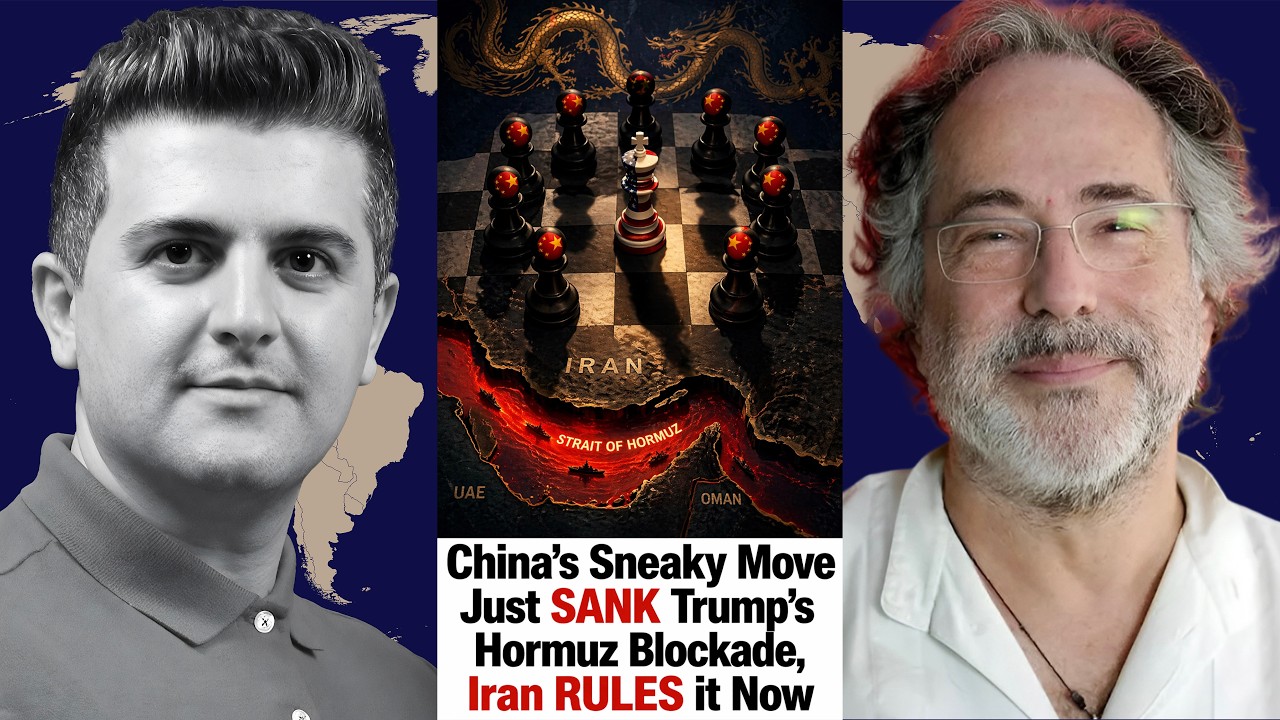
The US blockade of the Strait of Hormuz is largely ineffective due to Iran's strategic ambiguity, vast coastline, and alternative trade routes. Iran primarily uses threats and public messaging, not major military deployment, to deter shipping, making insurance companies the main 'blockade.' Logistically, policing Iran's 1,800 km coastline (the size of Western Europe) with 10,000 US forces is impractical, especially with existing smuggling and overland routes to Russia and Central Asia, and China's commitment to honoring its trade agreements with Iran.
Mohammad Ali Shabani's detailed explanation of Iran's tactics, the role of insurance companies, the logistical challenges of policing Iran's coastline, and the existence of alternative trade routes.
5Trump's Iran Strategy: Pressure or Exit Ramp?
The Trump administration's aggressive stance on Iran, including the blockade, could be either a continuation of a 'maximum pressure' campaign that has consistently failed to achieve policy objectives, or a calculated 'off-ramp' to announce a deal. By instituting a draconian measure that is logistically unsustainable and opposed by allies, Trump could later claim a 'big deal' was achieved through his extreme pressure, providing a political victory.
Shabani presents these two interpretations of the Trump administration's actions, noting the historical pattern of failed pressure tactics and the potential for a strategic withdrawal.
6US Demands and Iran's Sticking Points in Negotiations
Key sticking points in US-Iran negotiations include the timeline for an enrichment freeze (US demanding 10-20 years, Iran offering 5 years) and the fate of Iran's stockpiles of 60% and 20% enriched uranium. Iran has offered 'no stockpiling' (meaning no accumulation of nuclear material) and down-blending existing enriched uranium, but the US, influenced by Israel, insists on zero enrichment and handing over stockpiles, leading to repeated stalemates.
Shabani details the negotiation points from Geneva and Islamabad, including the specific timelines and Iran's proposals for managing enriched uranium.
Bottom Line
Iran's 'irrational' military response is a rational strategy to deter further aggression.
Despite being vastly outspent militarily (US+Israel combined budget >$1 trillion vs. Iran's $8 billion), Iran chose to attack multiple GCC countries after being hit. This 'irrationality' serves to signal that further attacks will invite disproportionate retaliation, making it a rational choice to appear unpredictable and deter larger powers.
This highlights a strategic paradox where conventional military disparity can be offset by unconventional, seemingly irrational, but calculated responses, forcing larger powers to reconsider the costs of intervention.
Trump's Iran policy may be driven by personal financial gain, not just geopolitical strategy.
The hosts speculate that the erratic nature of Trump's Iran policy, including demands for shared revenue from Strait of Hormuz tolls and rumors of accepting Trump-linked crypto for payments, suggests a motivation beyond national interest. This implies a potential for personal enrichment for Trump or his associates, rather than a coherent foreign policy.
This perspective suggests that understanding the financial interests of key decision-makers is crucial for predicting and interpreting foreign policy actions, especially in regimes where personal and state interests are blurred.
Key Concepts
Competitive Authoritarianism
A political system where formal democratic institutions (like elections) exist, but the ruling party manipulates the playing field through gerrymandering, media control, and pressure campaigns to disadvantage the opposition. While elections occur, they are not free and fair, making an overwhelming victory (e.g., 10-15% margin) necessary to unseat the autocrat.
Cultural Politics as Smokescreen
A strategy employed by authoritarian leaders (like Orban and Trump) where divisive cultural issues (e.g., anti-wokeism, anti-immigrant rhetoric, anti-LGBTQ+ sentiment) are amplified to distract the populace from the leader's corruption, economic mismanagement, and personal enrichment, allowing them to 'own the libs' while destroying national institutions and pocketing profits.
Lessons
- To counter authoritarian movements, shift focus from cultural grievances to exposing corruption and addressing material economic issues.
- Build broad solidarity against the 'billionaire class' and corrupt networks, even among groups with social disagreements, to unite against common enemies.
- Recognize that 'owning the libs' and similar cultural politics are often diversions designed to allow leaders to enrich themselves and their allies at the expense of the nation.
Notable Moments
JD Vance accidentally admitting the US engages in 'economic terrorism' against Iran.
This slip reveals the hypocrisy of US foreign policy, where actions deemed 'economic terrorism' when committed by adversaries are justified as legitimate leverage when used by the US, undermining moral authority.
A Republican senator invoking World War II and Hitler to justify the Iran conflict.
This comparison is a 'World War denial,' trivializing the scale of WWII and inverting historical roles, framing the US as a liberator while engaging in actions that critics liken to war crimes. It highlights the extreme rhetoric used to garner public support for military action.
Peter Maguar revealing Hungary bankrolled CPAC and other global far-right movements.
This exposes the concrete financial links between a 'soft authoritarian' state and international far-right political organizations, demonstrating how taxpayer money is used to export and sustain anti-democratic ideologies globally.
Quotes
"If the Iranians are going to try to engage in economic terrorism, we're going to abide by a simple principle that no Iranian ships are getting out either."
"If they engage in economic terrorism, we'll also engage in economic terrorism. You know what is typically associated with terrorism is acts of violence on civilians. And you guys actually started off with the actual terrorism by bombing a girl school, killing over 160 girls, doubletapping it, attacking their energy infrastructure, which is also terrorism."
"What Orban discovered was the formula of owning the libs. That's what he discovered. He discovered that you could get people to hand over their material future... in order to make university professors sad."
"We have to accept that on some level there is a percentage of the population at least in the West... that is like just really open to scapegoating segments of the population."
"People got sick of owning the libs. They finally saw through owning the libs. They're like, 'Wait, maybe maybe I actually want a country more than I want to see some... lower middle class college professor squirm. Maybe I want a future for my children.'"
"Uncertainty, I think, is the number one enemy of any business and I think Iran has caught up on that."
"The most rational thing for us to do is to appear irrational. Now what is irrational is to attack six countries at the same time knowing that your annual military spending is $8 billion. I'm going to attack them anyway. I don't care."
Q&A
Recent Questions
Related Episodes

Bibi DEMANDS Ground Troops As Marines Rushed to Iran
"Benjamin Netanyahu is pushing for US ground troops in Iran, framing air strikes as insufficient, while the US rushes Marines to the region and struggles to secure the Strait of Hormuz against surprisingly capable Iranian defenses."

Iran Update: Israel’s Newest Bombing Campaign, the Oncoming War With China and How to Avoid It
"Colonel Wilerson reveals how the US and Israel are actively bombing China's strategic infrastructure in Iran, escalating a covert economic war that Beijing intends to win without direct military conflict by dismantling the dollar's global dominance."

Patrick Henningsen: Hezbollah JUST Fired Back at Israel - Iran Vows to “Crush” All Attacks
"Patrick Henningsen argues that the US and Israel initiated an illegal war against Iran, driven by Trump's incompetence and Israeli influence, leading to an inevitable escalation with severe global economic repercussions."
Pepe Escobar: “Total Failure”: Trump’s Blockade Just Backfired Disastrously
"Pepe Escobar argues that the US blockade against Iran, spearheaded by Donald Trump, has utterly failed and backfired, accelerating global economic chaos and challenging US geopolitical dominance."