BREAKING: U.S. Strike On Iran May Be IMMINENT; IDF On HIGH ALERT For Retaliation Attack | TBN Israel
YouTube · H8U3N8LN3aE
Quick Read
Summary
Takeaways
- ❖Over a million people protested in Tehran, with Israeli intelligence estimating over 4,000 fatalities and 16,784 arrests.
- ❖President Trump threatened the Revolutionary Guard, stating 'help is on the way' for protesters and imposing a 25% tariff on countries doing business with Iran.
- ❖The IDF raised alert levels in its air force, military intelligence, and northern command, cooperating with US Central Command for potential Iranian retaliation.
- ❖US intervention options against Iran include symbolic strikes, heavy military action requiring force build-up, or supporting the return of Reza Pahlavi.
- ❖Hamas is secretly choosing a new head of its political bureau and deputy in Qatar, replacing Sinwar and Eluri.
- ❖Lebanese Foreign Minister Yusef Raji publicly criticized Hezbollah's weapons as a 'burden' and a justification for Israeli strikes, sparking fury from Hezbollah.
- ❖The Iranian regime attributes protests to 'foreign elements' (US/Israel) to justify crackdowns and tighten measures.
Insights
1US Covert Intervention in Iran Preceded Current Protests
The US and Israel have already been involved in weakening the Iranian regime through operations like 'Midnight Hammer' or 'Rising Lion' (Israel's term in June), sanctions, diplomatic pressure, and support for opposition figures like Reza Pahlavi, son of the former Shah. This long-term intervention is seen as a backdrop to the current wave of demonstrations.
Mati Shashani states: 'The fact that these demonstrations have reached this size... has to do with what the US and Israel by extension have been doing in Iran already. Operation Midnight Hammer or Rising Lion as Israel called it back in June. That's one of the triggers to what we're watching right now in Iran.' He also mentions sanctions and diplomatic pressure.
2Trump's 'Help is on the Way' Signals Imminent US Action Against Iran
President Trump's repeated statements, including 'Help is on the way' to Iranian protesters and advising Americans to leave Iran, are interpreted as strong signals of an impending US intervention. This is coupled with a 25% tariff threat on countries trading with Iran, intensifying economic pressure.
President Trump issued a threat against the Revolutionary Guard, saying they're in big trouble. 'Help is on the way.' () He replied, 'You'll find out soon enough.' () 'President Trump declared that a 25% tariff will be imposed on any country that continues to do business with Iran, including China, the United Arab Emirates, and Turkey.' ()
3IDF on Heightened Alert for Iranian Retaliation, Coordinating with US
The IDF has raised alert levels across its air force, military intelligence, and northern command, preparing for potential attacks from Iran's proxies or direct Iranian responses to a US strike. This includes cooperation with United States Central Command, indicating a coordinated defensive posture.
After this tweet, the IDF is raising the alert levels in various arenas, preparing for attacks by Iran's proxies and for scenarios of an American strike... The air force, military intelligence, and northern command are at a high level of alert and cooperation is taking place with United States central command.' (, )
4Hamas Covertly Electing New Leadership Post-Eliminations
Hamas has initiated a secret process to select a new head of its political bureau and deputy, replacing figures like Sinwar and Salah Eluri who were eliminated. This election is being conducted by the Shura Council in Gaza and abroad, with Khaled Kaya and Khaled Mashal as leading candidates in Qatar.
Hamas has begun a process to choose a new leader and deputy in place of Sinoir and Salah Eluri were eliminated during the war. Leading candidates in Qatar are fighting for control of the organization... The vote to appoint a successor is being conducted secretly in the Shura Council, a body of 50 members in Gaza and abroad. The two prominent names of leadership are Khaled Kaya and Khaled Mashal both based in Qatar.' (, )
5Lebanese Foreign Minister Publicly Condemns Hezbollah's Weapons
Lebanon's Foreign Minister, Yusef Raji, publicly stated that Hezbollah's weapons are a 'burden' on Lebanon and the Shiite community, and that their continued existence allows Israel to strike under the ceasefire agreement. This unprecedented public criticism from a Lebanese official drew strong condemnation from Hezbollah.
Lebanese foreign minister Ysef Raji said in an interview this week that as long as holds weapons, the ceasefire agreement allows Israel to strike... declaring that the weapons are a burden and do not protect the state.' () 'Bala was furious at this statement... claiming that Raji is justifying harm to Lebanese and filling the role of the Israeli foreign minister.' ()
Bottom Line
The Iranian regime's strategy to counter internal protests involves an internet shutdown, isolation of cities, judicial suppression (rapid convictions and executions), and a narrative that protests are foreign-instigated espionage to justify crackdowns.
This reveals a multi-pronged approach to control dissent, combining physical force, legal intimidation, and information warfare. The 'foreign hand' narrative is a key propaganda tool to delegitimize opposition and rally internal support against perceived external threats.
For external actors seeking to support Iranian protesters, circumventing internet blackouts and countering the 'foreign conspiracy' narrative with credible, localized information is critical. Understanding the regime's playbook allows for more effective counter-strategies.
The US is considering two main kinetic options for striking Iran: 'faster and more symbolic strikes' against regime/military targets without targeting ballistic missile arrays, or 'going in heavy' with a significant force build-up (2-3 aircraft carriers, heavy bombers) for deeper strikes.
This indicates a spectrum of military responses, from a limited punitive action to a major escalation. The 'heavy' option requires days of preparation, suggesting a window for diplomacy or further internal developments before a large-scale strike.
For regional states and international observers, monitoring US force movements (aircraft carriers, bombers) can provide early indicators of the scale of potential intervention. Understanding these options helps anticipate the likely Iranian response and regional impact.
Key Concepts
Spiritual Warfare
The host and guest frame the conflicts in the Middle East, particularly involving Israel, Iran, and Hamas, as a 'spiritual war' between 'good and evil,' suggesting a deeper, moral dimension to geopolitical events that transcends conventional political or military analysis.
Axis of Evil
The podcast consistently refers to Iran's Revolutionary Guard Corps as the 'head of the crumbling axis of evil in the Middle East,' portraying a unified, malevolent front of armed groups (Hamas, Hezbollah, Houthis, Shia militias) operating under Iranian command against regional stability and Israel.
Truth vs. Deceit
The host explicitly states that Hezbollah, like its 'masters in the IRGC of Iran,' 'runs on lies and deceit,' contrasting this with the podcast's mission to 'spread the truth.' This model suggests that a core aspect of the conflict is a battle over narrative and information control.
Lessons
- Stay informed on Middle East developments by following diverse news sources and 'ambassadors of truth' to counter misinformation.
- Engage in prayer for the peace of Jerusalem and the people of Iran, recognizing the spiritual dimensions of the conflict.
- Share factual information and personal experiences to counter anti-Semitism and misrepresentations of Israel, especially among younger audiences.
Notable Moments
TBN Israel's host, Pinto, and senior Middle East analyst, Mati Shashani, provide a detailed 'boots on the ground' report on the escalating situation in Iran, Gaza, and Lebanon, emphasizing the 'crumbling axis of evil' led by Iran.
This segment sets the tone for the podcast, establishing a clear narrative framework that positions Iran as the central antagonist and its proxies as extensions of its malevolent influence, while highlighting Israel's defensive posture.
Interview with Mike Gallagher, a conservative radio host, who discusses his pro-Israel stance, the importance of conveying truth in media, and the rise of anti-Semitism, particularly on US college campuses.
Gallagher's interview reinforces the podcast's ideological perspective, connecting geopolitical events to a 'good versus evil' narrative and emphasizing the role of media in shaping public opinion and countering 'misinformation' about Israel. His comments on 'America First' conservatives cooling on Israel also highlight internal challenges to pro-Israel advocacy.
Quotes
"The assessment is that he has decided to intervene, but the scope of the response and its timing are still unknown."
"It is widely understood that the protesters cannot take down the regime without help. And at least at this stage, they are far from toppling the regime."
"The system is not waiting for surprise to arrive. It is preparing in advance."
"Right now in Israel, the mood is simple. High anxiety, low certainty, and that combination is incredibly dangerous."
"To say America will get involved is ignoring the fact that we've already seen a very major involvement of the US government over multiple years and what's happening on the ground in Iran and it escalates in recent weeks and months."
"It is the worst thing imaginable for such a people when someone openly tells the truth and that's what they're really angry about."
"For me, this comes down to a battle between good and evil."
"Everything the left hates about the United States, they hate about Israel."
"As Israel falls, so do we. We're not going to let that happen."
Q&A
Recent Questions
Related Episodes
Palestinian Evangelical Analyst REACTS To U.S-Israeli War In Iran!
"The Young Turks dissect the US-Israeli war in Iran, alleging it's driven by Israeli expansionist goals, fueled by US political and media subservience, and resulting in devastating civilian casualties and economic fallout, while a Palestinian Christian analyst details the brutal realities of Israeli occupation and humiliation."

Alex Krainer: US STRIKES Iran – Iran RETALIATES Against Kuwait, Bahrain & Jordan!
"Amidst escalating US-Iran conflict and Iranian retaliation against regional US allies, this episode argues that US foreign policy is deeply controlled by an 'Anglo-Zionist conspiracy' led by the Rothschild banking dynasty, prioritizing Israeli interests over American ones."
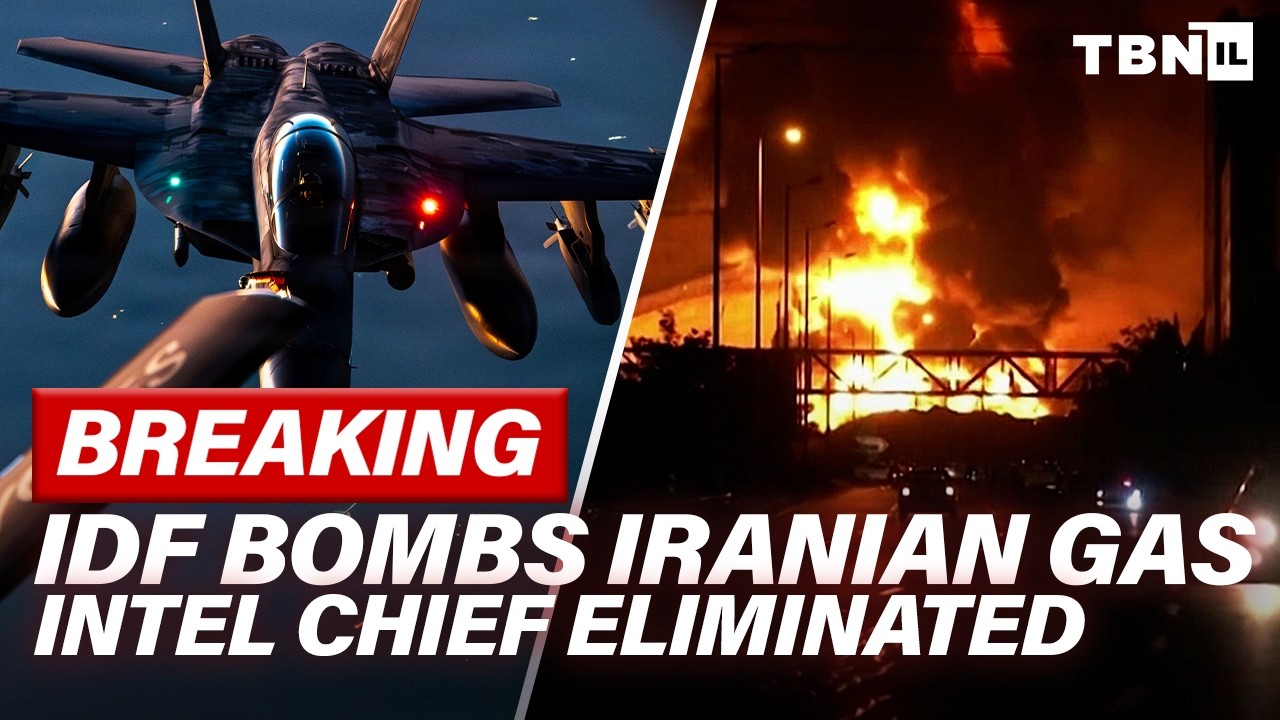
BREAKING: Israel BOMBS Major Iran Gas Site; Top Mullah ELIMINATED; Iran Vows VENGEACE | TBN Israel
"Israel and the United States have escalated their 'Roaring Lion War' against Iran, striking its largest gas facilities, eliminating key intelligence and military figures, and disrupting missile production, while Iran threatens a broader energy war in the Gulf."

'NOT America First!' Tucker Carlson On Iran, Trump, Ben Shapiro, Cruz & More!
"Tucker Carlson asserts that US involvement in the Iran war is not 'America First,' but rather driven by Israeli interests, weakening the US and fracturing the conservative movement while critics weaponize 'anti-Semitism' to silence dissent."