
🚨 LIVE: Crown Prince Reza Pahlavi URGENT Speech - Iran Uprising Escalates
YouTube · HHCk-vsqzf4
Quick Read
Summary
Takeaways
- ❖The Islamic Republic is a 'hostile occupying force' that has invaded Iran itself, using foreign terrorists and mercenaries to slaughter its people.
- ❖Over 12,000 Iranians were massacred in 48 hours, with the regime executing wounded protesters and charging families for bullets used to kill their loved ones.
- ❖Crown Prince Reza Pahlavi is uniquely positioned to lead a stable transition, with large sections of the army and security forces refusing to participate in killings and signaling loyalty.
- ❖Pahlavi has a comprehensive plan for an orderly transition, including a 100-day roadmap for national recovery and a constitutional process under international observation.
- ❖The international community must take six specific actions: degrade the regime's repressive capacity, apply maximum economic pressure, break information blockades, hold the regime accountable, demand prisoner release, and prepare for democratic transition.
- ❖A free, democratic Iran will be a 'pillar of peace' and 'game-changer' for the Middle East, embracing America as a friend and potentially extending the 'Abraham Accords' to 'Cyrus Accords'.
Insights
1Regime as a Hostile Occupying Force
The Crown Prince asserts that the Islamic Republic is not the legitimate government of Iran but a 'hostile occupying force' that has 'hijacked our homeland' and is using foreign mercenaries (Hezbollah, Iraqi militias) to brutalize its own citizens. This redefines the conflict from an internal struggle to one of national liberation against external control.
“The so-called Islamic Republic is not the government of Iran. It is a hostile occupying force that's hijacked our homeland... This regime has invaded Iran itself using foreign terrorists, Hezbollah fighters, Iraqi militias, and other mercenaries to slaughter the Iranian people.”
2Unprecedented Atrocities and Regime Desperation
Pahlavi details extreme brutality, including over 12,000 massacres in 48 hours, execution of wounded protesters in hospitals, forced collection of bodies in dump trucks, and charging families for bullets used to kill their loved ones. He frames the regime's use of 5,000 Arab proxies from Iraq and Lebanon as a clear sign of its internal weakness and inability to rely on its own security forces.
“More than 12,000 Iranians were massacred in 48 hours. One murder every 14 seconds. Kameese killers even hunted the wounded protesters in hospitals and executed them in cold blood... The regime collected piles of bodies with dump trucks and forced worried families to search unlabeled body bags. They refused to return bodies for burial without payment for the cost of the bullets that killed their loved ones.” and "About 5,000 Arab proxies are in Iran... They don't even have enough people. They have to bring in Arab proxies. That's a sign of weakness."
3Crown Prince's Claim to Leadership and Transition Plan
Reza Pahlavi states he is 'uniquely positioned' to lead a stable transition, citing calls from the Iranian people and loyalty from 'large sections of the army and security forces' who have refused to participate in civilian killings and signaled readiness to defect. He presents a detailed plan for a democratic transition, including a 100-day recovery roadmap, a temporary government, and a constitutional process culminating in free and fair elections.
“They have called for me to lead... I am uniquely positioned to ensure a stable transition... Large sections of the army and security forces have already refused to participate in the killing of civilians. They have whispered their loyalty to me. Tens of thousands have already signaled their readiness to defect... I have a comprehensive plan for an orderly transition which is ready to be implemented immediately.” and detailing the constitutional process from to .
4Six-Point International Call to Action
Pahlavi outlines specific demands for the international community: degrade the IRGC's repressive capacity (via surgical strikes), impose maximum economic pressure (block assets, target ghost tankers), break information blockades (Starlink, cyber operations), hold the regime accountable (expel diplomats, legal action), demand political prisoner release, and commit to recognizing a legitimate transitional government.
“Today, I ask the world to do six things. First, protect the Iranian people by degrading the regime's repressive capacity... Second, deliver and sustain maximum economic pressure... Third, break through the regime's information blockade... Fourth, hold the regime accountable... Fifth, demand the immediate release of all political prisoners. Six, prepare for a democratic transition in Iran by committing to recognize a legitimate transitional government.”
5Vision for a Free Iran: Regional Peace and Global Stability
Pahlavi argues that supporting a free, democratic Iran is not charity but essential for global stability, ending 47 years of terror and nuclear threats. He envisions a post-regime Iran as a 'pillar of peace, partnership, and prosperity' in the Middle East, embracing the US as a true friend and extending the 'Abraham Accords' to 'Cyrus Accords' with Israel and Arab nations.
“Global stability itself depends on the removal of this regime... A free democratic Iran will not be a source of endless crisis. It will be a pillar of peace, partnership, and prosperity for the Middle East and beyond... I see extending this idea to a free Iran through what we could call the Cyrus Accords, honoring our ancient heritage of tolerance and partnership.”
Bottom Line
The Iranian regime's reliance on imported Arab proxies from Iraq and Lebanon for internal repression is a critical indicator of its profound internal weakness and the widespread defection or non-compliance of its own security forces.
This suggests the regime's control is more fragile than external appearances, and its capacity for sustained internal repression is diminishing, making it more vulnerable to external pressure and internal resistance.
International efforts to target the regime's financial lifelines and support communication tools like Starlink could further accelerate internal fragmentation and defections, reducing the human cost of the uprising.
Crown Prince Pahlavi explicitly links the historical principles of the Cyrus Cylinder, which inspired American founding fathers like Thomas Jefferson, to his vision for a future democratic Iran and a 'Cyrus Accords' with Israel and Arab nations.
This framing aims to establish a deep historical and philosophical alignment between a future Iran and Western democratic values, particularly American ones, while simultaneously offering a blueprint for regional reconciliation that bypasses current geopolitical tensions.
Western governments, especially the US, could leverage this historical narrative to build broader public and political support for intervention, framing it as a restoration of shared values rather than mere geopolitical maneuvering.
Key Concepts
Wounded Animal Lashing Out
The regime's increased brutality and desperation, including importing foreign proxies, is framed as a sign of its imminent collapse, akin to a wounded animal lashing out as it faces its end. This suggests that extreme violence is a symptom of weakness, not strength.
Equalizing the Playing Field
The Crown Prince argues that international military intervention, specifically surgical strikes on the IRGC's repressive apparatus, is necessary to 'equalize the playing field' for unarmed Iranian protesters against a heavily armed and brutal regime, thereby reducing casualties and expediting the transition.
Exit Strategy for Security Forces
Pahlavi's plan includes an 'exit strategy' for security forces whose hands are not 'sold in the blood' of the Iranian people, ensuring they can survive regime change and become part of the solution to maintain security during transition, preventing a 'failed state' scenario.
Lessons
- Degrade the Islamic Revolutionary Guard Corps (IRGC) leadership and command infrastructure through targeted actions to reduce the regime's repressive capacity.
- Implement maximum economic pressure by blocking the regime's assets worldwide and dismantling its 'ghost tanker' fleet to cut off its revenue streams.
- Enable unrestricted internet access in Iran by deploying Starlink and other secure communication tools, and conduct cyber operations to disable the regime's internet shutdown capabilities.
- Expel Iranian diplomats from capitals and pursue legal enforcement actions against those responsible for crimes against humanity.
- Demand the immediate release of all political prisoners held by the Iranian regime.
- Commit to recognizing a legitimate transitional government in Iran to prepare for a democratic transition when the regime collapses.
Crown Prince Reza Pahlavi's Plan for Iranian Democratic Transition
**Phase 1: Immediate Collapse & Transitional Government** - Upon regime collapse, a transitional government takes control, establishing temporary judiciary, executive, and legislative branches, including a temporary parliament to oversee initial operations. Essential services (trash collection, transportation) are maintained, and public sector salaries are paid to prevent a 'failed state' scenario.
**Phase 2: Referendum on Governance System** - Approximately four months after collapse, the Iranian people participate in a referendum to decide their preferred future system of governance (e.g., republic or monarchy).
**Phase 3: Constitutional Assembly & Drafting** - A constitutional assembly, composed of representatives elected based on the referendum's outcome, is tasked with drafting a new constitution for the chosen system of government.
**Phase 4: Constitutional Ratification** - The drafted constitution is presented to the nation for ratification via a national referendum. If not ratified, it is sent back to the constitutional assembly for revision and resubmitted for a secondary referendum. This process repeats until a ratified constitution is achieved.
**Phase 5: First Democratic Elections** - Once the constitution is ratified, the first parliament of the new democracy is elected, followed by the election of the first government (e.g., President for a republic, Prime Minister for a monarchy).
**Phase 6: Dissolution of Transitional Government** - The transitional government formally dissolves, handing over all responsibility and authority to the newly elected government under the new constitution.
Notable Moments
Crown Prince Pahlavi asks for a moment of silence for those killed in the uprising, creating a solemn and impactful opening to his speech.
This act immediately humanizes the conflict, honoring the sacrifices of the Iranian people and setting a serious tone for his address, emphasizing the high human cost of the regime's repression.
Pahlavi directly addresses the Iranian youth, calling them the 'immortal guard of Iran' and urging them to continue the fight.
This moment serves as a powerful rallying cry, recognizing the central role of young people in the uprising and reinforcing their resolve, while also providing moral support against the regime's attempts to instill fear.
Pahlavi's confident response to a reporter's question about becoming a dictator, stating, 'I let historian write history. I'm here to make history, not to write it,' and emphasizing his unwavering commitment to democracy.
This directly addresses a common criticism or fear associated with monarchical restoration, projecting an image of a leader committed to democratic principles and popular sovereignty rather than personal power.
Quotes
"The so-called Islamic Republic is not the government of Iran. It is a hostile occupying force that's hijacked our homeland."
"The battle in Iran today is not between reform and revolution. It is between occupation and liberation."
"The people of Iran are being slaughtered in the streets and in their homes by a regime that shows no mercy. More than 12,000 Iranians were massacred in 48 hours. One murder every 14 seconds."
"I am uniquely positioned to ensure a stable transition. That's not my opinion. That's the verdict delivered loudly and clearly by the people in the face of bullets."
"This does not require putting boots on the ground. The Iranian people boots are already on the ground. They are the ones marching, sacrificing, and fighting for their freedom every single day."
"I let historian write history. I'm here to make history, not to write it."
"Iran today should have been the next South Korea of the Middle East. Iran at the time had five times the GDP of South Korea. Today we have become North Korea."
Q&A
Recent Questions
Related Episodes

Robby Soave GOES OFF On ANNOYING Liberal Black Woman Making Emotional Trump Deranged Arguments!
"The host dissects a heated foreign policy debate, arguing that 'left-wing' emotionalism and 'Trump derangement' prevent a rational understanding of US sanction strategies against Cuba and Iran."

Pentagon Prepares For EXTENDED War With Iran
"This episode dissects the geopolitical maneuvers surrounding potential US-Iran conflict, revealing strategic leaks, Netanyahu's diplomatic sabotage playbook, and the true intent behind economic sanctions."
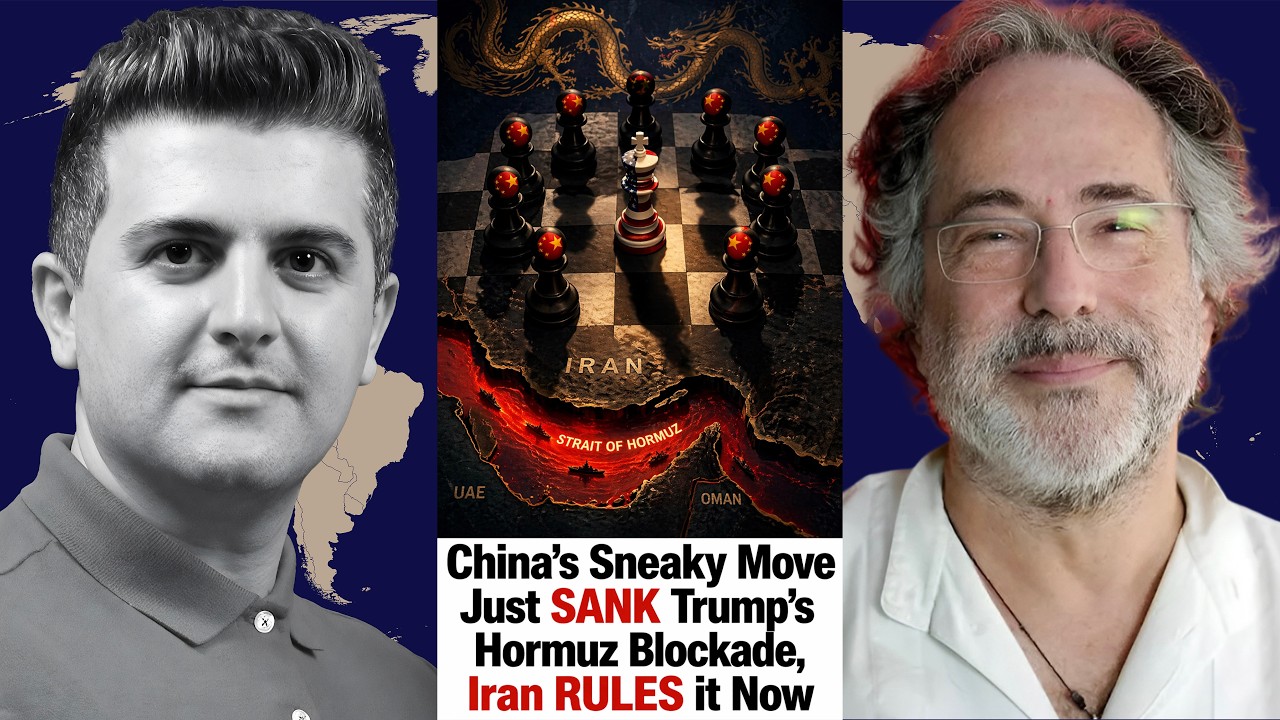
Pepe Escobar: “Total Failure”: Trump’s Blockade Just Backfired Disastrously
"Pepe Escobar argues that the US blockade against Iran, spearheaded by Donald Trump, has utterly failed and backfired, accelerating global economic chaos and challenging US geopolitical dominance."

Will Venezuela Be Trump's Vietnam?
"An expert breaks down three perilous pathways for Venezuela under potential US intervention, from a 'Panamanian model' to a 'Libyan-style civil war,' and the broader geopolitical fallout for Latin America."