
John Helmer: The Middle East Will Never Be the Same: Iran's UNTHINKABLE Play, U.S. & Israel Respond
YouTube · HfIxqx3QAVE
Quick Read
Summary
Takeaways
- ❖The Iranian Foreign Minister's visit to Moscow saw a Russian media blackout, signaling sensitive military intelligence sharing.
- ❖Admiral Igor Kostyukov, head of Russian military intelligence, met with the Iranian delegation, indicating discussions on US deployments and Russian defense assistance.
- ❖Putin's spokesman, Yuri Ushakov, publicly stated Russia would 'balance' its actions between the US, Israel, and Iran, contradicting official Russian foreign policy.
- ❖This 'balancing act' reflects a division between Putin's political appeasement towards Trump and the Russian military's commitment to deterring US aggression.
- ❖Kirill Dmitriev, a key Russian negotiator, has largely failed in US talks but represents a powerful oligarchy influencing Putin's economic policy.
- ❖Iran's three-stage negotiation proposal demands stable ceasefires, resolution of the Hormuz blockade with reparations, and then nuclear issues, effectively testing US commitment.
- ❖The sinking of the Iranian destroyer 'Dana' by US torpedoes, after it was disabled and its crew preparing to abandon ship, is framed as a war crime.
- ❖Indian and Sri Lankan governments are implicated in delaying safe harbor for the 'Dana,' potentially making them complicit in its destruction.
- ❖US political instability, including Trump's declining approval due to economic impacts of the Hormuz blockade, influences its foreign policy decisions.
- ❖The US consistently misunderstands its adversaries, leading to strategic mistakes and failed regime change attempts in Iran.
Insights
1Russia's Dual Foreign Policy on Iran
Russia exhibits a split approach: President Putin and his political advisors (like Ushakov) attempt to appease the US and Israel, even suggesting a 'balance' between the warring parties. In contrast, the Russian military, exemplified by the presence of Admiral Costikov at the meeting with Iran's Foreign Minister, is committed to providing intelligence and defense support to Iran, reflecting a 'strong do not get beaten' mentality.
Russian media blackout on the Iranian FM's visit, Putin's coded messages about Iran's Supreme Leader, Ushakov's statement about 'balancing' US, Israel, and Iran, and Admiral Costikov's presence at the meeting.
2Iran's Strategic Three-Stage Negotiation Formula
Iran has proposed a three-stage negotiation process designed to test the trustworthiness and commitment of the US and Israel. The first stage requires a stable, respected ceasefire. The second demands resolution of the Strait of Hormuz blockade and reparations. Only after these are proven can the third stage, addressing nuclear issues, be considered. This sequence highlights Iran's distrust of US agreements.
The Iranian negotiation formula emphasizes that 'nothing the Americans can sign, agree to, or negotiate can be trusted on its face.'
3US War Crime in Sinking the 'Dana' Destroyer
The US Navy intentionally sank the Iranian destroyer 'Dana' with two torpedoes. The first disabled the vessel, and the second, fired 90 minutes later while the crew was preparing to abandon ship, broke its keel and caused mass casualties. This act, targeting a disabled vessel with surrendering/abandoning crew, constitutes a war crime under international naval code.
Iranian captain's interview on TV, Peter Hegset's (War Secretary) admission of responsibility for the kill order, and the timeline of the two torpedo strikes.
4Indian and Sri Lankan Complicity in 'Dana' Sinking
Both the Indian and Sri Lankan governments are accused of complicity in the 'Dana' incident. They allegedly delayed granting safe haven to the Iranian squadron under immense US pressure, effectively leaving the unarmed vessels vulnerable to attack. This decision is seen as a betrayal of naval honor and non-alignment principles.
Iranian requests for safe haven in Sri Lanka and India, delays in granting permission, and the subsequent US attack.
Bottom Line
The Russian oligarchy, represented by figures like Kirill Dmitriev, holds significant sway over Putin's economic policies, even when their negotiation efforts fail. This internal power structure prioritizes maintaining Putin's power over strategic foreign policy effectiveness.
This suggests that Russia's foreign policy may not always be monolithic or purely strategic, but also influenced by powerful domestic economic interests, potentially leading to contradictory actions or missed opportunities in international relations.
Analysts should monitor the interplay between Russian economic elites and political decisions, as this internal dynamic can create unforeseen vulnerabilities or opportunities for external actors to exploit or navigate.
The US's consistent inability to accurately understand its adversaries, particularly Iran, leads to strategic miscalculations and self-defeating policies.
This fundamental misunderstanding perpetuates conflicts and prevents effective diplomatic resolutions, as US actions are based on flawed assumptions about the adversary's internal dynamics and motivations.
For nations opposing US hegemony, a deep understanding of US internal politics and cultural blind spots can be leveraged to create asymmetric advantages, as demonstrated by Iran's use of the 'oil weapon' to influence US domestic stability.
Key Concepts
The Melian Dialogue (Thucydides)
The ancient Greek principle, 'The strong do what they have the power to do and the weak accept what they must,' is invoked by Russian Foreign Minister Lavrov to emphasize Russia's determination not to be 'weak.' The podcast then reverses this, suggesting Iran's strategy demonstrates how the 'weak' can achieve equality of power against the 'strong' by exploiting their adversaries' vulnerabilities.
Lessons
- Monitor Russian state media blackouts and coded diplomatic language for insights into sensitive military and intelligence cooperation that is not openly publicized.
- Analyze the internal divisions within major powers (e.g., Russia's political vs. military factions) to understand potential inconsistencies or leverage points in their foreign policy.
- Scrutinize negotiation proposals from adversarial nations for underlying strategic objectives, such as Iran's three-stage formula designed to test trust and commitment rather than merely reaching an agreement.
- Investigate instances of alleged war crimes and international complicity, as these events can significantly alter geopolitical alliances and perceptions of international law.
- Assess the impact of domestic political instability and economic pressures (e.g., inflation, gas prices) on a nation's foreign policy decisions, as these can drive desperate or contradictory actions.
Notable Moments
The presence of Admiral Igor Kostyukov, head of Russian military intelligence, at the meeting between Putin and Iran's Foreign Minister.
This unpublicized detail strongly indicates that the meeting involved high-level military intelligence sharing and coordination regarding US deployments and defense strategies, underscoring the depth of Russia-Iran military cooperation.
Ushakov's statement that Russia would 'balance' its actions between the US, Israel, and Iran.
This public declaration by Putin's foreign affairs advisor directly contradicts Russia's official stance of supporting Iran against unprovoked aggression, revealing a significant internal division or strategic ambiguity within the Russian leadership.
The detailed account of the sinking of the Iranian destroyer 'Dana' by US torpedoes.
This incident is presented as a clear war crime, highlighting the brutal tactics employed in the conflict and the alleged complicity of regional powers like India and Sri Lanka, which has profound implications for international relations and naval conduct.
Quotes
"We see, says President Putin, how courageously and heroically the Iranian people are fighting for their independence and sovereignty. And of course, we very much hope that relying on this courage and determination, the Iranian people under the leadership of their new leader will go through this difficult period of trials and peace will come."
"We are going to balance what we've heard from the Americans, from the Israelis, making them equal."
"The Russian president has repeatedly said that the weak are beaten. That's all there is to say about it. So, you have to be strong."
"The standard of justice depends on the equality of power to compel and that in fact the strong do what they have the power to do and the weak accept what they must."
"What they can achieve and what they're beginning to show is how the weak how the weak can defeat the strong."
Q&A
Recent Questions
Related Episodes
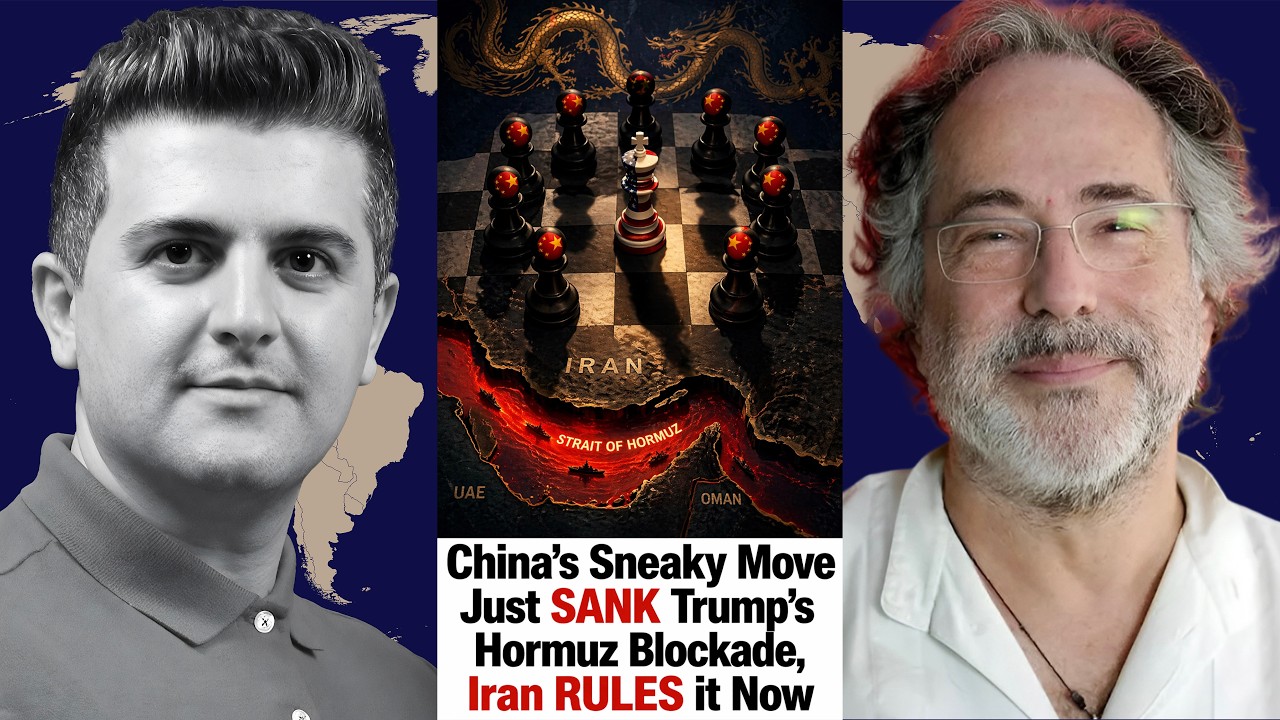
Pepe Escobar: “Total Failure”: Trump’s Blockade Just Backfired Disastrously
"Pepe Escobar argues that the US blockade against Iran, spearheaded by Donald Trump, has utterly failed and backfired, accelerating global economic chaos and challenging US geopolitical dominance."
Robby Soave GOES OFF On ANNOYING Liberal Black Woman Making Emotional Trump Deranged Arguments!
"The host dissects a heated foreign policy debate, arguing that 'left-wing' emotionalism and 'Trump derangement' prevent a rational understanding of US sanction strategies against Cuba and Iran."

Pentagon Prepares For EXTENDED War With Iran
"This episode dissects the geopolitical maneuvers surrounding potential US-Iran conflict, revealing strategic leaks, Netanyahu's diplomatic sabotage playbook, and the true intent behind economic sanctions."

Col. Jacques Baud: The World Is Entering a Lawless Era
"Colonel Jacques Baud details his personal experience with arbitrary EU sanctions and argues that the world has shifted from a law-based international order to a dangerous, rules-based system dictated by powerful actors, exemplified by US actions in Venezuela and the EU's 'teenager decision-making'."