
Ben Affleck EXPOSES AI Companies' Financial Lies
YouTube · Kk_cQCYmy8k
Quick Read
Summary
Takeaways
- ❖Ben Affleck states current AI (ChatGPT, Claude, Gemini) produces 'shitty' content that regresses to the mean, unsuitable for meaningful creative work.
- ❖Affleck argues AI technology is not progressing as presented; its improvement curve is plateauing and becoming prohibitively expensive.
- ❖AI companies inflate valuations by overstating future capabilities to justify massive capital expenditures on data centers.
- ❖Netflix executives actively demand plot reiteration and front-loaded action sequences in films to cater to viewers distracted by second screens.
- ❖This executive directive leads to a decline in writing quality, creating 'Netflix slop' that prioritizes quantity over artistic merit.
- ❖The hosts contend that historical warnings about technology (radio, TV) eroding critical thinking and family time were correct, and modern tech continues this trend.
- ❖The rise of AI-summarized books and declining reading rates indicate a further erosion of deep engagement and critical thinking in society.
Insights
1AI's Plateauing Progress and Financial Deception
Ben Affleck asserts that current AI models like ChatGPT, Claude, and Gemini produce 'shitty' content because they default to the average, lacking originality or depth. He observes that the technology's progression is not as rapid or revolutionary as often portrayed, with improvements like GPT-5 being only marginally better (25%) than GPT-4, but at four times the cost in electricity and data. Affleck frames the widespread 'existential dread' rhetoric around AI as a tactic by companies to justify inflated valuations and massive capital expenditures on data centers, promising future breakthroughs that are not materializing at the projected pace.
Ben Affleck: 'If you try to get Chat Gibbt or Claude or Gemini to write you something, it's really shitty. And it's shitty because by its nature it goes to the mean to the average... I don't think it's very likely that it's going to be able to write anything meaningful... I think it actually it turns out the technology is not progressing in exactly the same way they sort of presented it.' () 'The reason they're saying that is because they need to ascribe a valuation for investment that can warrant the capex spend they're going to make on these data centers.' ()
2Netflix's Content Degradation Driven by Audience Distraction
Affleck and Damon revealed that Netflix's content strategy is directly influenced by audience viewing habits, specifically the 'second screen phenomenon.' Executives now demand that films include a major action sequence within the first five minutes to hook viewers and require plot reiteration multiple times throughout the dialogue. This approach is a direct response to the assumption that viewers are often distracted by phones or other activities while watching, necessitating constant reminders of the plot to prevent them from losing track. This executive directive leads to a significant decline in writing quality, prioritizing retention over artistic integrity, resulting in what the hosts describe as 'Netflix slop.'
Ben Affleck: 'Netflix... the standard way to make an action movie... you usually have like three set pieces... now they're like, 'Can we get a big one in the first five minutes to get somebody... we want people to stay tuned in and... it wouldn't be terrible if you reiterated the plot three or four times in the dialogue because people are on their phones while they're watching.'' ()
3Technology's Erosion of Critical Thinking and Engagement
The hosts argue that historical warnings about the negative societal impacts of technologies like radio and television were largely correct, leading to a decline in critical thinking and deep engagement. They extend this argument to modern technology, particularly smartphones and AI. The pervasive use of phones, even during social interactions, and the trend of using AI to summarize books instead of reading them, contribute to record-low reading rates and a culture of superficial engagement. This constant distraction and reliance on simplified information hinders critical thought and impacts fundamental societal behaviors, including how children learn through mimicry.
Host (Sagar): 'The most disastrous statistics around phones and AI is books. The amount of Americans now who read even one book a year is like at a record alltime low.' () 'Professors across the country are talking about how all people do is just chat summarize books and readings instead of actually engaging or reading with the text.' ()
Bottom Line
The economic reality of AI's diminishing returns and escalating costs could lead to a 'race to the bottom' in creative industries, where cheap, AI-generated 'slop' content dominates due to its low production cost, despite its low quality.
This challenges the optimistic view of AI as a tool for enhancing creativity and suggests a future where economic incentives prioritize quantity and low cost over artistic merit, potentially devaluing human creative work.
For creators, this highlights the increasing value of truly original, high-quality content that cannot be easily replicated by AI, creating a niche for premium, human-driven artistic endeavors. For investors, it suggests caution in AI companies whose valuations rely on exponential, unproven progress.
Key Concepts
Regression to the Mean
Ben Affleck applies this concept to AI, explaining that AI-generated content tends towards the average, making it 'shitty' and unoriginal. The hosts extend this to Netflix's content strategy, where catering to the lowest common denominator of distracted viewers results in homogenized, low-quality 'slop'.
Lessons
- Be skeptical of AI companies' valuation narratives; question claims of exponential progress, especially when considering the high costs of advanced models.
- Critically evaluate streaming content, recognizing that plot reiteration and front-loaded action may be executive mandates designed to combat viewer distraction, not artistic choices.
- Actively cultivate deep engagement with media (e.g., reading physical books, minimizing second screens) to counter the societal trend of diminishing attention spans and critical thinking.
Quotes
"If you try to get Chat Gibbt or Claude or Gemini to write you something, it's really shitty. And it's shitty because by its nature it goes to the mean to the average."
"The reason they're saying that [AI will change everything] is because they need to ascribe a valuation for investment that can warrant the capex spend they're going to make on these data centers."
"Netflix... they're like, 'Can we get a big one in the first five minutes to get somebody... we want people to stay tuned in and... it wouldn't be terrible if you reiterated the plot three or four times in the dialogue because people are on their phones while they're watching.'"
"The most disastrous statistics around phones and AI is books. The amount of Americans now who read even one book a year is like at a record alltime low."
Q&A
Recent Questions
Related Episodes

Joe Rogan Experience #2519 - Scott Eastwood
"Joe Rogan and Scott Eastwood discuss the detrimental effects of American food processing, the manipulation of political division, the psychological benefits of psychedelics, and the importance of purpose and moderation in life."
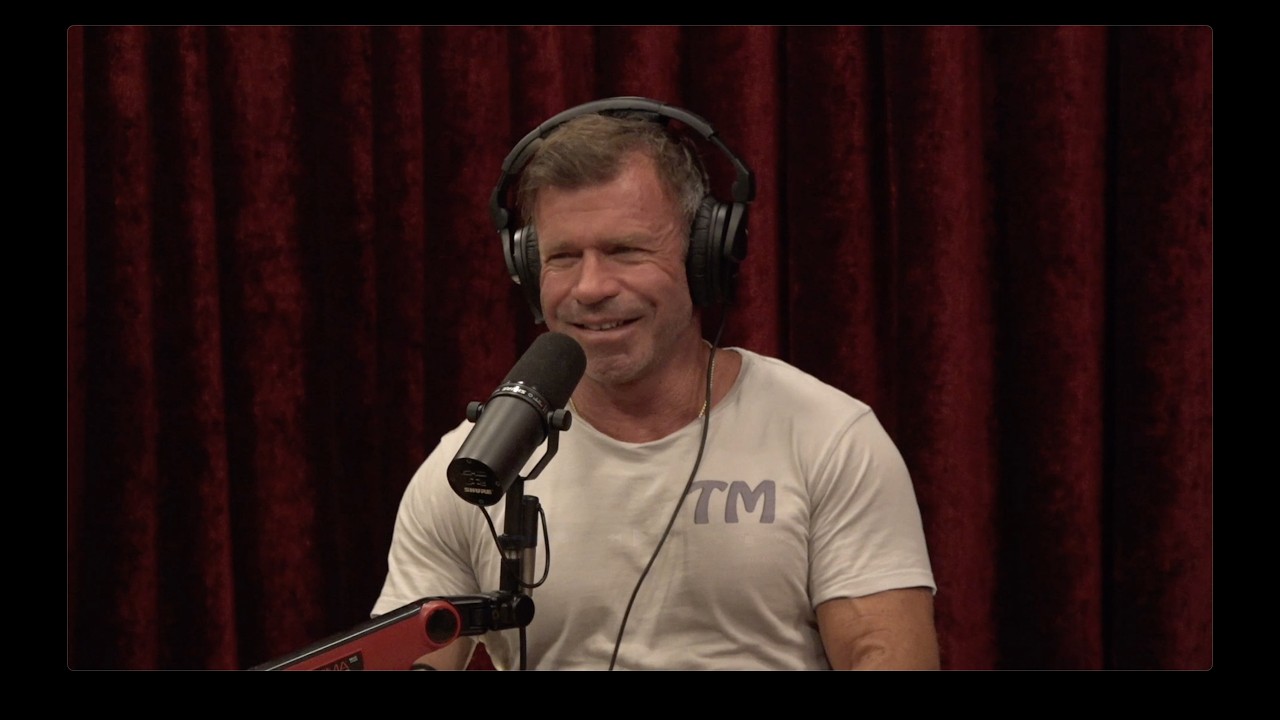
Joe Rogan Experience #2517 - Taylor Sheridan
"Taylor Sheridan and Joe Rogan dive into the inefficiencies of modern society, from government and media to health and education, contrasting them with the self-reliance and raw truths of nature and efficient production."

Epstein, Atlantis & Ark of the Covenant | Dan Richards
"This deep dive into ancient mysteries and modern science communication exposes how ego, algorithms, and financial incentives often obscure truth in archaeology and public discourse."

Archaeology WARNING: They Secretly Found Antarctica 300 Years Before Us! - Graham Hancock
"Graham Hancock argues that mainstream archaeology overlooks compelling evidence for a sophisticated lost civilization predating recorded history, wiped out by a global cataclysm, whose advanced knowledge was preserved and passed down through myths and monumental structures."