
“Trump Has UNLEASHED” US And Israel ATTACK Iran | With Mike Pence & Naftali Bennett
YouTube · KyJudt9c8hc
Quick Read
Summary
Takeaways
- ❖Mike Pence asserts Iran began a 47-year war against the US and its allies, and the current operation aims to 'finish it' by confronting the 'heart of terrorism' in Tehran.
- ❖Pence justifies the military action by citing Iran's nuclear program, ballistic missiles, and explicit threats against Israel and US allies, arguing international law should not constrain direct counter-strikes against a state sponsor of terrorism.
- ❖Piers Morgan and Glenn Greenwald draw parallels between the current Iran intervention and past US-led wars in Iraq, Libya, and Afghanistan, warning of similar disastrous outcomes and power vacuums.
- ❖Ana Kasparian contends the attack is a regime change war primarily on behalf of Israel, arguing Iran posed no direct threat to the US and that the US prioritizes Israeli interests.
- ❖General Mark Kim clarifies the US mission as 'leadership decapitation' to achieve specific objectives (no nukes, no ballistic missiles, no proxies), not full regime change, aiming to force Iran back to negotiations.
- ❖Naftali Bennett emphasizes the operation as self-defense to prevent Iran from acquiring nuclear weapons, given its explicit genocidal intent towards Israel and its attacks on multiple regional countries.
- ❖The UK's initial reluctance to support the operation is noted, with General Kim suggesting it was to avoid being seen as a 'British poodle' to the US, a historical concern from the Iraq War era.
- ❖A friendly fire incident involving three American fighter jets downed by Kuwaiti forces is mentioned as a rare and concerning event in the 'fog of war'.
- ❖Goldie Gamari, an Iranian activist, expresses immense gratitude for the US-Israel action, viewing the Ayatollah's death as a liberation event and predicting the regime's fall by the Persian New Year (March 20th).
- ❖Israel maintains a policy of not being the first to introduce nuclear weapons to the region, but consistently avoids directly confirming or denying its own nuclear arsenal, a point of contention for the host.
Insights
1Iran's 47-Year War and US Response
Mike Pence asserts that Iran has been waging war on the United States, Israel, and the West for 47 years, citing events like the 1979 hostage crisis and the 1983 Beirut barracks bombing. He frames the current US-Israel attack as a necessary response to 'take the fight to the heart of terrorism' in Tehran and 'finish' a long-standing conflict.
Pence states, 'the real objective here is to confront a war that started 47 years ago... from the time American hostages were taken in 1979 to the time that 220 Marines fell... Iran has been waging war... for 47 years.'
2Legality of Preemptive Strikes Against State Sponsors of Terrorism
Pence argues that international law has historically constrained Western nations from directly striking state sponsors of terrorism like Iran, despite their aggressive actions. He believes the current action is justified because Iran was reconstituting its nuclear program, advocating for Israel's destruction, and developing ballistic missiles threatening US allies and personnel.
Pence states, 'international law for literally generations has been... that terrorist organizations and the leading state sponsor of terrorism in the world can strike... but that nations of the west... is constrained from striking back directly at them.' He then adds, 'President Trump u learning that Iran was reconstituting its nuclear program... when Iran is developing and maintaining an arsenal of ballistic missiles... it seems to me more than justified the action.'
3Critique of US Interventions and Historical Parallels
Glenn Greenwald and Piers Morgan draw strong parallels between the current Iran operation and past US-led wars in Iraq, Libya, and Afghanistan. They argue these interventions were often based on false pretenses, led to disastrous outcomes, created power vacuums, and resulted in immense human and financial costs without achieving stated goals.
Greenwald states, 'everything that he [Pence] said in justification in defense of this new war was exactly the things that he and all the other American leaders who wanted this war in 2002 and 2003 were saying then.' He adds, 'It's not just the Iraq war. It's also exactly what happened in Libya... Afghanistan... Vietnam where we were lied into that war, lied through that war.'
4US Mission: Leadership Decapitation, Not Regime Change
General Mark Kim clarifies that the US operation is focused on 'leadership decapitation' rather than full 'regime change.' The objective is to dismantle Iran's nuclear program, ballistic missile capabilities, and proxy networks to compel them back to the negotiating table, avoiding the 'mission creep' seen in previous wars.
General Kim states, 'we didn't do regime change. It's highly unlikely we're going to do regime change. We've done a res what the president has said in so many words is we are doing a leadership decapitation.' He adds the end state is 'no nukes, no ballistic missile program of any size and no proxies.'
5Israel's Self-Defense Against Genocidal Intent
Former Israeli Prime Minister Naftali Bennett frames the attack as a matter of self-defense for Israel, asserting that Iran explicitly states its intent to annihilate Israel and has resumed its nuclear program and ballistic missile production. He argues that acting now is crucial to prevent Iran from acquiring nuclear weapons, which would make future action impossible.
Bennett states, 'We listen to what they say. They say that America is the big Satan. Israel is the small Satan. We want to annihilate you. And all that we're doing is not letting them achieve that. That's the whole thing. This is a matter of self-defense.'
6Israel's Nuclear Ambiguity and 'False Equivalence'
When pressed on Israel's own nuclear capabilities, Naftali Bennett reiterates the long-standing policy of 'not being the first to introduce nuclear weapons to the region' but refuses to directly confirm or deny their existence. He dismisses the comparison to Iran as a 'false equivalence,' arguing Israel has no genocidal intent.
Piers Morgan asks, 'does Israel have nuclear weapons?' Bennett responds, 'Israel has always been clear that we're not going to be the first ones to introduce nuclear weapons to the region.' He later adds, 'creating this sort of... equality or or equating us to any to Iran or to someone who has... genocidal desires. It's it's false equivalence.'
Bottom Line
The US-Israel attack on Gulf States by Iran following the initial strikes is inadvertently strengthening ties between Israel and Arab nations.
Iran's indiscriminate missile attacks on countries like UAE, Qatar, and Saudi Arabia, which initially did not want war, are creating a 'community of nations' united against Iran. This could accelerate regional normalization and cooperation, potentially making the Abraham Accords a 'down payment' on a wider peaceful future.
Diplomatic efforts could capitalize on this newfound unity to forge broader regional security alliances and economic partnerships, further isolating Iran and stabilizing the Middle East.
The 'friendly fire' incident where three American fighter jets were downed by Kuwaiti forces highlights the extreme complexity and potential for catastrophic miscalculation in a rapidly escalating regional conflict.
Such incidents, even if non-fatal, expose severe coordination failures and the inherent 'fog of war' when multiple allied forces operate in a volatile airspace. This could erode trust, complicate future joint operations, and potentially lead to unintended escalations or casualties.
This incident serves as a stark reminder for military planners to prioritize robust communication protocols, de-confliction measures, and real-time intelligence sharing among all allied forces to prevent similar, potentially more devastating, errors.
Key Concepts
The '47-Year War' Narrative
Mike Pence frames the current US-Israel attack on Iran not as a new conflict, but as the culmination of a 'war' initiated by Iran 47 years ago (dating back to 1979 with the hostage crisis and subsequent terrorist attacks). This model justifies the current offensive as a long-overdue decisive action to 'finish' an ongoing conflict rather than start a new one.
Historical Precedent of Intervention Failure
Glenn Greenwald and Piers Morgan repeatedly invoke the historical outcomes of US-led interventions in Iraq, Libya, and Afghanistan. This mental model uses past failures (e.g., false pretenses for war, creation of power vacuums, rise of new extremist groups) as a cautionary tale to predict similar negative consequences for the current Iran operation.
Leadership Decapitation vs. Regime Change
General Mark Kim distinguishes between 'leadership decapitation' and full 'regime change.' This model suggests a targeted military strategy aimed at neutralizing specific leadership elements and capabilities (nuclear, missiles, proxies) to compel negotiation, rather than a broader objective of overthrowing the entire government and rebuilding a nation, which carries higher risks of mission creep and prolonged conflict.
Restoring Deterrence
Mike Pence uses the concept of 'restoring deterrence,' arguing that the Biden administration's 'reckless withdrawal from Afghanistan' emboldened adversaries like Russia, Hamas, and Iran. This model posits that strong, decisive military action is necessary to re-establish a credible threat that discourages future aggression from hostile states and non-state actors.
Lessons
- Scrutinize official justifications for military interventions by comparing them to historical precedents and evaluating the long-term consequences of similar actions.
- Recognize the diverse and often conflicting geopolitical interests at play in major international conflicts, understanding that 'moral arguments' can be selectively applied by different actors.
- Pay close attention to the specific objectives articulated for military operations (e.g., 'leadership decapitation' vs. 'regime change') as these distinctions can significantly impact the scope, duration, and outcome of a conflict.
Notable Moments
A heated exchange between Ana Kasparian and Goldie Gamari, escalating to personal insults and accusations of 'jihadi propaganda' and 'terrorist piece of crap' during a discussion about American soldiers dying in wars on behalf of Israel.
This exchange highlights the extreme polarization and emotional intensity surrounding the US-Israel relationship and military interventions in the Middle East, demonstrating how quickly political discourse can devolve into personal attacks when deeply held beliefs are challenged.
General Mark Kim's refusal to 'dignify' Ana Kasparian's question about American soldiers dying 'on behalf of Israel's wars' as a 'trope,' despite being pressed by Piers Morgan to explain his reasoning.
This moment illustrates the sensitivity and political charge of the topic, where certain lines of questioning are deemed unacceptable or 'tropes' by some, leading to a breakdown in direct debate and an unwillingness to engage with specific criticisms.
Glenn Greenwald's direct questioning of IDF spokesman Jonathan Kriers about Israeli military and intelligence structures being built within and beneath residential areas of Tel Aviv, drawing a parallel to accusations against Hamas.
This exchange challenges the moral high ground often claimed by Israel in military conflicts, forcing a direct comparison of urban warfare tactics and potentially highlighting perceived hypocrisy in how different actors' actions are judged in the international arena.
Quotes
"Iran has been waging war on the United States, on Israel, on the West for 47 years. Our response has been all along the way... to slice away at the tentacles... but now by authorizing this action, President Trump has unleashed the armed forces of the United States. Israel's unleashed its armed forces to take the fight really to the heart of terrorism, which is the Mullas in Thrron."
"It is astounding to me that somebody like Mike Pence or so many other people who led our country into disastrous wars one after the next are now just speaking as though none of it ever happened."
"This is about a regime change war on behalf of Israel. Israel would like to be the hegeimon in the Middle East. And the United States is spilling blood and basically using its treasure to help Israel build an empire that I guarantee you will turn around and um well we'll suffer the consequences of that at some point."
"We didn't do regime change. It's highly unlikely we're going to do regime change. We've done a res what the president has said in so many words is we are doing a leadership decapitation."
"Israel has always been clear that we're not going to be the first ones to introduce nuclear weapons to the region. But I want to be also very clear. Israel never has never had and never will have any intent on destroying other countries."
"We Iranians were so grateful and I can tell you that this has been one of the most amazing weekends, not just for me, but for Iranians in occupied Iran and around the world. Hearing the news of of the death of Ki... that's like the equivalent of of hearing the news of the death of Hitler."
Q&A
Recent Questions
Related Episodes

"A Deal With BARBARIANS!" Scott Horton FIERY Debate On Iran War & Trump | With John Bolton
"This fiery debate dissects the US-Israel strategy towards Iran, featuring John Bolton's call for regime change and Scott Horton's scathing critique of US foreign policy and Israel's actions."

'Debate Me on IRANIAN TV!' Iran War Debate Feat Mohammad Marandi
"A fiery debate dissects the US-Iran conflict, with former US officials and journalists clashing over the justifications for war, the goal of regime change, and the historical context of US-Iranian relations, culminating in a direct challenge to an Iranian professor to criticize his own regime on air."

Sunny Hostin LOSES IT Over Ava Navarro And The View Panel CELEBRATING Trump Arresting Nicolas Maduro
"The host dissects the controversial US-led arrest of Venezuelan dictator Nicolas Maduro, celebrating the outcome while fiercely critiquing 'The View' panel's 'Trump derangement' and perceived hypocrisy regarding international law and regime change."
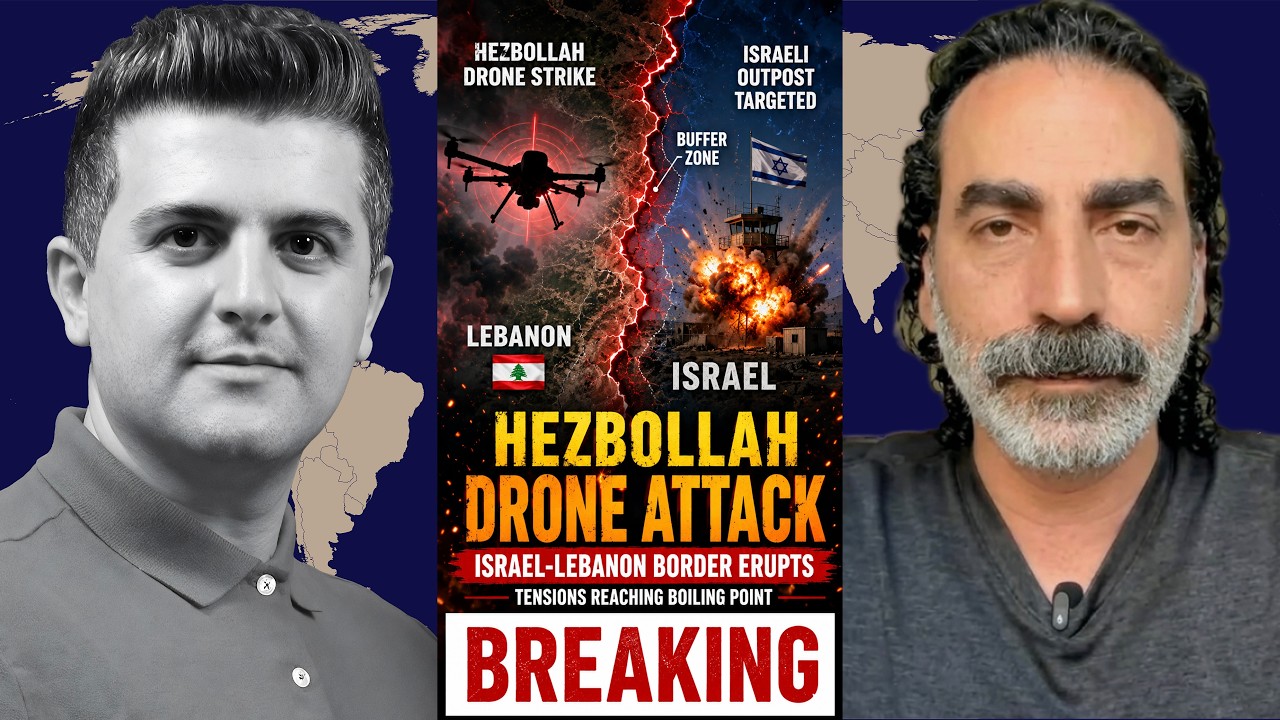
Laith Marouf: Hezbollah's drones & rockets just shattered Israel's buffer zone
"Hezbollah's advanced drone and rocket tactics have neutralized Israel's northern buffer zone, inflicting significant military and economic damage, and exposing the fragility of Israel's military supremacy."