
Ask Neil Anything, January 2026 | Free Patreon Exclusive
YouTube · MlVX1aH8-3E
Quick Read
Summary
Takeaways
- ❖A 'glitch' in a simulated universe might appear as an unexplained hard limit on a physical parameter, like a maximum age for life or a cosmic ray energy cutoff.
- ❖The original meaning of 'nice' was 'honed with precision,' evolving over centuries to its current, less specific sense of 'pleasant' or 'agreeable.'
- ❖Star Trek's utopian vision of humanity, free from internal conflict, is attributed by Tyson to the replicator's ability to eliminate resource scarcity, rather than a fundamental moral advancement.
- ❖The paradox of black hole time dilation, where an object appears frozen at the event horizon to an external observer but passes through normally from its own perspective, is resolved by considering the merging geometry of the object and the black hole's event horizon.
Insights
1Identifying Glitches in a Simulated Universe
If we live in a simulation, 'bugs' might appear as hard limits on physical parameters. Examples include a universal maximum human lifespan (e.g., 120 years) or a cosmic ray energy cutoff, representing the programmer's defined range of values. The host humorously compares this to the repeating backgrounds in 'The Flintstones' as a sign of computational laziness.
Neil deGrasse Tyson discusses the concept of finding 'glitches in the matrix' by observing phenomena that feel less like features and more like bugs in the system, such as a hypothetical hard limit on human age or cosmic ray energy levels, or repeating visual patterns like in 'The Flintstones'.
2The Evolution of the Word 'Nice'
The word 'nice' originally meant 'honed with precision' (15th century), as in a 'nice knife' being sharply crafted. It then evolved to signify a desirable feature of precision, eventually becoming a generic term for 'pleasant' or 'agreeable,' losing its original specificity.
Chuck Nice asks Neil deGrasse Tyson about the origin of his last name. Tyson explains the etymology of 'nice,' stating it meant 'honed with precision' and later 'precise' before becoming a general term of approval.
3JWST Galaxies and Multiverse Evidence
The James Webb Space Telescope's discovery of fully formed galaxies surprisingly early in the Big Bang timeline has prompted questions about adjacent universes. However, extensive searches in the cosmic microwave background (CMB) for imprints of other universes or signs of our universe doubling back on itself have yielded no evidence, reinforcing the Big Bang model.
A listener asks if JWST's early galaxies could be from an adjacent universe. Tyson explains that while not ruled out, searches in the cosmic microwave background for 'imprints' of other universes or signs of our own universe 'doubling back' have found no evidence.
4Resolving the Black Hole Time Dilation Paradox
The paradox of an object appearing to freeze at a black hole's event horizon to an outside observer, while experiencing normal time internally, is resolved by a merging of geometries. As the object nears the event horizon, its geometry merges with the black hole's, allowing it to be absorbed rather than remaining perpetually 'frozen' from an external viewpoint.
A listener questions how objects can cross a black hole's event horizon if they appear to stop from an outside perspective. Tyson references Janna Levin's explanation that the object's geometry merges with the black hole's event horizon, allowing absorption.
5Star Trek's Utopian Future: The Replicator, Not Morality
Neil deGrasse Tyson posits that Star Trek's depiction of a humanity free from internal conflict (e.g., wars over resources or rights) is primarily due to the invention of the replicator. By providing unlimited resources, the replicator eliminates the foundational causes of many historical conflicts, allowing humanity to unify and confront external 'evil forces' rather than fighting itself.
A listener asks what would be required for humanity to reach a Star Trek-like future. Tyson argues that the replicator, by providing unlimited resources, removes the primary driver for wars and conflicts over scarcity, enabling a unified humanity.
6Mathematics as a Model of the Universe
Mathematics is a precisely logical and effective language. When a mathematical model accurately describes physical phenomena, it allows for powerful predictions. However, if the math 'breaks down' (e.g., dividing by zero at a black hole singularity), it indicates a flaw in our *physical model* of the universe, not the math itself. This suggests that the universe might be fundamentally mathematically constructed.
Tyson explains how mathematics is used to model physics. He uses the example of a quadratic equation having two solutions (one real, one theoretical) and Einstein's equations breaking down at a black hole singularity (dividing by zero) to illustrate that mathematical failures point to incomplete physical models.
Bottom Line
The largest mismatch between observation and calculation in all of science is the predicted versus observed value of dark energy (cosmological constant), off by over 100 orders of magnitude. This profound discrepancy highlights a major gap in our understanding of quantum physics and the nature of space itself.
This massive discrepancy means our current fundamental theories of physics (quantum mechanics and general relativity) are incomplete or incompatible at this scale. Resolving it could lead to a revolutionary new understanding of the universe's fundamental forces and structure.
This 'biggest mismatch' represents a fertile ground for theoretical physicists to develop new models of quantum gravity or the vacuum energy, potentially leading to breakthroughs comparable to Einstein's relativity or the development of quantum mechanics.
Humanity's greatest superpower is its ability to cooperate and achieve things in groups, despite inherent tendencies towards tribalism and violence. Cultivating this cooperative aspect through continuous 'maintenance' (education, empathy, critical thinking) is crucial for societal progress.
Recognizing cooperation as a core strength, rather than focusing solely on negative human traits, can inform strategies for global problem-solving and conflict resolution. It suggests that positive societal change is achievable through intentional cultivation of collective good.
Investing in educational systems and social structures that foster cooperation, critical thinking, and empathy can directly enhance humanity's capacity to address complex challenges, from climate change to social inequality, by leveraging our most effective evolutionary advantage.
Key Concepts
Simulation Hypothesis
The idea that our reality could be an artificial simulation, often explored by looking for 'bugs' or 'limits' in observed phenomena that might betray programmatic constraints.
The Unreasonable Effectiveness of Mathematics in the Natural Sciences
Eugene Wigner's concept highlighting the surprising and profound utility of abstract mathematical concepts in accurately describing and predicting physical phenomena, suggesting a deep mathematical structure to the universe.
Lessons
- Question assumptions about reality by considering 'glitches' or unexplained limits in observed phenomena, as these could hint at deeper underlying structures or programmatic constraints.
- Appreciate the power and precision of language by exploring the etymology of words, understanding how their meanings evolve and impact communication.
- Cultivate cooperation and critical thinking within your community, recognizing that humanity's collective ability to work together is its greatest strength in overcoming challenges and fostering progress.
Quotes
"If you drop some acid and listen to the eagles and all of a sudden you in a black hole and you're being spaghettified... That's great. That's That's fantastic."
"We see the universe not as it is but as it once was. According to the light travel time from those destinations."
"Our greatest our greatest superpower as human as homo sapiens is our ability to come together, cooperate and achieve things in groups. That is our greatest ability."
Q&A
Recent Questions
Related Episodes
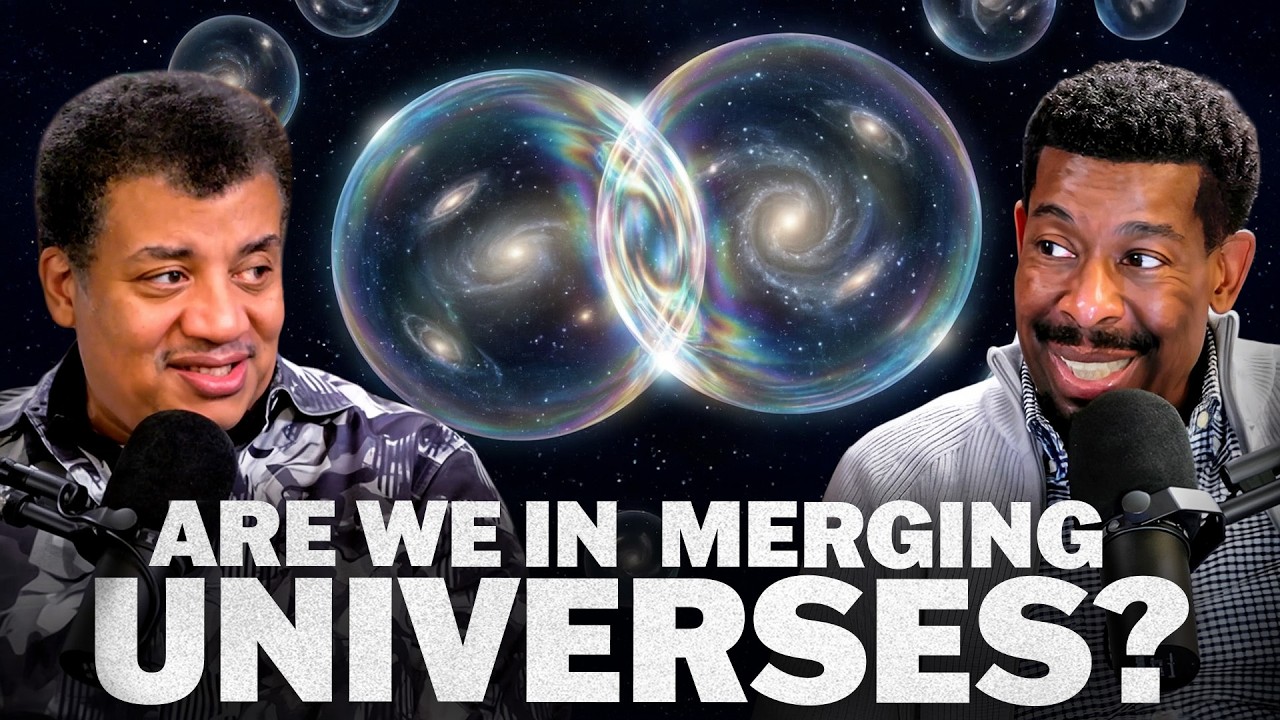
Alcubierre Drives, Antimatter Multiverses & More! | Cosmic Queries #103
"Neil deGrasse Tyson and Chuck Nice tackle listener questions ranging from the feasibility of reviving the sun with nukes to the physics of black holes, warp drives, and the multiverse."
The Hardest Questions in Physics | World Science Festival
"Leonard Susskind, a co-founder of string theory and a former plumber, shares his unique approach to physics, focusing on resolving fundamental conflicts between established principles like general relativity and quantum mechanics."

Joe Rogan Experience #2506 - Michelle Thaller
"NASA astrophysicist Michelle Thaller demystifies the universe's most mind-bending phenomena, from the true scale of galaxies and the bizarre nature of time to the profound implications of quantum entanglement and the potential future of human-AI consciousness."
How We’re Trying to Detect Dark Matter Particles, with Katherine Freese
"Theoretical physicist Katherine Freese reveals cutting-edge methods for detecting dark matter, from billion-year-old rocks to 'dark stars' observed by the James Webb Telescope, and challenges prevailing theories on dark energy."