
Patrick Henningsen: This Won’t Be Limited: The All-Out US-Iran War is Here, Countdown to Catastrophe
YouTube · N9ziEY_Aajk
Quick Read
Summary
Takeaways
- ❖Iran's society is prepared for war, demonstrating massive solidarity against external threats, making US regime change attempts futile.
- ❖The Iranian government operates with the consent of its people, with democratically elected positions across all strata, contrary to Western propaganda.
- ❖Iran has developed advanced, indigenous military technology, including hypersonic missiles and drones, designed for cost-efficient defense and regional deterrence.
- ❖Any US or Israeli attack will trigger widespread retaliation against all US positions in the region and Israel, potentially closing the Straits of Hormuz.
- ❖Western media and social platforms like X (formerly Twitter) are actively used to manufacture consent for war against Iran through fabricated atrocity propaganda.
- ❖Gulf Arab states are increasingly wary of supporting US/Israeli aggression against Iran, fearing direct retaliation within their territories.
- ❖The US and Israel risk severe damage and a permanent weakening of their regional influence if they proceed with a full-scale war against Iran.
Insights
1Iran's Societal and Governmental Resilience
Patrick Henningsen's recent visit to Iran revealed a society prepared for war, exhibiting massive solidarity against external threats. He observed millions on the streets during National Day, indicating strong popular support for the government. Contrary to Western narratives, Iran's government is described as a republic where every position (except the Supreme Leader) is democratically elected, operating with the consent of the people. This deep-seated national sovereignty and ideological commitment, rooted in the Islamic Revolution's values of dignity and defending the oppressed, makes US-led regime change efforts impossible.
Henningsen's firsthand account from Iran, including observing 2.5 million people on the streets of Tehran during National Day, and discussions with academics. He states, 'the government in Tehran serves with the consent of the people. It's an Islamic revolution... it has the consensus approval and permission to govern from the people.'
2Failure of US/Israeli 'Regime Change' Operations (Plans A & B)
The US and Israel have already attempted multiple strategies to destabilize Iran. 'Plan A' involved an Israeli decapitation strike and internal destabilization to soften Iran for regime change, which failed. 'Plan B' leveraged economic protests, triggered by EU sanctions and currency devaluation, hoping to incite a mass uprising. This also failed because the Iranian population, despite economic hardship, remains unified against foreign intervention and views the government as legitimate.
Henningsen details 'Plan A' as an Israeli sneak attack during nuclear negotiations () and 'Plan B' as hijacking legitimate economic protests in late December/early January (). He states, 'I'm here to tell you Nema after spending time in the Islamic Republic of Iran that plan B was impossible. You there you can't get regime change.'
3Iran's Advanced Indigenous Military Capabilities and Deterrence
Iran has strategically invested in indigenous, cost-effective military technology, focusing on drone technology, missile defense, and air defense. They possess proprietary hypersonic missile technology (Mach 20 capable) that can hit moving targets like ships. These systems are homegrown, developed through reverse engineering captured US drones and extensive R&D. This capability establishes a clear deterrence: any attack, even a limited one, will result in retaliation against US positions in the region and Israel, potentially involving targets like Diego Garcia and Cyprus, and the closure of the Straits of Hormuz.
Henningsen discusses Iran's 'proprietary technologies, their hypersonic missile technology is native' (), their ability to 'strike naval assets' (), and that 'their tomahawk missiles cost probably somewhere in the range of... 1/100th of a US tomahawk missile' (). He explicitly states, 'They've said very clearly any strike, even a limited one, will be they'll retaliate against any and all targets that they so choose of US positions in the region and Israel.'
4Western Propaganda and Social Media's Role in War Justification
Western governments and media, including social media platforms like X (formerly Twitter), are accused of actively manufacturing consent for war against Iran. This involves spreading fabricated atrocity propaganda (e.g., '30,000 dead protesters') and amplifying pro-war narratives while throttling independent journalism. This propaganda aims to dehumanize Iranians and justify potential mass casualties, mirroring tactics seen in other conflicts.
Henningsen recounts being told, 'you are there on the standing on the blood of 30,000 dead protesters' () and states, 'Elon Musk used X to open up the algorithm to give them priority that all of those videos promoting you demanding war against Iran' (). He calls it 'classic operant conditioning, classic cognitive dissonance.'
Bottom Line
Iran's military-industrial complex prioritizes cost-effective, indigenous defense technologies (drones, missiles, air defense) over expensive imported manned fighter jets, enabling robust deterrence despite crippling sanctions.
This strategy allows Iran to maintain a strong defensive posture against technologically superior adversaries without bankrupting its economy, demonstrating a unique model of national security resilience under extreme pressure.
Other sanctioned or developing nations facing external threats could study Iran's model of indigenous, asymmetric defense development to build effective deterrence capabilities without relying on costly foreign military imports.
The concept of 'martyrdom' in Iranian culture, particularly among scientists and engineers targeted by adversaries, acts as a powerful motivator, lengthening queues for critical technical fields rather than deterring participation.
This cultural value fundamentally undermines conventional deterrence strategies that rely on fear or economic disincentives, as it transforms perceived threats into a source of national resolve and dedication.
Understanding such deep cultural motivators is essential for any actor engaging with Iran, as misinterpreting these values leads to ineffective or counterproductive policies, and could inform more nuanced diplomatic or engagement strategies.
Key Concepts
Manufacturing Consent
The deliberate manipulation of public opinion through propaganda and media control to gain support for government policies, particularly military interventions, by creating a false narrative about the adversary.
Cognitive Dissonance
The mental discomfort experienced by a person who holds contradictory beliefs, ideas, or values, or is confronted by new information that conflicts with existing beliefs. In this context, it explains why Western publics might accept war propaganda to alleviate guilt about their governments' actions.
Lessons
- Critically evaluate Western media narratives about Iran, especially those promoting 'regime change' or 'limited strikes,' as they may be part of a broader propaganda effort to justify military action.
- Recognize the significant risk of a regional war in the Middle East, including the potential closure of the Straits of Hormuz and its global economic implications, and consider its impact on investments and supply chains.
- Understand that Iran's military capabilities, particularly in indigenous missile and drone technology, are substantial and designed for effective retaliation, making any 'limited' conflict highly improbable and dangerous.
Notable Moments
Patrick Henningsen's recent visit to Iran, despite US State Department warnings for Americans to 'leave now' or 'hide in a building,' to gain firsthand insight into the country's situation.
This direct observation provides a stark contrast to mainstream Western media portrayals, offering a unique, on-the-ground perspective that underpins the entire analysis of Iran's societal and military readiness.
The explicit discussion of how social media platforms, specifically X (formerly Twitter) under Elon Musk, are allegedly used to amplify pro-war propaganda against Iran and throttle independent journalists.
This highlights the weaponization of information and technology in modern geopolitical conflicts, demonstrating how public opinion is shaped and consent for war is manufactured through digital channels.
Quotes
"The country, the society is prepared for war. That that that's clear. But life life goes on as normal per day. But when it comes time to mobilize, when it comes time to when the state needs to do what it needs to do and the people need to do what they need to do, they just get on with it and they shift um into that mode."
"There is no military strike that is going to change the regime as they call it in Iran. It's not going to happen."
"The more you threaten the Iranians like this, the more society comes together. That's what I witnessed."
"If any western country was under the economic pressure and and sanctions that Iran has been under um they would fold within 12 months. The governments would would collapse."
"Iran doesn't have any nuclear weapons. There's no evidence they do. The US's own intelligence assessment says they don't have it. So what on earth is Donald Trump flapping his gums about other than he himself is just like you know regurgitating uh you know just a lie after lie uh about this..."
"They've said very clearly any strike, even a limited one, will be uh they'll retaliate against any and all targets that they so choose of US positions in the region and Israel."
"The highest level of achievement in in in this situation, you know, in life is to die protecting your people, your country, your values."
Q&A
Recent Questions
Related Episodes
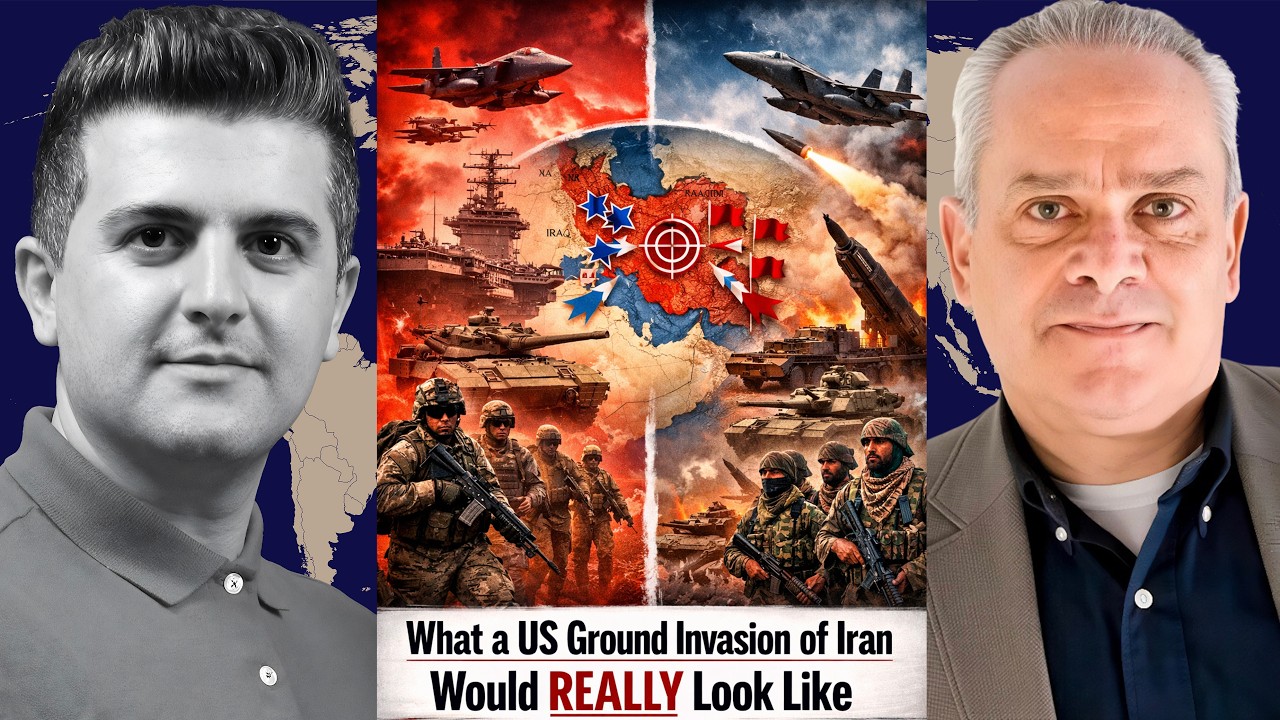
Col. Jacques Baud: What a US Ground Invasion of Iran Would REALLY Look Like
"Colonel Jacques Baud dissects the strategic futility of a US ground invasion of Iran, arguing that current troop levels are insufficient and such an action would backfire, exposing US allies and potentially leading to Iran's nuclearization."
Robby Soave GOES OFF On ANNOYING Liberal Black Woman Making Emotional Trump Deranged Arguments!
"The host dissects a heated foreign policy debate, arguing that 'left-wing' emotionalism and 'Trump derangement' prevent a rational understanding of US sanction strategies against Cuba and Iran."

Pentagon Prepares For EXTENDED War With Iran
"This episode dissects the geopolitical maneuvers surrounding potential US-Iran conflict, revealing strategic leaks, Netanyahu's diplomatic sabotage playbook, and the true intent behind economic sanctions."

🚨 THEY F*CKED AROUND FOR THE LAST TIME 😭😭😭
"This episode unleashes a torrent of highly opinionated commentary on the US-Iran deal, Israel's role, and a scathing critique of 'leftist' policies and immigration, particularly highlighting the UK grooming gang report as evidence of Western societal decay."