
Does This Theory Explain the Entire Republican Party? (w/ John Ganz) | Bulwark Podcast
YouTube · NcZV9dzjIZw
Quick Read
Summary
Takeaways
- ❖Trump's political actions are often driven by personal whims and a 'deal-making' mentality, making systemic policy incoherent.
- ❖The guest argues Trump is psychologically incapable of understanding abstract systems, viewing the world as a series of personal transactions.
- ❖Right-wing populism, as practiced by Trump, was envisioned by figures like Murray Rothbard and Sam Francis in the early 1990s.
- ❖Trump's 'unfrozen caveman' political instincts were shaped by his near financial ruin in the late 80s/early 90s, intensifying his paranoia.
- ❖The rise of right populism is attributed to both media fragmentation and economic anxiety among squeezed middle and lower-middle classes.
- ❖J.D. Vance's conversion to Christianity, influenced by Peter Thiel and René Girard, is seen as a utilitarian response to elite resentment rather than a deep spiritual journey.
- ❖Democrats face a challenge in reaching 'aggrieved voters' who feel unrepresented, requiring a more populist approach beyond 'competent technocrats'.
Insights
1Trump's Mercurial Decision-Making and Incoherence
Trump's actions are driven by personal whims and a transactional 'deal' mentality, rather than systemic thinking or coherent ideology. This makes political analysis difficult, as his positions can shift rapidly. His approach to issues like the Iran war exemplifies this: talked into a simplistic idea, found it tough, then walked away to pursue a 'new deal,' praising former 'lunatics' as 'reasonable people.'
Ganz states, 'With the actions of the Trump administration, it's very difficult I find to give them any coherence because it's so based on Trump's personal whims and his own, you know, very idiosyncratic and mercurial way of doing things.' He cites the Iran war as an example where Trump was 'talked into it,' found it 'tougher than he was led to believe,' and then 'decided to walk away.'
2The Early 1990s Roots of Trumpism
The guest's book, 'When the Clock Broke,' details how figures like Murray Rothbard and Sam Francis foresaw and advocated for a right-wing populism that Trump later embodied. This involved bypassing traditional media, directly attacking elites, and adopting protectionist, 'America First' foreign policies. Trump's own instincts, shaped by his near financial ruin in the late 80s/early 90s, aligned with this paranoid, zero-sum worldview.
Ganz explains, 'Rothbard foresaw the type of politics that Trump practices as a path forward for like the hard right, which is basically a kind of what he called it at the time, right-wing populism.' He connects Trump's 'protectionist instincts' and 'adversarial' view of the world to this period, noting Trump's 'near brush with ruin in the late '80s, early '90s' intensified his paranoia.
3Economic Anxiety and Media Fragmentation Fuel Populism
The rise of right-wing populism in both the early 90s and 2016 is attributed to a combination of economic anxieties among the middle and lower-middle classes and the fragmentation of mass media. While media changes allow fringe voices to reach broader audiences, the underlying appeal of populist politicians stems from a widespread feeling of being economically squeezed, dispossessed, and unrepresented by corrupt politicians.
Ganz states, 'the appeal of these politicians only makes sense if you consider the trajectory of the society and the fact that you have large members of the middle and lower middle classes feeling increasingly squeezed and dispossessed and feeling that the only and feeling unrepresented by their politicians who they feel are intrinsically corrupt.' He links Trump's rise to the 2008 crash and the perception of a 'rigged' system.
4J.D. Vance's Utilitarian Approach to Religion and Mimetic Theory
J.D. Vance's embrace of René Girard's mimetic theory and subsequent conversion to Christianity is portrayed as a utilitarian, almost cynical, response to social and psychological needs rather than genuine faith. Vance, influenced by Peter Thiel, appears to adopt religion as a social necessity to align with perceived 'smart people' and to cope with the 'painful' competitive pressures of elite society, rather than a deep spiritual conviction.
Ganz notes, 'what he's describing there is not really being moved by religious sentiment. It's kind of realizing that the smart people that he wants to be in with are religious and then kind of changing his tune.' He adds that Vance's approach, and that of many conservatives, views religion as 'some kind of social or psychological necessity, and that's not quite the same as believing.'
Key Concepts
Mere Puffery (Trump's Discourse)
A term from advertising law where exaggerated claims (e.g., 'best coffee in the world') are not taken seriously as factual statements. John Ganz applies this to Trump's rhetoric, suggesting his declarations are primarily self-promotional and not meant to be taken literally, making diplomacy or business with him extremely difficult due to unreliability.
Unfrozen Caveman (Trump's Political Persona)
A metaphor used to describe Trump's political instincts and preoccupations as being stuck in the late 1980s/early 1990s. This includes obsessions with urban crime, protectionist trade policies against Japan/Germany, and a Cold War-era view of Russia, all shaped by his personal experiences of near ruin and a hostile worldview from that period.
Mimetic Rivalry (René Girard's Theory)
A philosophical concept positing that people mimic each other's desires, leading to inevitable conflict and competition. Girard suggests religious faith (imitating Christ) as an escape. The guest argues that figures like J.D. Vance cynically adopt this theory not to avoid scapegoating, but to justify picking 'the right people' as scapegoats, viewing religion as a social/psychological necessity rather than a matter of genuine belief.
Jock/Creep Theory of Fascism
A humorous but insightful classification of political figures, initially applied to historical fascists (Italians as 'jocks,' Germans as 'creeps'). The theory categorizes contemporary right-wing figures based on whether they embody a 'jock' (aggressive, outwardly confident, often performative) or 'creep' (insidious, intellectualized, often resentful) persona. Trump is identified as a 'jock,' while J.D. Vance and Stephen Miller are 'creeps,' illustrating the coalition's diverse personalities.
Lessons
- When analyzing political figures like Trump, prioritize understanding their personal psychology and transactional approach over searching for deep ideological coherence.
- Recognize that populist movements often tap into genuine economic anxieties and feelings of unrepresentation, which traditional parties may fail to address.
- Be critical of public figures who adopt philosophical or religious frameworks in ways that appear utilitarian or cynical, especially when used to justify divisive tactics like scapegoating.
- For Democrats, consider adopting a more populist stance that directly addresses systemic corruption and economic grievances, rather than relying solely on a 'competent technocrat' image, to appeal to alienated voters.
Quotes
"With the actions of the Trump administration, it's very difficult I find to give them any coherence because it's so based on Trump's personal whims and his own, you know, very idiosyncratic and mercurial way of doing things."
"I don't think that I think basically he has The reason why he likes he he is sometimes swayed by conspiratorial rhetoric is some people are ideologically conspiratorial because it it sort of supports their worldview. I think that Trump is basically psychologically incapable of understanding things as processes that don't have like a person behind them."
"Trump's almost every word is is essentially mere puffery. Like, that's that's his functional mode of discourse."
"The Massie quote where he said, 'Oh, I realized that they didn't care what I believe. They were just voting for the crazy son of a bitch.' is one of the most insightful things about American politics anybody said in about 20 years."
"I grew up in a household, a Hindu household, a very stable household, and I've not felt the same sense of of need to seek something different that he has."
Q&A
Recent Questions
Related Episodes

IHIP News: Stephen Miller CRACKING Under Pressure As His EVIL Plan BLOWS UP In His FACE!
"Paula Ramos, an Emmy-winning journalist, dissects the complex political landscape of Latino voters, revealing how right-wing tactics exploit cultural conservatism and the psychological impact of anti-immigrant rhetoric, even on those who support Trump."

Iran Deal Skepticism. Whoopi Vs Vance. Potomac Park Invasion. Racist Hurls Slurs At Black Boy.
"This episode dissects multiple instances of alleged anti-Black policies and racial injustice, from the Trump administration's legal challenges to reparations and the Iran deal, to police brutality and the erasure of Black history."
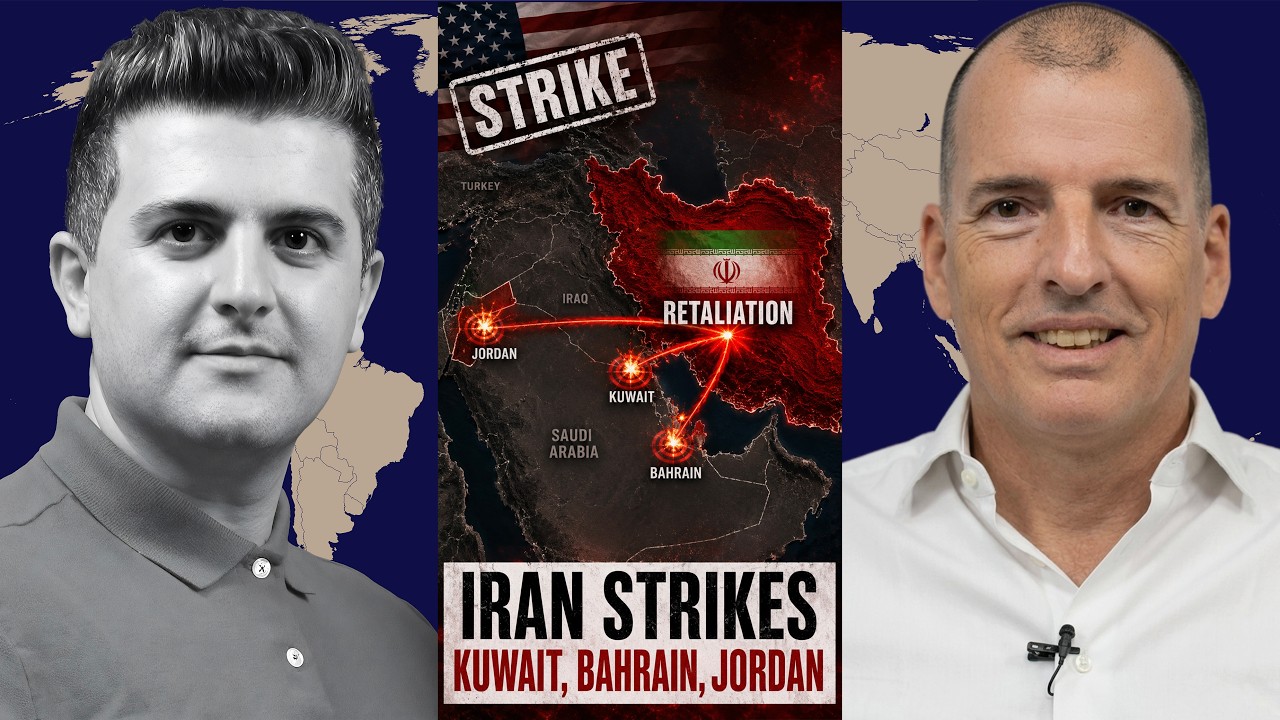
Alex Krainer: US STRIKES Iran – Iran RETALIATES Against Kuwait, Bahrain & Jordan!
"Amidst escalating US-Iran conflict and Iranian retaliation against regional US allies, this episode argues that US foreign policy is deeply controlled by an 'Anglo-Zionist conspiracy' led by the Rothschild banking dynasty, prioritizing Israeli interests over American ones."

Larry Johnson: Iran Missiles Rain Down on Northern Israel – Massive Strikes!
"Geopolitical analyst Larry Johnson details how Israel's recent strike on an 'empty building' in Beirut triggered direct Iranian missile retaliation, escalating regional tensions and jeopardizing a US-Iran peace deal brokered by Pakistan."