
MN To LOSE Congressional Seat Over Deportations, Attacks Against ICE Getting WORSE | Timcast IRL
YouTube · P53B43K7TH4
Quick Read
Summary
Takeaways
- ❖The ICE agent's shooting of Renee Good is debated, with one guest suggesting it was intentionally mishandled to escalate political division.
- ❖Arguments are made that the ICE agent's actions were legally justified self-defense, regardless of the car's speed or the number of shots.
- ❖A guest proposes a 'harsh' and 'systemized' approach to immigration enforcement, suggesting targeted, rapid deportations to prevent prolonged protests.
- ❖The concept of deporting 30-40 million people from the US is discussed as a practical goal to address illegal immigration and those on welfare.
- ❖Skepticism is expressed regarding US foreign policy in the Middle East, particularly concerning Iran and Israel, framed as serving external interests.
- ❖The hosts and guests discuss the idea of a 'deep state' or 'uni-party' orchestrating societal division and controlling narratives, including the Epstein files.
- ❖One host questions the scientific reality of nuclear weapons, suggesting they are a 'fake news' threat used to scare civilians.
Insights
1ICE Shooting Justification Debate
The panel extensively debates the justification of an ICE agent shooting Renee Good. Phil Labonte argues the agent was legally justified in using defensive force as the car accelerated towards him, regardless of speed or number of shots, citing law enforcement policy. Sulaman Ahmed contends the situation was handled incompetently, possibly intentionally, to inflame tensions, and that the agent's life was not sufficiently threatened by a slow-moving car.
Phil: 'As soon as she accelerated... he is in a position where he's like, I have to be I'm in defense of my life.' Sulaman: 'his life wasn't threatened. The car was at standstill. No, it doesn't matter. But his life wasn't threatened. And the first shot was the car was moving towards him.'
2Critique of Current Immigration Enforcement Strategy
Sulaman Ahmed criticizes the current US approach to illegal immigration as 'extremely incompetent and extremely bad.' He suggests that instead of gradual, piecemeal operations that allow for protests and escalation, enforcement should be 'systemized' and 'harsh' – targeting specific cities for rapid, overwhelming operations by ICE and National Guard to prevent public backlash and division.
Sulaman: 'Either you just leave it or you deal with it in a very systemized uh harsh manner.' And 'you have to either go in harshly or light.' He later clarifies 'harsh' means 'send in ICE and the National Guard immediately go in, find everyone, do the operation in a very small period of time. You don't have time to get the protest and the gatherings done.'
3Proposal for Mass Deportations and Denaturalization
A guest proposes a 'pie in the sky' goal of 80-100 million people leaving the US, with a 'practical' target of 30-40 million. This would include illegal immigrants, 'anchor babies,' and potentially denaturalizing anyone who immigrated after the 1965 Heart-Seller Act, prioritizing 'heritage Americans' (white and black Americans).
Guest: '80 to 100 million people need to like be out of the country.' Practical: 'probably 30 to 40 million.' Criteria: 'illegal... anchor babies... anybody that came in because of the heart seller act... on welfare.'
4Skepticism of US Foreign Policy and 'Deep State' Influence
The panel expresses strong skepticism about the motivations behind US foreign policy, particularly regarding Iran and Israel. They suggest that interventions are not for American benefit but serve external interests, citing the 'Project for a New American Century' and the influence of multinational corporations and 'Zionists.' The 'deep state' is accused of manufacturing division to maintain control.
Alex Stein: 'The objective is solely for Israel.' Sulaman: 'The only reason Iran has issues with America is because of Israel.' Guest: 'The deep state be in favor of immigration? Because they want more federal government's control.'
5Lack of Transparency in Epstein Files and Government Protection of Pedophiles
The hosts and guests express frustration over the lack of transparency surrounding the Jeffrey Epstein files, believing that incriminating information has been suppressed or destroyed. They suggest that powerful individuals are being protected and that the government, including the FBI and CIA, may be complicit in protecting pedophiles, citing the official narrative of Epstein's death as suspicious.
Alex Stein: 'I just get a little frustrated that they're not going to give his transparency because it feels like they're protecting pedophiles.' Guest: 'any incriminating information on the Epstein files there's none because any powerful pe like you think Bill Clinton like did this or whoever did this and then they don't erase all the information relating to it.'
Bottom Line
The argument that current, gradual immigration enforcement tactics are counterproductive, actively 'fermenting' public unrest and division, suggests that a rapid, overwhelming show of force would paradoxically lead to less overall conflict by preventing prolonged opposition.
This challenges the conventional wisdom of de-escalation, proposing that extreme initial force can be a more 'peaceful' long-term strategy by preempting sustained resistance and public outcry.
Policymakers could explore highly concentrated, short-duration enforcement operations in specific areas, rather than prolonged, diffused efforts, if their primary goal is to minimize public protest and media attention during enforcement actions.
The claim that nuclear weapons are 'totally fake' and merely 'fire bombs,' with the threat of global destruction being 'fake news' used to scare civilians, fundamentally redefines the geopolitical landscape and the nature of global power dynamics.
If true, this would mean much of modern deterrence theory and international relations are built on a fabricated premise, potentially leading to a re-evaluation of military spending and foreign policy strategies.
This perspective, while highly fringe, could inspire alternative analyses of historical conflicts and current geopolitical tensions, focusing on non-nuclear forms of power and influence.
Key Concepts
Manufactured Consent/Division
The idea that powerful entities (e.g., 'deep state,' 'uni-party') intentionally create and escalate political and social conflicts to divide the populace, distract from real issues, and consolidate power.
Escalation Principle
The belief that gradual, 'soft' approaches to conflict or enforcement (e.g., immigration raids) can lead to worse outcomes by allowing situations to 'ferment' and intensify, necessitating a more decisive, 'harsh' initial response.
Utilitarian Imperialism
The perspective that the US should act as an empire, even through military intervention, to protect its values (e.g., free speech, gun rights) and economic interests globally, viewing it as the 'least worse' option for global stability.
Lessons
- Question official narratives and seek diverse perspectives on controversial events, especially those involving government agencies and foreign policy.
- Recognize how political figures and media outlets may use 'escalation' and 'division' to achieve specific political outcomes or distract from underlying issues.
- Consider the potential for 'deep state' or 'uni-party' influence when analyzing political actions and policy decisions, particularly those that seem to benefit established powers.
- Investigate the historical context and alleged motivations behind US foreign interventions, particularly in the Middle East, beyond stated objectives.
- Be critical of claims regarding government transparency, especially concerning high-profile cases like the Epstein files, and demand accountability.
Notable Moments
The host, Alex Stein, provocatively states, 'We love you, Israel. You are the promised land. You are the chosen people. You're better than everybody, especially that brown guy over there.' This sets a highly controversial and irreverent tone for the discussion.
This moment immediately establishes the podcast's willingness to engage in highly provocative and potentially offensive commentary, signaling a disregard for political correctness and setting the stage for extreme opinions throughout the episode.
A guest proposes a 'pie in the sky' scenario of deporting 80-100 million people from the US, including those who immigrated after 1965 and their descendants, to restore a 'heritage American' demographic.
This extreme proposal highlights the radical end of the spectrum in immigration debates, revealing a desire for fundamental demographic restructuring and a rejection of post-1965 immigration policies.
One host questions the scientific reality of nuclear weapons, suggesting that the destruction of Hiroshima and Nagasaki were 'fire bombs' and that the concept of blowing up the Earth '10 times over' is 'fake news' used to scare civilians.
This challenges a foundational aspect of modern geopolitics and science, reflecting a deep distrust in institutional narratives and a willingness to embrace highly contrarian theories, even on matters of global security.
Quotes
"When you deal with the issue that you did where you're basically sending ICE agents in and you're basically doing it based on some kind of propaganda... it's just going to ferment the situation and make it a lot worse."
"As soon as she accelerated, he's he is in a position where he's like, I have to be I'm in defense of my life. and he has he's authorized to use defensive force."
"The government can do something wrong to you. So the government's not perfect. That ice age is not perfect and and held to a higher standard as a law enforcement."
"My position is neither the left or the right should be exercising dystopian power because when that happens, you lose your right."
"The more diverse society gets it's actually easier for ruling powers it's like a homogeneous society is actually..."
"I would argue that legal immigration is almost worse than the illegal immigration. The fact that you have H-1B visas..."
"80 to 100 million people need to like be out of the country."
"I don't think it's good to steal someone's eye personally."
"I think nuclear weapons are totally fake. The idea that like they split the atom and this big bomb goes off..."
Q&A
Recent Questions
Related Episodes

Patrick Henningsen: Hezbollah JUST Fired Back at Israel - Iran Vows to “Crush” All Attacks
"Patrick Henningsen argues that the US and Israel initiated an illegal war against Iran, driven by Trump's incompetence and Israeli influence, leading to an inevitable escalation with severe global economic repercussions."
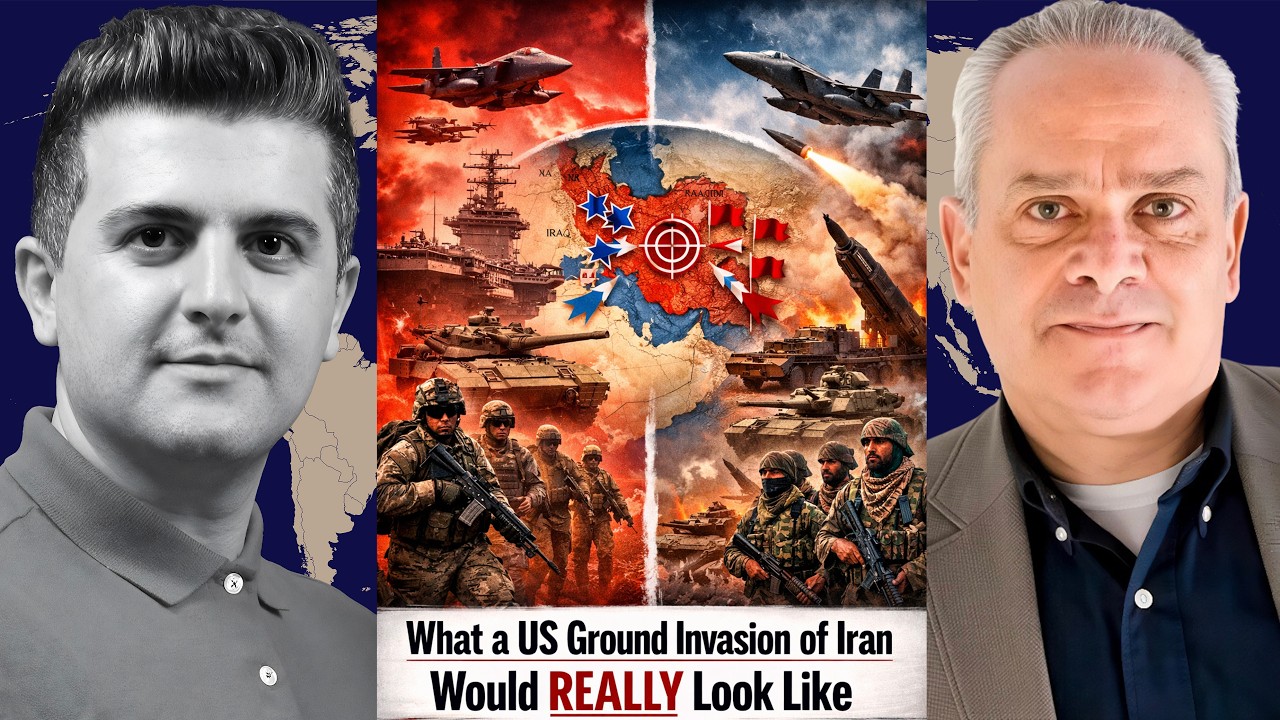
Col. Jacques Baud: What a US Ground Invasion of Iran Would REALLY Look Like
"Colonel Jacques Baud dissects the strategic futility of a US ground invasion of Iran, arguing that current troop levels are insufficient and such an action would backfire, exposing US allies and potentially leading to Iran's nuclearization."

Alex Krainer: US STRIKES Iran – Iran RETALIATES Against Kuwait, Bahrain & Jordan!
"Amidst escalating US-Iran conflict and Iranian retaliation against regional US allies, this episode argues that US foreign policy is deeply controlled by an 'Anglo-Zionist conspiracy' led by the Rothschild banking dynasty, prioritizing Israeli interests over American ones."

Iran Update: Israel’s Newest Bombing Campaign, the Oncoming War With China and How to Avoid It
"Colonel Wilerson reveals how the US and Israel are actively bombing China's strategic infrastructure in Iran, escalating a covert economic war that Beijing intends to win without direct military conflict by dismantling the dollar's global dominance."