The Supreme Court’s War on Voting Rights and Black Political Power #TheOtherSideOfChange
YouTube · P7BtWf_1JS0
Quick Read
Summary
Takeaways
- ❖The Supreme Court is increasingly acting as a political actor, advancing conservative priorities and weakening civil rights.
- ❖The 2013 Shelby County v. Holder decision gutted Section 5 of the Voting Rights Act, leading to immediate and widespread voter suppression.
- ❖Voter suppression today is bureaucratic, involving polling place closures, shortened voting windows, and racial gerrymandering.
- ❖The Court's 'shadow docket' allows emergency rulings without full hearings or transparency, impacting critical areas like elections and reproductive health.
- ❖Democrats need to invest in comprehensive voter education beyond just urging people to vote, as many are unprepared for complex ballots.
- ❖The alleged $1.8 billion 'slush fund' for January 6 rioters, contrasted with the rejection of reparations, highlights systemic inequities.
- ❖Corporate rollbacks of employee benefits, like PTO and parental leave, disproportionately harm women and minorities in the U.S.
Insights
1Supreme Court as a Political Actor and the Shadow Docket
The Supreme Court is no longer a neutral body but an active political actor, particularly in advancing conservative and Trump-era priorities. Its increasing reliance on the 'shadow docket' for emergency rulings, issued without full hearings or transparency, allows major decisions on immigration, elections, and reproductive health to reshape policy in real-time, bypassing traditional judicial scrutiny.
Many legal scholars argue the court has become an active political actor (). The shadow docket is used for major decisions on immigration, elections, reproductive health, and environmental policy without real transparency (-).
2Gutting the Voting Rights Act and its Immediate Consequences
The 2013 Supreme Court decision in Shelby County v. Holder effectively gutted Section 5 of the Voting Rights Act of 1965, which previously required states with histories of racial discrimination to get federal approval for voting law changes. Chief Justice John Roberts argued these protections were no longer necessary, leading to an immediate and widespread implementation of restrictive voting measures by states.
In 2013, Shelby County v. Holder gutted Section 5 (-). Chief Justice John Roberts argued protections were unnecessary (-). Within hours of the decision, states implemented voter ID laws, polling place closures, and redistricting plans previously blocked (-).
3Modern Voter Suppression and Racial Gerrymandering
Contemporary voter suppression is bureaucratic, manifesting as closed polling places, shortened voting windows, strict ID laws, and purged voter rolls. Racial gerrymandering dilutes Black voting power through district maps designed to fracture communities, often incorporating prison populations into rural white districts to inflate representation while disenfranchising urban Black voters.
Voter suppression today is bureaucratic: closed polling places, shortened voting windows, ID laws, purged voter roles (-). Black voting power is diluted through maps designed to fracture communities and pack Black voters (-). Prisons in rural communities count Black and brown inmates as part of the census, impacting representation and resources (-).
4The Need for Comprehensive Voter Education
Despite increased Democratic voter turnout in primaries, significant losses occurred in key judicial races due to a lack of voter education. Many voters were unprepared for long, complex ballots, unaware of nonpartisan races, or how to properly fill out a ballot, highlighting that simply encouraging people to vote is insufficient without proper guidance.
In Georgia, greater Democratic turnout didn't translate to flipping needed seats (-). Many voters didn't know how to read a ballot, how many seats were on it, or who they were voting for (-). A friend was intimidated by the ballot and walked out (-).
Bottom Line
The alleged $1.8 billion Department of Justice 'slush fund' for January 6 rioters, negotiated without congressional oversight, is a direct theft from American taxpayers to fund future political violence.
This sets a dangerous precedent where executive power can bypass checks and balances to reward those who attacked the Capitol, effectively arming a 'militia' for future insurrections while public services suffer.
This incident exposes the vulnerability of public funds to executive abuse and underscores the urgent need for legislative action to prevent such unilateral financial allocations and protect democratic institutions.
The Democratic National Committee (DNC) has not released an autopsy report on why they lost the last election, hindering the party's ability to learn and adapt for future electoral success.
This lack of transparency and self-assessment within the Democratic Party prevents it from effectively fighting back against the systematic dismantling of voting rights and other conservative agendas, leaving its base without a fully prepared advocate.
Demanding transparency and a critical self-evaluation from the DNC could force the party to develop more effective strategies, foster unity among diverse communities, and build a more robust defense against anti-democratic forces.
Key Concepts
Complying in Advance
This concept describes how corporations, like Target or Deloitte, preemptively roll back progressive policies or benefits (e.g., LGBTQ+ support, employee leave) in anticipation of conservative backlash or economic downturns, rather than holding firm on their stated values or commitments.
Lessons
- Stay informed about Supreme Court decisions and their real-world implications, especially regarding voting rights and civil liberties.
- Actively participate in and support local voter rights organizations to protect and expand access to the ballot box in your community.
- Engage in comprehensive voter education efforts to ensure that all citizens, regardless of literacy level or political engagement, are prepared to navigate complex ballots and understand the importance of all races, including judicial ones.
Notable Moments
Black people marching across the Edmond Pettus Bridge in Selma, Alabama, 60 years after being beaten there, to fight for the same voting rights now under attack.
This moment powerfully symbolizes the cyclical nature of the struggle for civil rights in America, highlighting that progress is not permanent and requires continuous vigilance and activism against persistent efforts to suppress Black political power.
Quotes
"Some of the most devastating changes to democracy have come through the courts, specifically the Supreme Court's steady dismantling of voting protections and civil rights safeguards."
"People not knowing how to vote, people do not know how the government function, who is responsible for what. That is a symptom of a system that is working to deliberately keep them out of participating in politics."
"We have to almost tell white people not to be racist. We have to write it into law in order for them to not do it."
"The Supreme Court just gave them that exact perfect moment."
"This is not just people like I think sometimes hate gets to reduce to like gh you're just like really a mean person or a bad person. No, these are people who got a lot of money on the line."
Q&A
Recent Questions
Related Episodes

All Roads Lead To the South: Nat’l Day Of Action For Voting Rights | Mass Rally | Montgomery, AL
"A mass rally in Montgomery, Alabama, ignites 'Freedom Summer 2026' to combat the Supreme Court's decimation of Black political power and demand unprecedented voter mobilization across the South."
Moral Monday at BLM Plaza. Cleo Fields Sounds Alarm on Louisiana & Gary Chambers Pushes Turnout
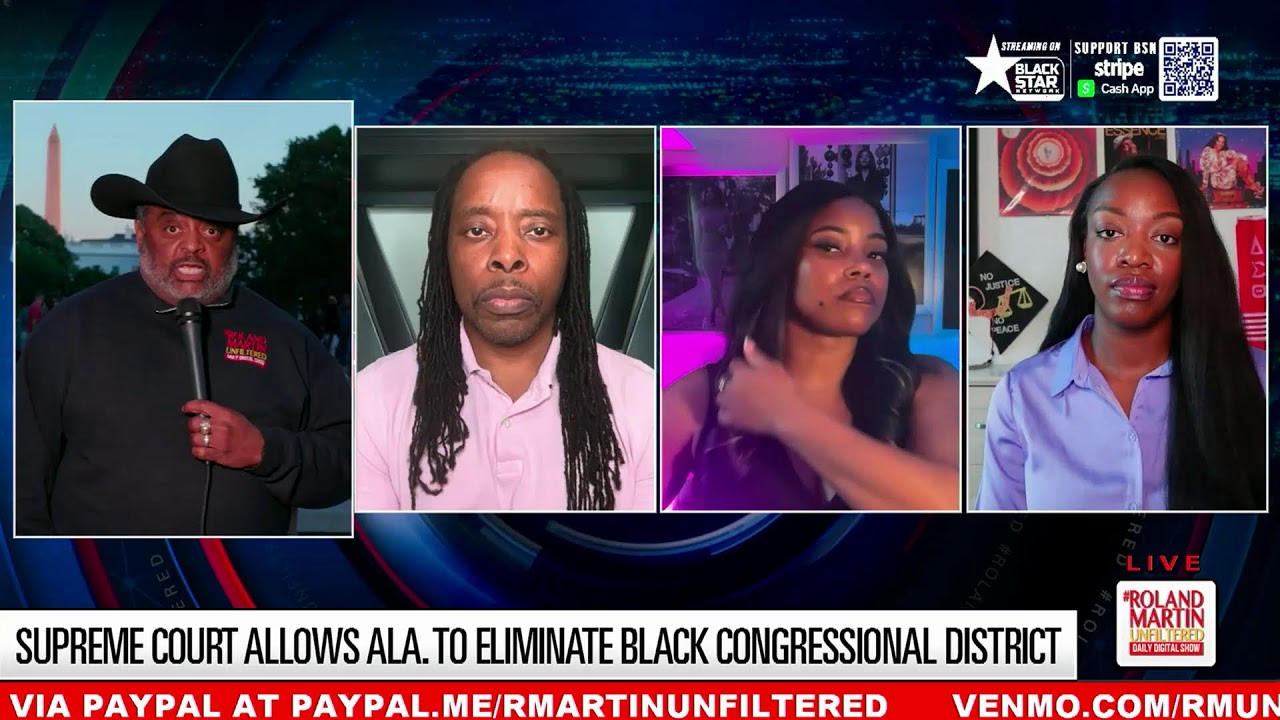
"Activists and faith leaders gathered at Moral Monday to denounce 'policy violence' in various forms, from war and budget cuts to voter suppression and healthcare denial, urging sustained mobilization against a 'hijacked' democracy."

INSTANT FALLOUT from MAJOR Supreme Court Decision... | PoliticsGirl
"The Supreme Court's recent decision in Louisiana v. Cala effectively gutted Section 2 of the Voting Rights Act, opening the door for widespread racial gerrymandering and signaling a return to Jim Crow-era voter suppression tactics."

Warnock UNLOADS on Trump SAVE Act. Calls It a Power Grab to Block Voters
"Senator Raphael Warnock vehemently opposes the 'SAVE Act,' framing it as a politically motivated voter suppression tactic that disproportionately disenfranchises eligible citizens under the false pretense of preventing non-existent voter fraud."