
LIVE: MASSIVE NO KINGS PROTESTS TAKE OVER USA!!!
YouTube · QOz_6AJBIRg
Quick Read
Summary
Takeaways
- ❖Minnesota's 'No Kings Day' rally was the flagship event for a national movement against authoritarianism and federal overreach.
- ❖The community successfully pushed back against ICE's 'Operation Metro Surge,' inspiring similar resistance nationwide.
- ❖Speakers condemned the Trump administration's policies, including those on immigration, healthcare, and foreign wars.
- ❖A core message was the importance of unity and solidarity among diverse communities (Black, Brown, immigrant, queer, trans, indigenous) to protect rights.
- ❖Calls to action included monitoring polling places, reporting voter suppression, and participating in an economic 'no business as usual' strike on May 1st.
- ❖The rally honored victims of state violence, including Renee Good and Alex Pretty, who lost their lives during federal operations.
- ❖Leaders stressed that democracy doesn't defend itself and requires relentless, determined, and creative organizing.
- ❖The movement advocates for a progressive agenda: healthcare for all, taxing the rich, clean energy, living wages, and union rights.
- ❖Minnesota's response demonstrated that local communities can effectively challenge and overcome federal aggression through organized collective action and mutual aid.
Insights
1Minnesota as a Model of Resistance Against Federal Overreach
The rally repeatedly framed Minnesota as the 'flagship' and 'epicenter' of the 'No Kings Day' movement, having successfully repelled federal ICE agents during 'Operation Metro Surge.' Speakers highlighted the community's courage, solidarity, and innovative organizing tactics, such as neighborhood alert networks and mutual aid infrastructure, as an inspiration for the entire nation to resist authoritarianism.
Liz Winstead states, 'we are the flagship rally of No Kings Day. Simply because we showed the world how you DO IT, Y'ALL.' () Ashley Woodward Henderson notes, 'This is a place where a wanna-be king SENT 3,000 FEDERAL AGENTS TO TERRORIZE YOUR NEIGHBORS... They didn't know Minnesota.' () Flannery Clark details, 'my community and I have built systems of protection in nearly every neighborhood of our city... our response time to an ICE sighting in South Minneapolis was less than 2 minutes.' ()
2The Centrality of Solidarity and Mutual Aid in Community Defense
Multiple speakers emphasized that Minnesota's success stemmed from profound community solidarity and the establishment of mutual aid networks. This involved delivering groceries, providing transportation, offering legal clinics, and creating sanctuary networks, demonstrating a commitment to protecting all neighbors regardless of background. This collective care was presented as a direct counter to divisive and fear-based governance.
Nick Benson, a volunteer with Minnesota 50/51, shares his personal journey into activism and states, 'When the government fails to meet our needs, we meet them ourselves. We feed each other, clothe each other, and care for each other. We keep us safe.' () Flannery Clark highlights, 'we created a mutual aid infrastructure that has paid over $10 million in rent, taken thousands of kids to and from school, and delivered meals for countless families.' ()
3Call to Action: Electoral Engagement and Economic Disruption
Beyond protesting, the rally issued clear calls for sustained action, focusing on electoral participation and economic pressure. Attendees were urged to register for election protection networks, monitor polling places, and prepare for potential election sabotage. A significant call was for a national 'no business as usual' strike on May 1st, inspired by Minnesota's 'day of truth and action,' to demonstrate worker power and challenge economic inequality.
Liz Winstead instructs, 'text the word vote to 30319. What that will do is you're going to get plugged into the election protection network, which is so crucial, and they'll call on you to monitor polling places, report voter suppression...' () Ezra Levin announces, 'on May 1st, on May Day, across the country, we are saying no business as usual. No work, no school, no shopping. We're going to show up and say we're putting workers over billionaires and kings.' ()
4Advocacy for a Broad Progressive Agenda and Anti-War Stance
Speakers articulated a comprehensive progressive vision, linking the 'No Kings' message to broader issues of social and economic justice. This included demands for universal healthcare, fair taxation, clean energy, living wages, union rights, and equality for all marginalized groups. A strong anti-war sentiment was also prevalent, with explicit condemnation of military operations in Iran, Venezuela, and Ecuador, and a call to end the sale of weapons to Israel.
Robert Weismann declares, 'WE HAVE TO PERSIST TO WIN OUR YES AGENDA. YES TO HEALTHCARE FOR ALL. YES TO TAX THE RICH. YES TO THE CLEAN ENERGY REVOLUTION. YES TO OVERTURN CITIZENS UNITED. YES for a living wage.' () Bernie Sanders states, 'we have got to stop stop the out-of-control militarism of the Trump administration... we are being lied to today about the war in Iran. This war must end immediately.' ()
Lessons
- Text 'VOTE' to 30319 to join the election protection network, monitor polling places, and report voter suppression.
- Participate in the national 'No Business As Usual' economic strike on May 1st by refraining from work, school, and shopping to demonstrate collective power.
- Actively engage in local community organizing and mutual aid efforts, following the lead of established groups rather than starting new ones, to protect neighbors and build resilience.
- Contact elected officials to demand an end to military operations in Iran and other countries, and to block the sale of weapons to governments committing human rights abuses.
- Support and advocate for policies that promote universal healthcare, living wages, union rights, affordable housing, and tuition-free education.
Notable Moments
Liz Winstead's opening remarks celebrating Minnesota's role as the 'flagship rally' of No Kings Day and humorously recounting how Minnesotans 'chased out PURE EVIL' like Greg Abbott and Kristi Noem.
This set the tone for the rally, establishing Minnesota's leadership in the resistance and injecting humor into the serious political discourse, while also naming specific political figures as targets of their activism.
Performance of 'Don't Buy The Lie' by Kashimana and Thomasina Petrus, with lyrics emphasizing interconnectedness and collective liberation: 'None of us are free till all of us are free.'
This song powerfully articulated the rally's core message of solidarity and mutual liberation through artistic expression, resonating deeply with the audience's commitment to collective action.
A moment of silence led by Liz Winstead for victims of the regime, including those targeted by ICE, law enforcement, and conflicts in Palestine and Iran.
This moment provided a solemn pause, acknowledging the human cost of the policies being protested and reinforcing the emotional and moral foundation of the movement beyond just political rhetoric.
Doreen Day Wabaniquay's performance of a healing song in the Ojibwe language, the first time it was performed publicly outside an indigenous community.
This performance was a significant act of cultural sharing and healing, emphasizing indigenous sovereignty and the spiritual dimension of resistance, connecting the political struggle to deeper cultural and historical roots.
Bruce Springsteen's performance of a song specifically about the events in Minneapolis, honoring Renee Good and Alex Pretty, and condemning federal actions.
Springsteen's presence and custom song lent significant cultural weight and emotional power to the rally, nationalizing the specific tragedies in Minnesota and framing them within a broader narrative of American struggle and injustice.
Rebecca Good's (Renee Good's wife) statement, read by Jane Fonda, expressing heartbreak but also gratitude for community support and advocating for 'radical kindness.'
This personal testimony brought a poignant, human dimension to the rally, directly connecting the political struggle to individual suffering and offering a powerful vision of compassionate resistance.
Quotes
"We are the flagship rally of No Kings Day. Simply because we showed the world how you DO IT, Y'ALL."
"None of us are free till all of us are free."
"We are each other's business. We are each other's magnitude and bond."
"When they tell you what they need done, you do that. And you pay enough attention to the amazing organizers who've been on the ground who actually have the information... instead of starting your own."
"The opposite of authoritarianism IS NOT JUST justice and democracy and freedom. IT'S ALSO SOLIDARITY and community and love and neighbors. And persistence."
"Donald Trump is facing down a midterm election that he knows he is going to lose because people hate this MAD KING BUSINESS. And so, what is he going to do? He's going to try to steal it. But he's going to fail because we are going to stop him."
"You damn right we've been radicalized. RADICALIZED BY COMPASSION. RADICALIZED BY DECENCY. RADICALIZED by due process. RADICALIZED BY DEMOCRACY. AND RADICALIZED TO DO ALL WE can to oppose authoritarianism."
"They picked the wrong city. The power and the solidarity of the people of Minneapolis and of Minnesota was an inspiration to the entire country."
"If we have survived all of that, we will SURVIVE YOUR HARSH WORDS."
"We do not wait for permission to protect each other. We do not beg a wanna-be king to do the right thing. WE ORGANIZE. WE REFUSE TO COMPLY OR COOPERATE WITH EVIL forces in high places."
"Freedom ain't free and some of us have to pay the dearest cost for the sake of freedom."
"Sometimes you got to pick a fight to win one."
"We will not allow this country to descend into authoritarianism or oligarchy. In America, we, the people, will rule."
"We are not A COUNTRY OF KINGS. We are a country of laws. WE ARE A COUNTRY WHERE PEOPLE look out for one another."
"Get the [__] out the way if you can't lend a hand. For the times, they are changing."
Q&A
Recent Questions
Related Episodes

LIVE! Love Forward Together Mass People’s Assembly & Moral March Mobilization In Raleigh, NC
"Thousands marched across North Carolina in the 'This Is Our Selma' movement, led by Reverend William Barber, to combat gerrymandering, voter suppression, and advocate for a proactive, love-driven vision of social and economic justice."

Barber Lays Out the Math of Power. 7,000 Votes Control Congress & How We Nationalize State Movements
"Bishop William Barber reveals how a mere 7,000 votes determined the current Congress and outlines a data-driven strategy to nationalize state movements by mobilizing infrequent, low-wage voters."

Woman arrested for death of 2 Black girls. Explosives thrown at Mamdani. Growin' Good In The Hood.
"This episode unpacks critical news affecting the Black community, from a mother's arrest in a tragic child death and threats against a NYC mayor to the enduring legacy of Jesse Jackson Sr. and innovative community-led initiatives in food security and entrepreneurship."
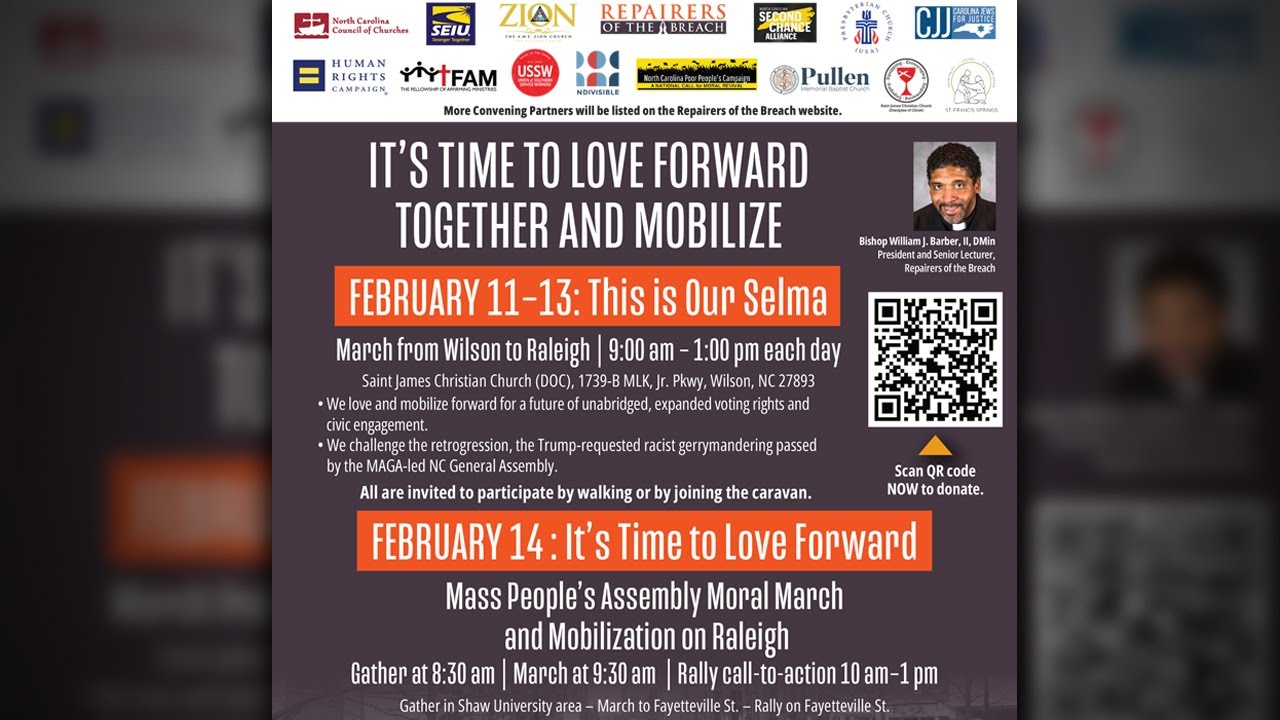
Love Forward Together Mass People’s Assembly & Moral March Mobilization | Day 2
"This episode documents Day 2 of the 'Love Forward Together' march in rural North Carolina, a mobilization against voter disenfranchisement and redistricting, emphasizing community unity and persistent activism."