Barber Lays Out the Math of Power. 7,000 Votes Control Congress & How We Nationalize State Movements
YouTube · -ubrqvkdpY4
Quick Read
Summary
Takeaways
- ❖The current Congress is in office due to a 7,000-vote margin, despite 90 million people not voting in the last election.
- ❖Effective political strategy requires nationalizing state movements, focusing on what you stand 'for' rather than just 'against'.
- ❖Over 1.7 million poor and low-wage people in North Carolina and 2 million in Georgia, who were registered but voted infrequently, did not vote in recent elections.
- ❖Micro-organizing involves sustained engagement, starting months before elections, to educate, enlighten, inform, and engage voters on issues like healthcare, SNAP benefits, and living wages.
- ❖A mere 8-10% turnout increase among infrequent poor and low-wage voters can flip almost any state, including southern states.
- ❖The greatest potential for expanding the vote lies among the 80 million poor and low-wage voters, 30 million of whom didn't vote in recent elections because 'nobody talks to them'.
Insights
1The Micro-Margin of Power in Congress
The current composition of Congress, and thus the ability to pass significant legislation, is determined by an incredibly small margin. The speaker states that the current Congress is in office due to a 7,000-vote margin in a context where 90 million people did not vote.
The current Congress that we have in office right now is there because of a 7,000 vote margin, in a time when 90 million people didn't vote.
2Nationalizing State Movements: The Path to Power
Instead of focusing solely on national-level resistance, the strategy must be to nationalize state movements. This involves rallying people in states around core principles and what they stand 'for,' rather than just what they are 'against.' This bottom-up approach is crucial for sustained change.
We must nationalize state movements. I don't know how many times I can say that. We need to be rallying the people in our states and it doesn't even have to be partisan. It can be principled and mobilize in a way around what we stand for.
3Untapped Electoral Power: Infrequent and Low-Wage Voters
Millions of registered voters, particularly poor and low-wage individuals, vote infrequently or not at all. For example, over 300,000 Black registered voters and 1.7 million poor/low-wage people in North Carolina, and similar numbers in Georgia, did not vote in recent elections. These groups represent a massive, unmobilized voting bloc that could shift electoral outcomes.
Over 300,000 black that were registered and had voted infrequently didn't vote. Over 1.7 million poor and lowwage people who had voted were registered but voted infrequently and didn't vote. ... Trump wins by a little over 100,000 votes, but over 300,000 400,000 African-Americans didn't vote. Over 2 million poor and low-wage people who had infrequently voted... did not vote.
4Connecting Pain to Political Power
People are experiencing direct pain from policy changes, such as 20 million losing healthcare and others losing food stamps. This pain can be a powerful motivator for political engagement if connected to their inherent power to change these conditions through voting.
When 20 when these folk lost their healthcare and losing their snap they're seeing more money put in ICE than put in public education... there is a level of pain now that has people wide awake. Our job now is to connect that pain to their power and show them you don't have to be suffering like this.
5The MLK Model: Local Mobilization for National Impact
Dr. Martin Luther King Jr.'s movement built its national power by focusing intensely on local struggles in places like Birmingham, Montgomery, and Selma. These local efforts created models and bases that others then adopted, demonstrating that fundamental change originates from the states, not from Washington D.C.
The work that has been done across this nation grew out of the work done in three places, Birmingham, Selma, and Mount. ... Doc's primary focus was Alabama and Georgia. ... If without those three things he says in those speech, they would not have built the models and the bases. And what other folk did was they picked up what they saw.
6Flipping States with Small Turnout Increases
By mobilizing just 10% of black infrequent voters and 10% of poor and low-wage infrequent voters, it is possible to flip almost any state, even traditionally conservative southern states. This demonstrates the immense, untapped power of these demographics.
If you jin up 10% of just black folk who didn't engage in the last election and then jin up 10% of poor and low-wage people that didn't engage around an election, you can flip almost any state, even these southern states.
Bottom Line
The 'Southern Strategy' aimed to prevent unity between Black and white low-income voters by fostering division. Countering this requires 'positive polarization' by uniting these groups around shared economic and moral issues.
Understanding this historical strategy reveals that division is a deliberate tactic. A counter-strategy must actively build coalitions across racial lines based on common economic interests, which is precisely what the 'greedy oligarchy' fears most.
Organizers can explicitly frame their efforts as a direct challenge to the Southern Strategy, highlighting how unity among diverse low-wage communities can fundamentally shift economic and political power structures.
Political campaigns often ignore poor and low-wage voters, leading to their disengagement, despite their progressive voting tendencies when mobilized.
This oversight represents a massive missed opportunity for progressive movements. By neglecting these voters, campaigns leave millions of potential votes on the table, contributing to the very problem they aim to solve.
Organizations that prioritize and adequately resource outreach to poor and low-wage communities can gain a significant electoral advantage, as these voters are receptive to messages addressing their economic concerns and tend to vote progressively when engaged.
Lessons
- Implement a 'micro-organizing' strategy: Focus on local communities, neighborhoods, blocks, and even individual houses to engage infrequent voters.
- Mobilize early and consistently: Begin voter engagement in January, not just months before an election, and maintain consistent communication through education, enlightenment, information, and engagement.
- Connect policy to personal impact: Clearly articulate how issues like healthcare, SNAP benefits, living wages, and public education directly affect the lives of poor and low-wage people.
- Utilize 'race and economic mapping': Conduct thorough data analysis of communities to identify pockets of poor and low-wage voters (defined as families of four earning $50,000/year or less) for targeted outreach.
- Leverage key voting periods: Plan mobilization events (e.g., marches, rallies) to coincide with early voting periods and same-day registration opportunities to maximize immediate impact.
Micro-Organizing for Electoral Power
Mobilize within your existing organization: Ensure everyone in your church, group, or organization is engaged and ready to act, not just attending.
Draw a 5-mile radius around your base: Identify communities closest to your location that represent poor and low-wage voters as your primary target.
Take the message to the streets: Go into neighborhoods, communities, and 'hoods' where poor and low-wage individuals (families of four earning $50,000/year or less) reside.
Connect pain to power: Articulate how current policy decisions (e.g., loss of healthcare, food stamps) directly cause suffering and how collective action can alleviate it.
Provide concrete action steps: Offer clear instructions for civic engagement, voter push, and participation in early voting and same-day registration.
Notable Moments
The Kentucky gubernatorial election where Andy Beshear unseated an incumbent Republican governor.
This victory serves as a powerful case study for the proposed mobilization strategy. Beshear, initially challenged by the Poor People's Campaign to address economic issues, changed his campaign schedule to visit low-income counties. This led to four of six targeted counties flipping, demonstrating that connecting with poor and low-wage voters on moral and economic issues (like healthcare and wages) can lead to unexpected electoral success, even in conservative states.
Quotes
"The greatest fear of the greedy oligarchy in this country is for the masses of poor black people and poor lowwage white people and others to join together and form a voting block that can fundamentally shift the economic architecture."
"The current Congress that we have in office right now is there because of a 7,000 vote margin, in a time when 90 million people didn't vote."
Q&A
Recent Questions
Related Episodes

Georgia Fort Pleads Not Guilty. Paralyzed Man Case Charges Dropped. Roy Cooper Senate Bid
"This episode delivers a powerful, multi-faceted tribute to Reverend Jesse Jackson Sr., highlighting his unparalleled impact on civil rights, economic empowerment, political strategy, and global diplomacy, emphasizing his role as an irreplaceable force for justice."
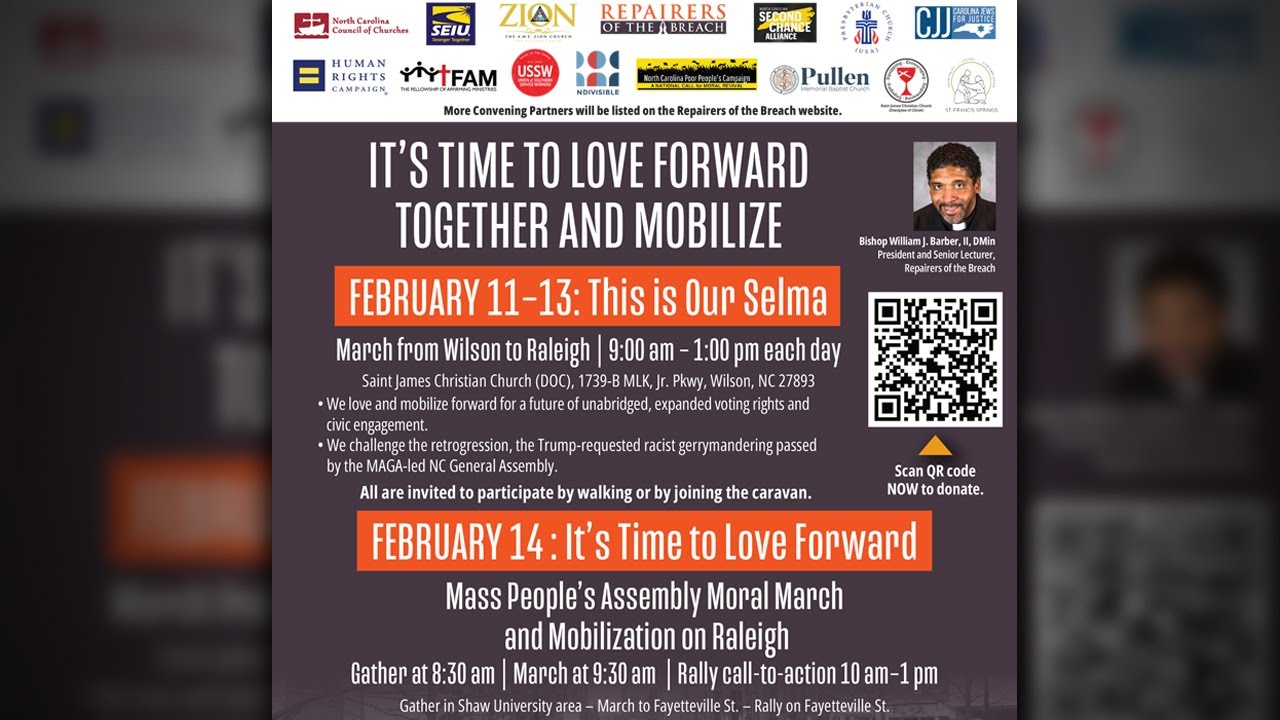
Love Forward Together Mass People’s Assembly & Moral March Mobilization | Day 2
"This episode documents Day 2 of the 'Love Forward Together' march in rural North Carolina, a mobilization against voter disenfranchisement and redistricting, emphasizing community unity and persistent activism."

Obama Center Opens. Fox Expert Wants More Teen Pregnancy. Viral Black Doll Trend Backlash
"This episode unpacks the opening of the Obama Presidential Center, exposes a Fox News expert's call for more teen pregnancies, and reveals the global geopolitical implications of declining white birth rates and the ongoing dismantling of civil rights infrastructure in the US."

Black Men Created America’s First Paramedics. Freedom House’s Hidden History
"Discover the untold history of Freedom House, where Black men in Pittsburgh founded America's first paramedic service in 1966, revolutionizing emergency medicine despite facing pervasive systemic racism and institutional sabotage."