
Seyed M. Marandi: Iran Strikes BACK – Missiles Hit Kuwait & U.S. 5th Fleet in Bahrain!
YouTube · RDXTQO2JNhk
Quick Read
Summary
Takeaways
- ❖Iran's military responses are becoming more severe and effective, despite U.S. claims of shooting down all projectiles.
- ❖Iran has successfully prevented tankers from passing through the Strait of Hormuz without its permission, contradicting Western media reports.
- ❖Iran's missile and drone capabilities have significantly increased both qualitatively and quantitatively since the war began.
- ❖Iran has adopted a new policy of direct retaliation against Israel if Hezbollah or Dahiyeh in Lebanon are attacked.
- ❖The Lebanese government is perceived as collaborating with Western and Saudi interests to isolate and weaken the resistance movement.
Insights
1Iran's Disproportionate Retaliation and Strategic Deception
Iran's recent retaliatory strikes are described as disproportionate, hitting harder than the initial American attacks. The U.S. and Western media are accused of lying about the effectiveness of Iranian missiles and drones, falsely claiming they are all shot down. This deception is part of a broader manipulation to control oil prices and public perception.
The host mentions IRGC statements about hitting an oil tanker and Iranian responses to American drone attacks on Qeshm and Sirik. Professor Marandi states, 'The Iranians are striking their targets with high efficiency... During the past two strikes the Iranians have been hitting the Americans harder in retaliation than in the past.' He also refutes claims of tankers passing through Hormuz, calling it 'completely untrue.'
2Rapid Advancement of Iranian Military Capabilities
Iran's military strength, particularly in missile and drone technology, has grown significantly since the war began. They are rapidly producing advanced weapons, improving precision, and developing new methods to bypass defense shields. Older missiles are being used in current exchanges to clear inventory and test air defenses, making way for newer, more sophisticated armaments.
Professor Marandi states, 'militarily speaking, the Iranians are stronger today than they were before the war. And their missiles are larger in number, their advanced missiles have increased.' He adds, 'they're reading getting rid of the older missiles in these in these exchanges... so that they can empty their underground missile bases of the older missiles and focus on the newer missiles that are being rapidly produced.'
3New Iranian Policy on Lebanon and Hezbollah
Iran has adopted a new, explicit strategy: any attack on Lebanon or Hezbollah will trigger a direct Iranian response. This marks a significant shift, as Iran has not previously declared such a direct retaliatory policy for actions against its regional allies, especially in Lebanon. This commitment aims to deter Israeli aggression and prevent a civil war scenario in Lebanon.
The host notes, 'this is the first time Iran coming out and saying that if you attack Lebanon, if you attack Hezbollah, we're going to respond.' Professor Marandi confirms this, stating, 'Iran is basically saying that we're going back to war for the sake of Lebanon.'
4Lebanese Government's Perceived Collaboration Against Resistance
The current Lebanese president and prime minister are accused of collaborating with Western NGOs, embassies, and Gulf regimes to undermine Hezbollah and the resistance movement. This includes preventing aid from Iran and Iraq to Lebanese civilians and restricting the movement of predominantly Shia refugees, aiming to demoralize resistance supporters.
Professor Marandi states, 'the Lebanese president who was installed by the Americans has spoke out against Iran and and the resistance.' He further elaborates, 'the Saudis, the Qataris, the regimes in the Persian Gulf, the Western NGOs and Western embassies are all cooperating with the president, the prime minister... to create this wall to prevent people from moving around in their own country.'
Bottom Line
Iran's use of older, less accurate MRBMs (middle-range ballistic missiles) for strikes on nearby targets like Kuwait and Bahrain serves a dual purpose: clearing obsolete inventory and actively testing enemy air defenses against various missile types.
This suggests a sophisticated military strategy where current engagements are not just about retaliation but also about real-world testing and optimization of future warfighting capabilities, potentially revealing vulnerabilities in U.S. and allied defense systems without expending premium assets.
Analysts could gain deeper understanding of Iran's evolving missile doctrine by correlating missile types used in strikes with their known inventory and the specific defensive systems present in targeted regions. This could inform more accurate threat assessments and counter-proliferation strategies.
The discussion implies a deliberate effort by certain 'powerful elites' and 'Zionist elites' within the U.S. to weaken Benjamin Netanyahu's position, potentially through leaks like the Axios report on his phone call with Trump, to facilitate his removal and 'facelift' the Israeli regime's image.
This indicates a potential internal power struggle within the pro-Israel lobby and U.S. political establishment, driven by concerns over Netanyahu's perceived failures and the global backlash against Israeli actions. A 'facelift' could involve replacing Netanyahu with a similarly hardline but publicly more palatable leader to restore international legitimacy.
Observing shifts in U.S. media narratives and political rhetoric surrounding Israeli leadership could provide early indicators of such an internal strategy. Businesses and governments should prepare for potential changes in Israeli political leadership and subsequent shifts in regional policy, which could impact stability and alliances.
Lessons
- Monitor Iranian military statements and actions for continued shifts in retaliation policy and missile deployment, particularly regarding the use of older vs. newer systems.
- Analyze Western media coverage of Middle East conflicts for discrepancies and potential psychological warfare tactics, especially concerning the effectiveness of U.S. and Israeli military operations.
- Evaluate the political stability and allegiances of regional actors like Lebanon, Kuwait, and Bahrain, recognizing their potential roles as proxies and targets in a broader conflict with Iran.
Notable Moments
The host mentions the date of the podcast is Saturday, June 6th, 2026, and details specific attacks that occurred 'last night' (June 5th, 2026), including Iranian missile strikes on U.S. 5th Fleet in Bahrain and Kuwait.
This sets the immediate context for the discussion, grounding the analysis in very recent, specific military escalations and providing a temporal anchor for the events discussed.
Professor Marandi highlights that Iran's missile and drone capabilities are 'greater today than before' and that they are 'getting rid of the older missiles in these exchanges' to focus on newer, rapidly produced ones.
This reveals a strategic military modernization effort by Iran, using current conflicts not just for retaliation but also for inventory management, testing, and upgrading its arsenal, indicating long-term planning and increasing military sophistication.
The host brings up General Mohsen Rezaei's statement to CNN that the next phase of war, if escalated by the U.S., would involve pushing U.S. forces to the Indian Sea.
This indicates Iran's willingness to significantly expand the theater of conflict beyond the Persian Gulf, signaling a higher threshold for escalation and a more aggressive posture against U.S. military presence in the region.
Professor Marandi discusses the Shia jurisprudence concept of 'ijtihad' (gates are open), where time and place are key factors in religious rulings, implying that a fatwa (like the one against nuclear weapons) could theoretically change under different circumstances or leadership.
This provides a nuanced understanding of the religious and legal framework within which Iran's nuclear policy operates, suggesting that while the current fatwa against nuclear weapons stands, its theological basis allows for re-evaluation if an 'existential threat' is perceived, adding a layer of strategic ambiguity.
Quotes
"The United States has been lying from the very beginning... with regards to Iranian strikes US assets. It's been lying."
"The Iranians are striking their targets with high efficiency. And they can't hide it."
"Without Iranian permission, they can't leave. So, the Americans again in their anger, they struck a couple of empty areas..."
"militarily speaking, the Iranians are stronger today than they were before the war. And their missiles are larger in number, their advanced missiles have increased."
"Iran is basically saying that we're going back to war for the sake of Lebanon. They know that they're talking nonsense."
"If Iran wanted to develop a nuclear weapon, it would it would have developed it years ago."
"If Iran's is faces an existential threat, then Iran would reconsider its nuclear posture."
Q&A
Recent Questions
Related Episodes

Patrick Henningsen: Hezbollah JUST Fired Back at Israel - Iran Vows to “Crush” All Attacks
"Patrick Henningsen argues that the US and Israel initiated an illegal war against Iran, driven by Trump's incompetence and Israeli influence, leading to an inevitable escalation with severe global economic repercussions."
Col. Jacques Baud: What a US Ground Invasion of Iran Would REALLY Look Like
"Colonel Jacques Baud dissects the strategic futility of a US ground invasion of Iran, arguing that current troop levels are insufficient and such an action would backfire, exposing US allies and potentially leading to Iran's nuclearization."
BREAKING: Protests ERUPT In Iran Over IRGC Surrendering To Trump - Infighting Clashes In Tehran
"Iran is experiencing severe internal infighting and protests as hardline IRGC elements clash with government figures over a perceived 'surrender' to the US, while mainstream Western media misrepresents the situation."
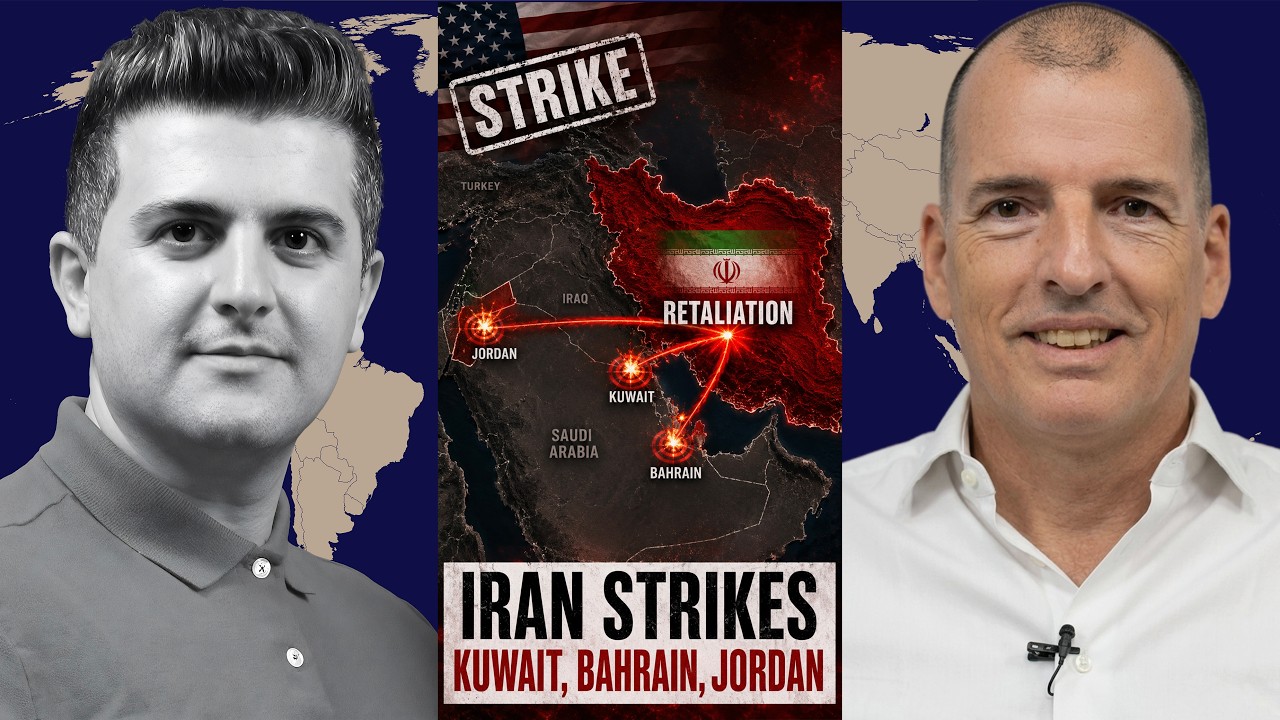
Alex Krainer: US STRIKES Iran – Iran RETALIATES Against Kuwait, Bahrain & Jordan!
"Amidst escalating US-Iran conflict and Iranian retaliation against regional US allies, this episode argues that US foreign policy is deeply controlled by an 'Anglo-Zionist conspiracy' led by the Rothschild banking dynasty, prioritizing Israeli interests over American ones."