Venezuelan Vice President IMMEDIATELY FOLDS TO TRUMP After He ISSUES ANOTHER BRUTAL WARNING!
YouTube · RI9OAzeDvTU
Quick Read
Summary
Takeaways
- ❖Cuba is on the verge of collapse due to the cessation of Venezuelan oil income.
- ❖The Trump administration captured Venezuelan dictator Nicholas Maduro, leading to celebrations among Venezuelan patriots and protests from leftists.
- ❖Interim Venezuelan Vice President Deli Rodriguez initially issued defiant statements but quickly softened her stance, inviting US collaboration after public threats from President Trump.
- ❖The US seeks access to Venezuela's oil, steel, aluminum, and critical mineral industries, with new elections to follow once these economic interests are secured.
- ❖The host argues that US foreign policy is driven by resources, power, and geopolitical strategic interests, not by promoting democracy.
- ❖Maduro and his wife face charges of narco-terrorism, cocaine conspiracy, and weapons charges in the US, with mandatory minimum sentences of 30 years.
Insights
1Coercive Diplomacy's Immediate Efficacy
The Trump administration's strategy of capturing Nicholas Maduro and issuing direct, public threats to his successor, Deli Rodriguez, quickly shifted Venezuela's stance from defiance to an invitation for collaboration. This demonstrates a highly effective, albeit aggressive, form of coercive diplomacy that bypasses traditional negotiation.
Trump's public threat to Rodriguez: 'if she doesn't do what's right, she's going to pay a very big price, bigger than what Maduro paid.' () Following this, Rodriguez's statement softened, inviting US cooperation. ()
2US Foreign Policy Driven by Strategic Resource Acquisition
The host asserts that the US intervention in Venezuela is explicitly for strategic interests, primarily securing access to Venezuela's vast oil reserves, along with steel, aluminum, and critical minerals, rather than for promoting democracy or freedom. This 'honesty' about motives is praised.
Trump stated, 'We're running the country and we're going to get access to the oil.' () Marco Rubio clarified US interest in 'the oil quarantine' and preventing adversaries from controlling Venezuela's energy reserves. (, ) Howard Lutnick mentioned looking into steel, aluminum, and critical minerals. ()
3Outdated Analytical Frameworks in Geopolitics
The host criticizes other analysts for applying 'outdated frameworks' and 'dumerism' by comparing the Venezuela situation to US interventions in the Middle East (Iraq, Afghanistan, Libya). He argues that Latin America, being the 'Western Hemisphere' and under Marco Rubio's foreign policy guidance, presents a different dynamic where direct action against leadership is more effective without full-scale ground invasions.
The host states, 'This is not Iraq, this is not Afghanistan, this is not Libya, it's not that.' () He adds, 'We're in Latin America and Marco Rubio is running our foreign policy and he's he's an expert.' ()
Bottom Line
The US strategy in Venezuela, characterized by targeted leadership removal and direct threats, is presented as a template for asserting control in the Western Hemisphere without requiring extensive ground invasions.
This suggests a shift in US foreign policy doctrine towards more surgical, high-leverage interventions in its immediate sphere of influence, potentially reducing the financial and human costs associated with traditional warfare while achieving geopolitical objectives.
Nations within the Western Hemisphere, particularly those with significant resource reserves or perceived as aligned with US adversaries, may face similar, swift, and decisive US actions, requiring them to re-evaluate their geopolitical alignment and internal governance.
The host's praise for Trump's 'honesty' about US strategic interests (oil, power) over 'democracy' narratives reflects a growing segment of political thought that values transparency in geopolitical motives, even if those motives are purely self-serving.
This indicates a potential erosion of public and political appetite for interventions framed solely on humanitarian or democratic ideals, favoring a more pragmatic, realist approach to foreign policy that openly acknowledges national self-interest.
Political leaders who articulate foreign policy based on clear, tangible national interests, rather than abstract values, may resonate more strongly with certain electorates, especially if such policies are perceived as effective and cost-efficient.
Key Concepts
Game Theory
The host applies game theory to predict the Venezuelan leadership's actions, arguing that given the US's demonstrated capability to capture leaders and the severe consequences of non-compliance, cooperation is the only logical choice for survival.
Common Sense / Logic
The host repeatedly emphasizes that 'common sense' and 'logic' dictate that the Venezuelan leadership, facing the threat of capture and imprisonment, would inevitably cooperate with the US, contrasting this with what he perceives as 'outdated frameworks' of other analysts.
Lessons
- Recognize that US foreign policy, particularly in its immediate sphere of influence, may increasingly prioritize direct, coercive action and strategic resource acquisition over traditional diplomatic or democracy-promotion efforts.
- Understand that public statements by foreign leaders, especially after a significant geopolitical event like a leader's capture, may be 'propaganda' aimed at saving face, and true intentions are revealed by subsequent actions and behind-the-scenes communications.
- Evaluate geopolitical analyses for 'outdated frameworks' that might misinterpret current events by applying lessons from different historical or geographical contexts, especially when assessing US interventions in Latin America versus the Middle East.
Notable Moments
Capture of Nicholas Maduro and subsequent US threats to interim VP Deli Rodriguez.
This event is framed as the catalyst for Venezuela's 'folding' to US demands, demonstrating the effectiveness of a direct, coercive foreign policy approach.
Deli Rodriguez's shift from defiant public statements to an invitation for US collaboration.
This change in tone is presented as direct evidence of the US strategy's success, validating the host's 'common sense' and 'game theory' predictions.
Quotes
"Cuba looks like it's ready to fall. I don't know how they if they're going to hold out, but Cuba now has no income. They got all of their income from Venezuela, from the Venezuelan oil. They're not getting any of it. And Cuba literally is ready to fall."
"We fight wars for resources, power, geopolitical, strategic interest, right? That is why we fight wars. And it's nothing wrong with that, right? That's why every war in history has been fought."
"This is the Western Hemisphere. This is where we live. And we're not going to allow the Western Hemisphere to be used as a base of operation for our nation's adversaries and competitors and rivals of the United States."
"If she doesn't do what's right, she's going to pay a very big price, bigger than what Maduro paid."
"We extended invitation to the US government to work together on a cooperative agenda oriented towards shared development with the within the framework of international law and to strengthen lasting community coexistence."
Q&A
Recent Questions
Related Episodes

Will Venezuela Be Trump's Vietnam?
"An expert breaks down three perilous pathways for Venezuela under potential US intervention, from a 'Panamanian model' to a 'Libyan-style civil war,' and the broader geopolitical fallout for Latin America."

Patrick Henningsen: Hezbollah JUST Fired Back at Israel - Iran Vows to “Crush” All Attacks
"Patrick Henningsen argues that the US and Israel initiated an illegal war against Iran, driven by Trump's incompetence and Israeli influence, leading to an inevitable escalation with severe global economic repercussions."
BREAKING: Protests ERUPT In Iran Over IRGC Surrendering To Trump - Infighting Clashes In Tehran
"Iran is experiencing severe internal infighting and protests as hardline IRGC elements clash with government figures over a perceived 'surrender' to the US, while mainstream Western media misrepresents the situation."
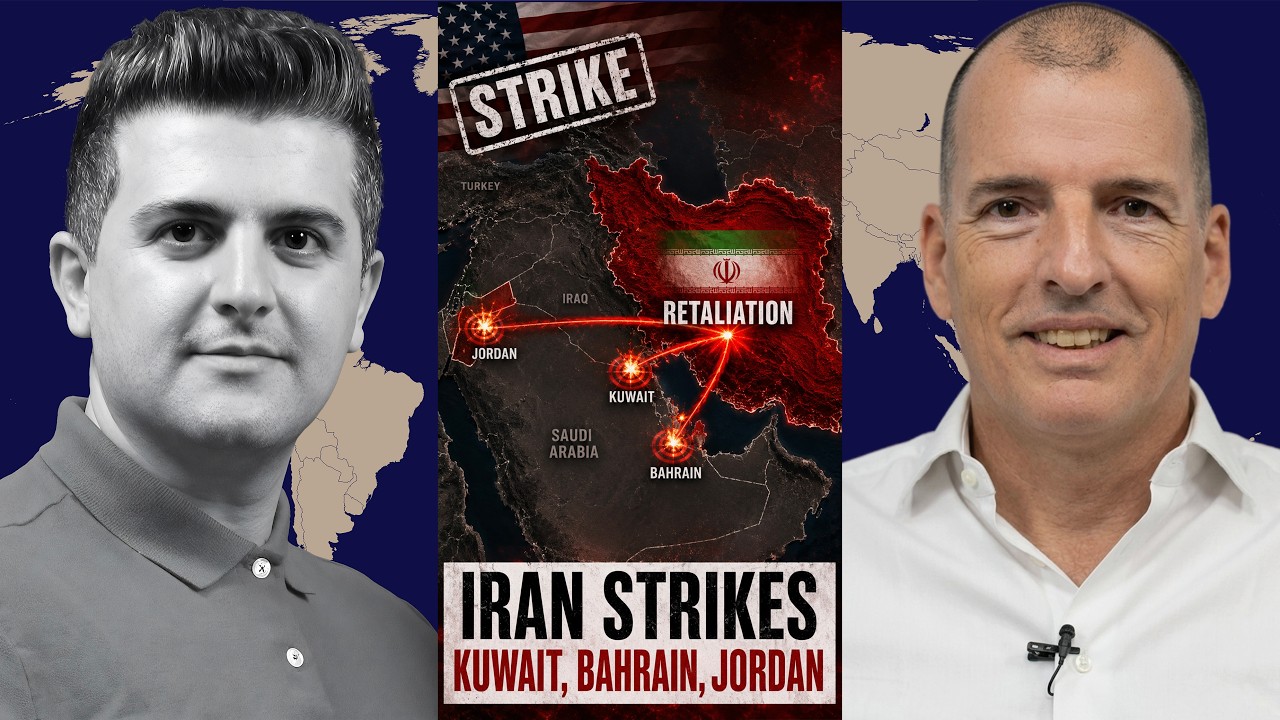
Alex Krainer: US STRIKES Iran – Iran RETALIATES Against Kuwait, Bahrain & Jordan!
"Amidst escalating US-Iran conflict and Iranian retaliation against regional US allies, this episode argues that US foreign policy is deeply controlled by an 'Anglo-Zionist conspiracy' led by the Rothschild banking dynasty, prioritizing Israeli interests over American ones."